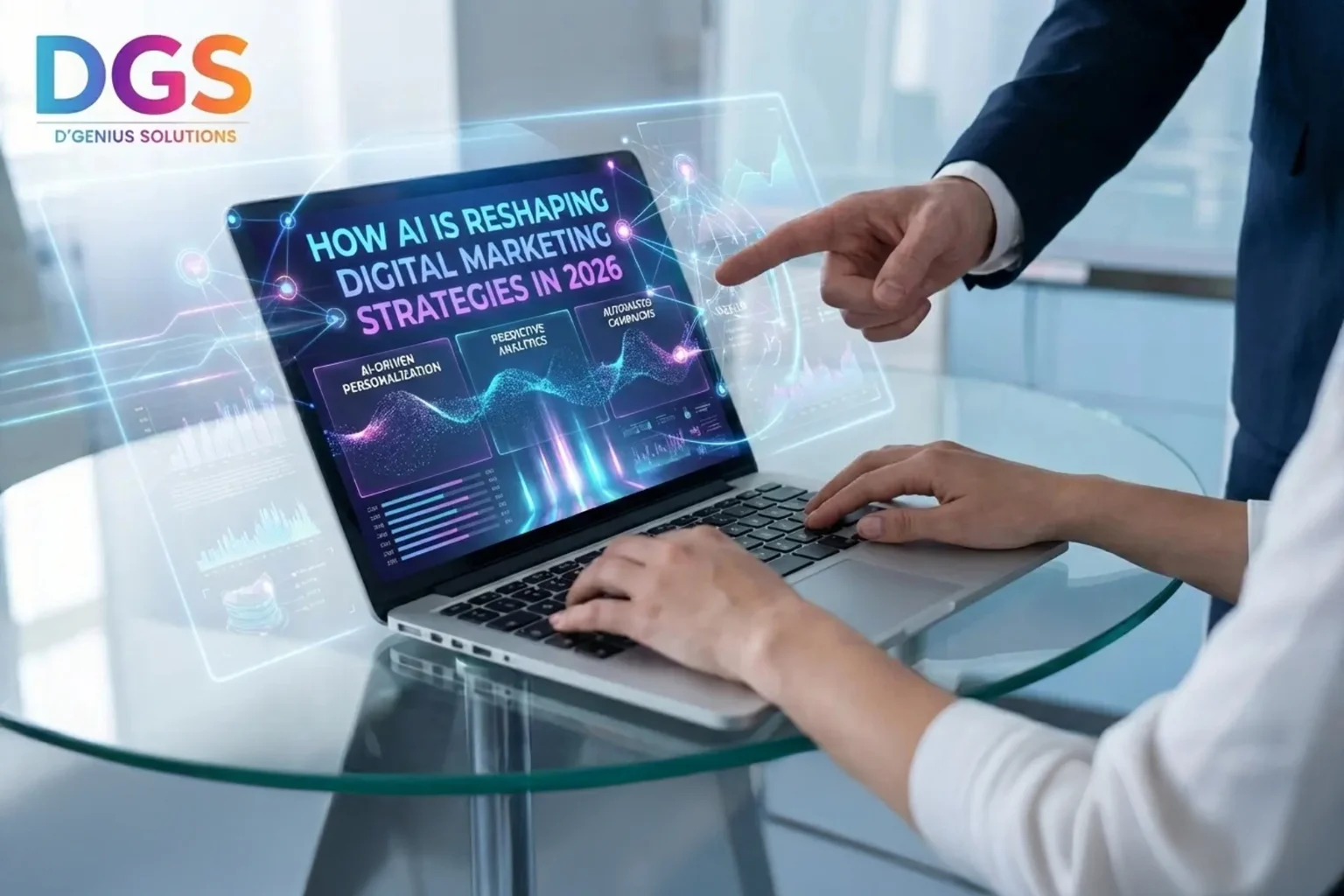
How AI Is Reshaping Digital Marketing Strategies in 2026
In this article
- How AI Marketing Strategies Improve Digital Campaigns
- Personalization Is Becoming More Meaningful
- Content Creation Is Becoming More Strategic
- Search and SEO Are Evolving With AI
- Automation Is Becoming More Intelligent
- Campaign Performance Is Easier to Improve
- Trust and Ethics Matter More Than Ever
- Human Expertise Still Leads the Strategy
- How D'Genius Solutions Uses Smarter Digital Marketing
- Conclusion
- FAQs
- 1. How is AI changing digital marketing strategies in 2026?
- 2. Will AI replace digital marketers?
- 3. How does AI help in personalized marketing?
- 4. Why is AI important for SEO in 2026?
- 5. How does AI improve marketing automation?
AI marketing strategies are helping brands plan smarter campaigns, understand customers better, and improve digital performance in 2026.
AI is no longer an experimental tool in digital marketing. In 2026, it has become a practical part of how brands plan campaigns, understand customers, create content, automate workflows, and improve results.
This shift does not mean marketers are being replaced. It means their role is becoming more strategic. Teams now spend less time on repetitive execution and more time on planning, creativity, brand thinking, and performance decisions.
For businesses, the real value comes from using smart technology with human expertise. When both work together, digital marketing becomes faster, sharper, and more useful for customers.
AI marketing strategies are now helping brands connect data, automation, creativity, and customer intent in one stronger marketing system.
How AI Marketing Strategies Improve Digital Campaigns
Modern marketing teams can now study customer behavior, campaign activity, search patterns, and engagement signals much faster than before. Earlier, many decisions were based on past reports, assumptions, or slow manual analysis.
Today, intelligent systems help brands understand which audiences are more likely to respond, which channels need more attention, and which messages are performing well.
The benefit is not only speed. The bigger advantage is clarity. When brands understand customers better, campaigns become more focused and less dependent on guesswork.
Strong AI marketing strategies help teams understand customer behavior faster and make campaign decisions with better clarity.
Personalization Is Becoming More Meaningful
Generic marketing messages are becoming easier to ignore. Customers expect brands to understand their interests, needs, and stage in the buying journey.
With better data support, marketers can create more relevant emails, ads, landing pages, offers, and content experiences. This is not just about adding a name to an email. It is about showing the right message at the right moment.
For example, a first-time visitor may need educational content. A returning user may need proof, comparisons, or a stronger reason to enquire.
Personalization works best when it feels natural. If it helps the customer instead of overwhelming them, it can improve trust and conversions.
Well-planned AI marketing strategies make personalization more useful because messages can match user needs and buying stages.
Content Creation Is Becoming More Strategic
Content creation is not only about producing more blogs, captions, or ads. In 2026, the focus is shifting toward better research, topic planning, structure, search intent, and quality.
Smart tools can support content teams with outlines, ideas, headline options, FAQs, and optimization suggestions. But the final content still needs human review.
Good content needs accuracy, brand voice, examples, emotion, and real-world understanding. Without that, it can feel flat or generic.
The best approach is to use technology for support, then let marketers refine the message so it feels useful, original, and trustworthy.
Modern AI marketing strategies also support topic planning, content structure, research, and performance-focused improvements.
Search and SEO Are Evolving With AI
Search engines are becoming better at understanding meaning, context, and user intent. This means brands cannot depend only on keyword repetition or basic optimization.
Strong search content now needs clear answers, helpful structure, internal links, trusted information, and a smooth user experience. Pages should solve real questions instead of simply repeating terms.
For businesses that want stronger organic visibility, D'Genius Solutions offers SEO services in Mumbai that combine content quality, technical optimization, search intent, and modern growth strategy.
Google’s official guide on AI features and your website explains how site owners can think about visibility in intelligent search experiences. It also reinforces the importance of helpful, reliable, people-first content.
For marketers, the direction is clear. Search success now depends on quality, clarity, structure, and trust.
Search-focused AI marketing strategies help brands create clearer content that works for users, search engines, and modern discovery platforms.
Automation Is Becoming More Intelligent
Automation has been part of digital marketing for years, but it is becoming more adaptive. Instead of sending the same message to every user, smarter workflows can respond to behavior, timing, and engagement.
This helps brands improve email journeys, lead nurturing, ad optimization, reporting, and customer follow-ups.
For example, when a user visits a service page, downloads a brochure, or interacts with an ad, automation can help deliver a more relevant next message.
The goal is not to remove people from marketing. The goal is to make communication more timely, useful, and efficient.
Strong AI marketing strategies help brands use data, automation, and creativity together instead of depending only on manual marketing work.
Campaign Performance Is Easier to Improve
Digital campaigns work better when decisions are based on real signals. Marketers can now review performance across paid ads, organic search, social media, content, and email with better clarity.
This helps teams adjust budgets, test creative ideas, improve messaging, and identify high-performing audiences.
Instead of waiting until the end of a campaign, brands can make improvements while the campaign is still active.
This makes marketing more flexible and performance-focused.
Effective AI marketing strategies make automated workflows more timely, relevant, and helpful for both brands and customers
Trust and Ethics Matter More Than Ever
As advanced technology becomes more common in marketing, trust becomes even more important. Brands must use customer data responsibly and avoid misleading communication.
Over-personalization, inaccurate claims, fake reviews, careless automation, or content without proper review can damage credibility quickly.
Businesses need clear checks for accuracy, transparency, privacy, and brand consistency.
Marketing should feel helpful, not manipulative. In 2026, trust is not only a brand value. It is a competitive advantage.
Human Expertise Still Leads the Strategy
AI can support research, planning, automation, and optimization, but it cannot replace human understanding. Strategy, creativity, emotional intelligence, cultural context, and ethical judgment still need people.
Marketers understand brand positioning, customer emotion, business goals, and long-term reputation. Technology can support the process, but people must guide the final decisions.
The best digital marketing strategies use smart systems for insight and speed while keeping storytelling, quality control, and decision-making in human hands.
How D'Genius Solutions Uses Smarter Digital Marketing
D'Genius Solutions looks at modern marketing as a mix of creativity, data, technology, and strategy. The focus is not to use tools just because they are trending. The focus is to use them where they genuinely improve results.
This can include better content planning, search workflows, campaign analysis, creative support, automation, reporting, and performance tracking.
For businesses, this means marketing becomes more focused and measurable. Campaigns can be planned with better insight, content can match user intent more closely, and teams can spend more time on strategy instead of repetitive tasks.
Conclusion
AI is reshaping digital marketing strategies in 2026 by making campaigns smarter, faster, more personalized, and more data-led. It supports better content planning, search optimization, automation, customer understanding, and performance improvement.
Still, success does not come from technology alone. The strongest results come when brands combine intelligent tools with human creativity, strategy, ethics, and brand understanding.
For businesses that want to stay competitive, the goal should not be to replace marketers. The goal should be to help marketing teams work better, think deeper, and create more meaningful customer experiences.
D'Genius Solutions helps brands build this balance so digital marketing stays performance-focused, trustworthy, and ready for the future.
In 2026, the best AI marketing strategies combine smart tools with human creativity, ethics, and brand understanding.
FAQs
1. How is AI changing digital marketing strategies in 2026?
AI is changing digital marketing by helping brands make faster decisions, personalize campaigns, improve content, automate workflows, and optimize performance with better insights.
2. Will AI replace digital marketers?
No. It supports digital marketers by handling data, automation, and optimization, while people continue to lead strategy, creativity, storytelling, brand voice, and decision-making.
3. How does AI help in personalized marketing?
It helps by studying user behavior, preferences, browsing patterns, and engagement history. This allows brands to deliver more relevant content, ads, emails, and landing pages.
4. Why is AI important for SEO in 2026?
AI is important for SEO because search engines now focus more on intent, context, content quality, and user experience. It helps marketers plan better topics, improve structure, and create more useful search-focused content.
5. How does AI improve marketing automation?
It improves marketing automation by making workflows smarter. It can support lead nurturing, ad optimization, campaign timing, reporting, and communication based on user behavior.
Accelerate Your Digital & Search Growth
Speak directly with our Mumbai-based SEO, AI search, and digital marketing strategists for a bespoke growth audit.
Get a Free Strategy AuditRelated Insights
AI Search Optimization for E-commerce Brands: 9 Proven Strategies for 2026 - D'Genius Solutions
AI Search Optimization for E-commerce Brands helps online stores appear in Google and AI recommendations. Discover 9 proven strategies for 2026.
Optimize Content for AI Search With 11 Proven Strategies
Optimize content for AI search with 11 proven strategies for ChatGPT, Gemini, Perplexity