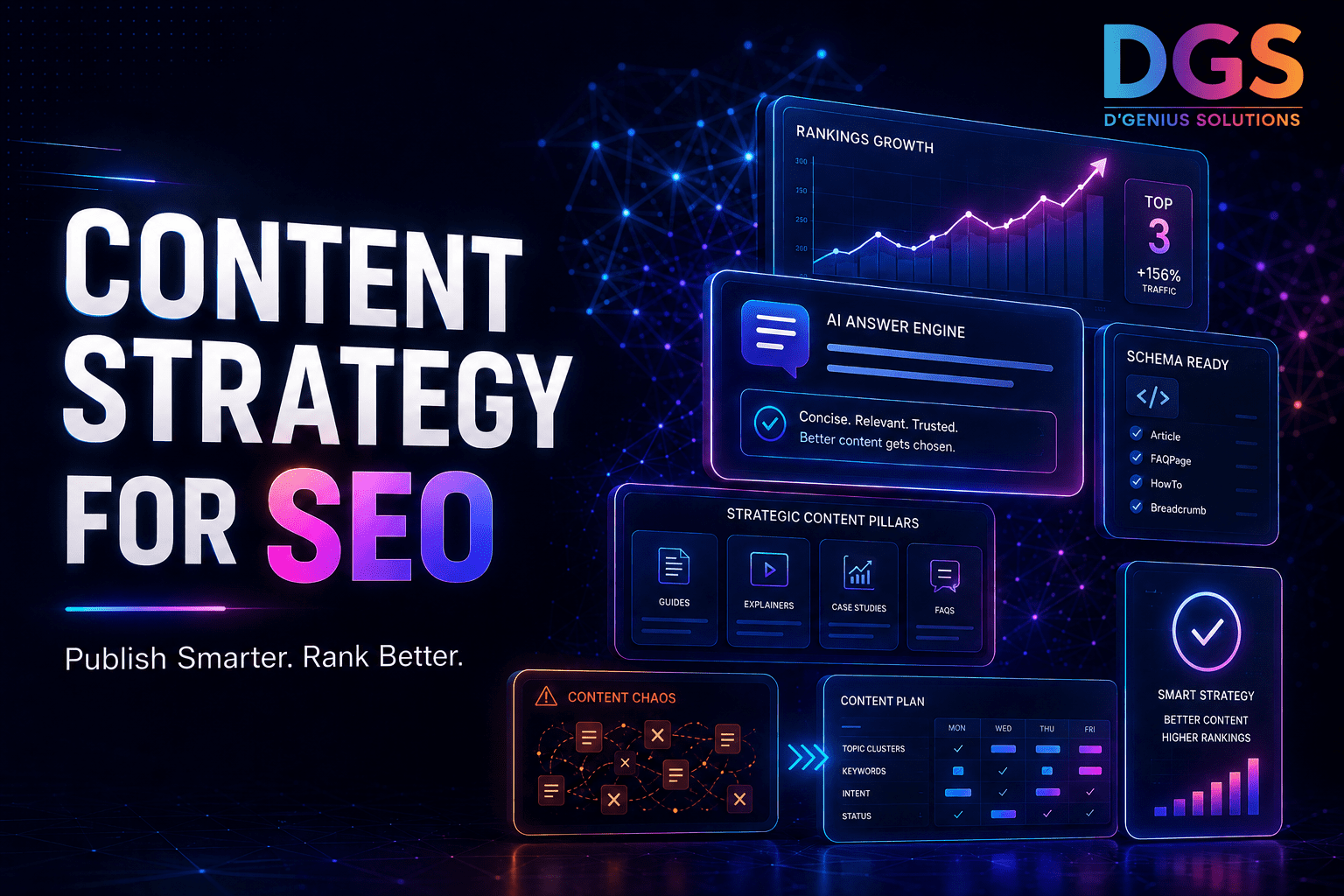
Content Strategy for SEO: 7 Powerful Ways to Avoid Ranking Loss
In this article
- Quick Answer
- Introduction
- What Is Content Strategy for SEO?
- Why Publishing More Content Can Hurt SEO
- 1. Create Content That Supports Your Service Pages
- 2. Avoid Writing Multiple Blogs on the Same Intent
- 3. Improve Old Content Before Publishing New Content
- 4. Build Topic Clusters Around Main Services
- 5. Use Internal Links With a Clear Purpose
- 6. Optimize for Google, AI Overviews, and Answer Engines
- 7. Measure Content by Business Results, Not Blog Count
- Common Signs Your Website Has a Weak Content Strategy
- How D'Genius Solutions Helps Businesses With SEO Content Strategy
- Conclusion
- FAQs
- What is content strategy for SEO?
- Can publishing too much content hurt SEO?
- How many blogs should a business publish every month?
- Why are my blogs not ranking on Google?
- How does content strategy support service page ranking?
- Does content strategy help with AI search visibility?
Quick Answer
Content strategy for SEO is not about publishing more blogs every week. It is about publishing the right content, targeting the right intent, supporting the right service pages, and building clear topical authority. When a website publishes too many similar pages, Google may struggle to decide which page deserves ranking. A strong content strategy for SEO helps businesses avoid duplicate topics, weak pages, keyword cannibalization, poor indexing, and low-quality traffic.
Introduction
Many businesses believe that publishing more content will automatically improve Google rankings. More blogs, more keywords, more pages, and more updates may look like progress, but it can also create serious SEO problems when there is no clear strategy behind it.
This is where content strategy for SEO becomes important.
A website does not rank only because it has many pages. It ranks when Google understands the business, trusts the content, sees clear topical authority, and finds strong connections between service pages, blogs, case studies, and internal links.
At D'Genius Solutions, we help businesses build SEO-focused content systems that improve rankings, support lead generation, and strengthen visibility across Google, AI Overviews, answer engines, and modern AI search platforms.
If your business is publishing content regularly but still not seeing results, the problem may not be content quantity. The problem may be content direction.
What Is Content Strategy for SEO?
Content strategy for SEO is the process of planning, creating, optimizing, linking, updating, and measuring website content so it supports search rankings and business growth.
It includes:
- Choosing the right primary keyword
- Understanding search intent
- Creating topic clusters
- Linking blogs with service pages
- Avoiding duplicate content topics
- Improving old pages
- Building topical authority
- Supporting Google indexing
- Optimizing content for AI search and answer engines
A good content strategy for SEO gives every page a clear role. A blog should not randomly exist on the website. It should support a service page, answer a real user question, build trust, and guide the visitor toward action.
Why Publishing More Content Can Hurt SEO
Publishing more content can hurt SEO when the content is repetitive, thin, unclear, or disconnected from the main business goals.
For example, a digital marketing agency may publish separate blogs on:
- Best SEO company
- SEO agency services
- SEO services for business
- SEO company near me
- SEO experts for ranking
If all these pages say almost the same thing, Google may not know which page is the strongest. Instead of helping the website rank, these pages can compete with each other.
This is called keyword cannibalization.
But today, the problem is bigger than just keywords. Google and AI search systems also analyze meaning, entities, structure, and topical relationships. If many pages have similar meaning, the website can lose clarity.
That is why content strategy for SEO should focus on quality, intent, and structure instead of only content volume.
1. Create Content That Supports Your Service Pages
Every business website should have strong service pages. These pages are usually responsible for generating leads and conversions.
For DGS, important service pages include:
SEO Services Mumbai
LLM SEO Service
AI Video Production Agency
Content Creation Services
Your blog content should support these pages.
For example, if the main service page is about SEO services, supporting blogs can cover:
- Why your pages are crawled but not indexed
- How SEO helps local businesses generate leads
- Why content quality matters more than content quantity
- How technical SEO improves website performance
- How AI search is changing Google rankings
This builds a clear content cluster. Google can understand that your website has depth around SEO, not just random blog posts.
2. Avoid Writing Multiple Blogs on the Same Intent
Many websites make the mistake of targeting the same topic again and again with small changes in title.
For example:
- What is SEO?
- What is search engine optimization?
- SEO meaning for business
- SEO basics for beginners
- Why SEO is important
These topics are closely related. If each blog is thin and similar, the website may look repetitive.
A better content strategy for SEO is to create one strong main blog and then create supporting blogs with different intent.
For example:
Main blog:
What Is SEO and How Does It Help Businesses Grow?
Supporting blogs:
Technical SEO Checklist for Business Websites
Local SEO Mistakes That Stop Businesses From Ranking
SEO Content Strategy for Lead Generation
How to Choose the Right SEO Agency in Mumbai
Each blog has a different purpose. This improves topical depth without creating internal competition.
3. Improve Old Content Before Publishing New Content
Publishing new content is not always the best first step.
Sometimes, improving existing content gives faster results.
You should update old blogs and service pages by adding:
- Better headings
- Fresh examples
- Internal links
- FAQs
- Schema markup
- Stronger calls to action
- Original insights
- Better keyword placement
- Updated images
- Clearer service positioning
If a page has impressions but low clicks, improve the title and meta description.
If a page is crawled but not indexed, improve content depth and internal links.
If a page ranks on page two, strengthen the content and add supporting links.
This is how content strategy for SEO helps businesses grow without creating unnecessary pages.
4. Build Topic Clusters Around Main Services
A topic cluster is a group of related pages connected through internal links.
For example, if your main topic is SEO, your website can have one main SEO service page and multiple supporting blogs around SEO problems, benefits, and solutions.
A simple SEO topic cluster can look like this:
Main page: SEO Services Mumbai
Supporting blogs:
- Content strategy for SEO
- Technical SEO checklist
- Crawled but not indexed issue
- SEO-friendly website design
- Local SEO for Mumbai businesses
- Google ranking factors for businesses
This gives Google a stronger signal that your website has authority in SEO.
The same approach can be used for AEO, GEO, LLM SEO, AI video production, branding, website development, and content creation.
5. Use Internal Links With a Clear Purpose
Internal links are not just for navigation. They help Google understand which pages are most important.
A blog about content strategy for SEO should link to relevant service pages such as SEO services, content creation, website development, and LLM SEO.
For example, if a paragraph explains how content improves Google rankings, it should link to the SEO service page. If a paragraph explains blogs, videos, or creative assets, it should link to the content creation page.
Good internal linking helps:
- Pass authority to important pages
- Improve crawling
- Reduce orphan pages
- Support service page ranking
- Improve user journey
- Increase conversions
Every blog should have a clear internal linking plan before publishing.
6. Optimize for Google, AI Overviews, and Answer Engines
Modern SEO is not only about traditional blue links on Google. Users now discover brands through AI Overviews, ChatGPT, Gemini, Perplexity, voice search, and answer engines.
That means your content should be easy for both search engines and AI systems to understand.
Use:
- Clear definitions
- Short answer sections
- FAQs
- Structured headings
- Natural keyword placement
- Entity-rich language
- Direct explanations
- Service-focused context
- Trust-building content
This is where LLM SEO, AEO, GEO, and traditional SEO work together.
A strong content strategy for SEO improves your chances of being discovered not only on Google search but also across AI-powered search experiences.
7. Measure Content by Business Results, Not Blog Count
A common mistake is measuring SEO success by how many blogs were published.
That is not enough.
A better content strategy for SEO measures:
- Indexed pages
- Ranking keywords
- Organic clicks
- Search impressions
- Lead generation
- Internal link strength
- Service page growth
- Conversion rate
- AI search visibility
- Content engagement
A blog that brings qualified leads is more valuable than ten blogs that bring no business results.
For DGS and similar service-based businesses, content should always support visibility, trust, and lead generation.
Common Signs Your Website Has a Weak Content Strategy
Your website may need a better content strategy for SEO if:
- Many pages are crawled but not indexed
- Multiple blogs target the same keyword
- Service pages are not getting organic traffic
- Blogs do not link to service pages
- Content sounds generic or AI-written
- Pages have low word count
- There are too many tag or archive URLs
- Google is not ranking your important pages
- Website traffic is not converting into leads
These are not just content problems. They are strategy problems.
How D'Genius Solutions Helps Businesses With SEO Content Strategy
D'Genius Solutions helps businesses create content systems that support Google rankings, AI visibility, and lead generation.
Our approach includes:
- SEO content planning
- Keyword research
- Service page optimization
- Blog strategy
- Internal linking
- AEO and GEO optimization
- LLM SEO planning
- Content audits
- Website structure improvement
- Conversion-focused content creation
We do not create content just to fill a website. We create content that supports business growth.
Whether your goal is better rankings, more leads, improved indexing, or stronger AI search visibility, a clear content strategy can help your website perform better.
Conclusion
Publishing more content is not always the solution. In many cases, publishing without direction can create keyword cannibalization, thin pages, poor indexing, and weaker rankings.
The smarter approach is to build a content strategy for SEO that focuses on clarity, authority, internal linking, service-page support, and business results.
If your website already has many blogs but your rankings are not improving, it may be time to audit your content, remove duplication, strengthen your service pages, and build a better SEO content structure.
D'Genius Solutions helps businesses create SEO-focused content strategies that improve visibility across Google, AI search platforms, and modern answer engines.
Contact D'Genius Solutions to build a stronger content strategy for SEO and turn your website into a better ranking and lead-generation asset.
FAQs
What is content strategy for SEO?
Content strategy for SEO is the planning and optimization of website content to improve Google rankings, search visibility, user experience, and lead generation. It includes keyword research, topic planning, internal linking, content updates, service-page support, and performance tracking.
Can publishing too much content hurt SEO?
Yes. Publishing too much content can hurt SEO when pages are thin, repetitive, poorly linked, or targeting the same search intent. This can create keyword cannibalization and make it harder for Google to identify the strongest page.
How many blogs should a business publish every month?
The right number depends on business goals, competition, and content quality. For many businesses, publishing four strong blogs with proper internal linking and service-page support is better than publishing many weak or repetitive posts.
Why are my blogs not ranking on Google?
Your blogs may not rank because of weak keyword targeting, poor search intent matching, low content depth, missing internal links, duplicate topics, technical SEO issues, or lack of authority. A content audit can help identify the exact problem.
How does content strategy support service page ranking?
Content strategy supports service page ranking by creating relevant blogs that link back to important service pages. This helps Google understand topic authority and improves the visibility of lead-generation pages.
Does content strategy help with AI search visibility?
Yes. A strong content strategy helps AI search systems understand your brand, services, expertise, and topical authority. Clear answers, structured content, FAQs, and entity-rich language can improve visibility in AI Overviews, answer engines, and LLM-based platforms.
Accelerate Your Digital & Search Growth
Speak directly with our Mumbai-based SEO, AI search, and digital marketing strategists for a bespoke growth audit.
Get a Free Strategy AuditRelated Insights
Content Writing for SEO: 9 Ways to Rank and Convert - D'Genius Solutions
Content writing for SEO helps businesses create helpful, search-focused, and conversion-ready pages that rank higher on Google and convert visitors into

7 Smart Content Strategy Tips for High-Intent Traffic
Learn how to build a content strategy for high-intent traffic with SEO, EEAT, and AEO-focused content that attracts the right audience and drives better leads
Voice Search SEO in 2026: How Businesses Can Win Conversational Searches - D'Genius Solutions
Voice Search SEO helps businesses optimise their websites for searches made through spoken questions and natural, conversational language.