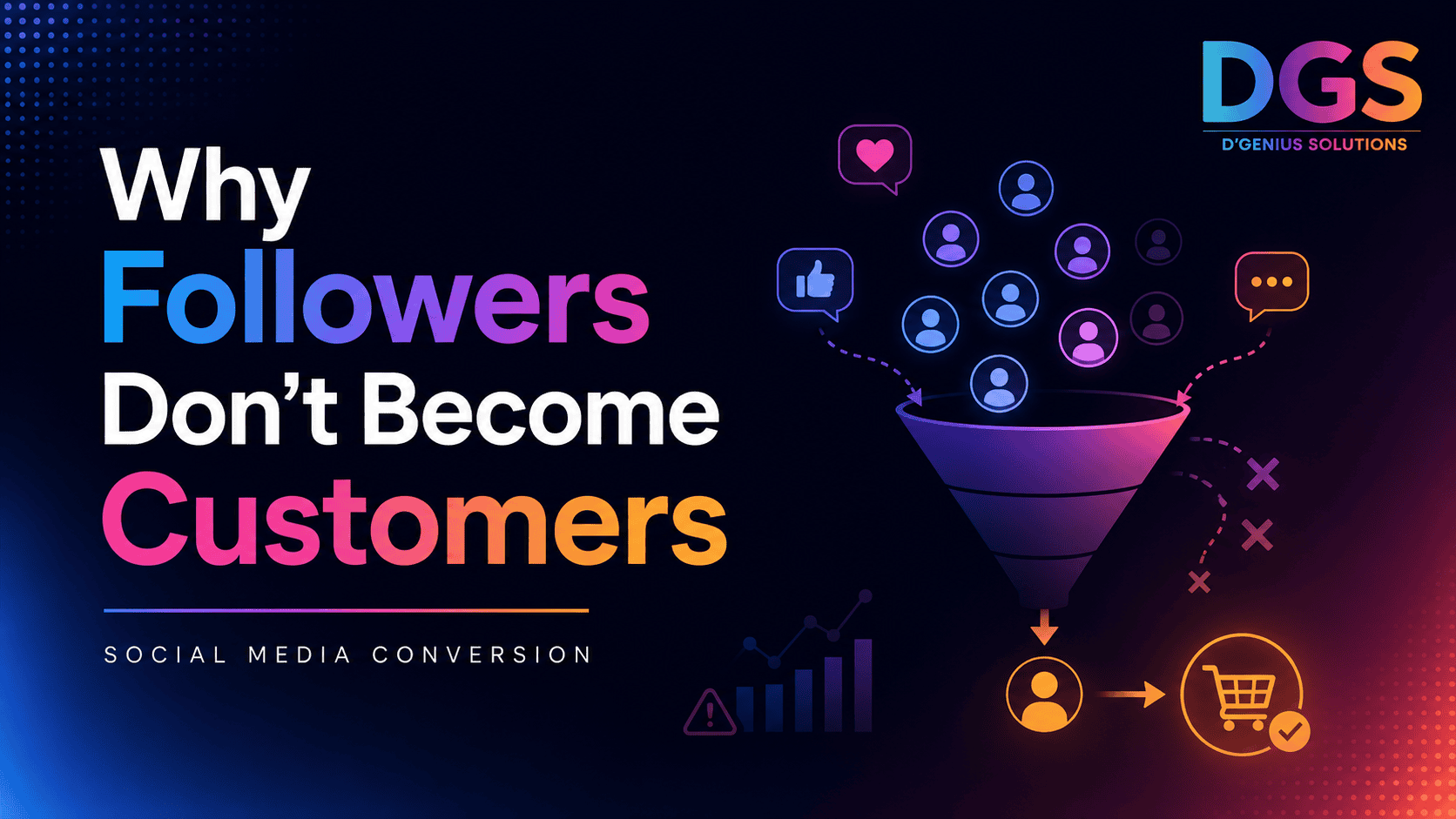
Social Media Conversion: Why Your Followers Are Not Becoming Customers
In this article
- Why Social Media Followers Do Not Automatically Become Customers
- You May Be Attracting the Wrong Followers
- Your Content May Be Engaging but Not Commercially Relevant
- Your Value Proposition Is Not Clear Enough
- Your Followers May Not Trust Your Brand Yet
- You Are Trying to Sell Before the Customer Is Ready
- Your Calls to action are too generic.
- Your Website May Be Losing the Leads Social Media Generates
- You Are Not Following Up With Interested People
- You Are Measuring Likes Instead of Business Results
- How to Turn Social Media Followers Into Customers
- Social Media Success Is About More Than Follower Growth
- What Google's Current Content Guidance Means for Your Strategy
- Final Thoughts
- FAQs About Social Media Conversion
- Why are my social media followers not buying from me?
- How do I convert social media followers into customers?
- Why am I getting engagement but no sales?
- Should every social media post promote my services?
- Is follower count important for social media marketing?
You are posting consistently. Your follower count is increasing. Reels are getting views, people are liking your posts, and some of your content may even be getting shared. On paper, your social media presence looks healthy.
But there is one problem: those followers are not becoming customers.
This is one of the most common challenges businesses face with social media conversion. Brands often spend months building an audience only to realise that more followers do not automatically mean more enquiries, leads, or sales.
The problem is rarely social media itself. More often, there is a gap between getting someone’s attention and giving that person enough reason to trust your brand, understand your offer, and take action.
A follower may enjoy your content without needing your service. Someone may watch your reel without remembering your company. Another person may visit your profile but leave because they cannot understand what you actually provide.
So, if your social media engagement looks good but your sales numbers tell a different story, it is worth looking beyond follower count.
Why Social Media Followers Do Not Automatically Become Customers
Social media followers represent attention, not guaranteed buying intent.
Think about the number of brands, creators, businesses, and personalities you personally follow. You probably do not intend to purchase from every one of them. Your customers behave in exactly the same way.
People follow accounts for entertainment, information, inspiration, industry updates, offers, or simply because one particular post caught their attention.
That means successful social media conversion requires much more than building an audience. Your content must gradually move the right followers from awareness to interest, then from interest to trust, and finally from trust to action.
If any part of that journey is missing, even a large social media audience may produce very few customers.
You May Be Attracting the Wrong Followers
One of the biggest mistakes brands make is focusing on audience size instead of audience quality.
A viral reel might generate thousands of views and hundreds of new followers. That looks impressive in a monthly report, but the real question is whether those new followers are potential customers.
For example, imagine a B2B company that consistently posts trending memes. The content might perform extremely well, but if the people engaging with it are students, casual browsers, or users outside the company’s target market, the increased reach may contribute very little to actual business growth.
This is why a strong social media marketing strategy should not chase reach simply for the sake of reach.
Your content should attract people who are genuinely relevant to the products or services you offer.
Instead of asking only, “How many followers did we gain?” businesses should also ask whether those followers match their ideal customer profile, interact with service-related content, visit the website, or eventually become inquiries.
A smaller but highly relevant audience can often generate far better results than a large but disconnected one.
Your Content May Be Engaging but Not Commercially Relevant
Another reason followers fail to become customers is that brands become very good at creating content people enjoy but fail to connect that content with what the business actually sells.
There is nothing wrong with entertaining content. In fact, entertaining, educational, and relatable posts can be excellent for increasing reach.
The problem begins when every post is designed only to generate likes and views.
If someone follows your account for three months but still cannot explain what your company offers, the content is doing only half its job.
Good social media content should gradually help potential customers understand your expertise. That does not mean turning every post into an advertisement. It means creating a healthy mix of content that attracts attention while also answering customer questions, solving problems, demonstrating results, and showing what makes your business useful.
A marketing agency, for example, could publish educational posts about advertising mistakes, show how a campaign was improved, explain why certain ads fail, share creative processes, discuss industry changes, and present genuine case studies.
This kind of content makes the transition from follower to potential customer far more natural.
Your Value Proposition Is Not Clear Enough
When someone discovers your social media profile for the first time, they should quickly understand three things: what you do, who you do it for, and why it matters.
Many businesses make this more difficult than necessary.
Their bios contain broad statements such as “Helping brands succeed” or “Transforming businesses digitally.” These phrases may sound professional, but they do not tell a potential customer very much.
Compare that with a message such as the following:
“Helping businesses generate qualified leads through Google Ads, Meta Ads, SEO, and conversion-focused digital campaigns.”
The second version immediately tells visitors what the company does and what outcome it is trying to create.
Clear positioning is extremely important for social media conversion because people rarely spend much time trying to understand a confusing business.
If they cannot understand your offer within a few seconds, they are likely to continue scrolling.
Clarity usually converts better than clever wording.
Your Followers May Not Trust Your Brand Yet
People rarely buy from a company simply because it publishes attractive social media posts.
Before making an enquiry, potential customers want reassurance.
They want to know whether your business is credible, whether other customers have worked with you, whether you understand their problem, and whether you can realistically deliver what you promise.
This is especially important for services where customers are making a significant financial or long-term commitment.
Trust can be created through client testimonials, portfolio work, case studies, customer experiences, team expertise, educational content, behind-the-scenes processes, and real examples of your work.
Instead of repeatedly telling people that your company is experienced, show them.
If you helped improve a campaign, explain what was changed. If you created a successful project, show the process. If a customer achieved a positive result, share the story with appropriate context.
The more uncertainty you remove, the easier it becomes for interested followers to take the next step.
You Are Trying to Sell Before the Customer Is Ready
Not everyone who follows your page is ready to buy today.
Some people may have discovered your brand five minutes ago. Others may already be comparing you with competitors. Another group may have been following you for several months and may simply need one more reason to enquire.
Treating all of these people exactly the same can hurt conversion.
A person who has just discovered your business probably does not want to see “Book a consultation now” repeatedly. They may first need helpful content that explains the problem your company solves.
Someone who already understands your service, however, may respond well to a case study, demonstration, consultation offer, or specific service page.
This is why content should support different stages of the customer journey.
Awareness content introduces problems and ideas. Educational content builds understanding. Case studies and proof build confidence. Commercial content helps people make decisions.
When these stages work together, converting followers into customers becomes much easier.
Your Calls to action are too generic.
Many brands spend significant time creating social media content and then finish the post with a weak call to action such as “Contact us”, “Learn more”, or “DM us”.
These CTAs are not necessarily wrong, but they often lack context.
A stronger call to action tells the user why taking the next step is worthwhile.
Instead of simply saying “Learn more”, you might invite users to explore how the service works. Instead of saying “Contact us”, you could encourage them to request an audit, consultation, quotation, or campaign review.
The CTA should also match the content.
Someone reading an educational post may be ready to visit a detailed blog. Someone viewing a case study may be interested in your service page. Someone repeatedly engaging with your commercial content may be ready to speak with your team.
A small change in how you guide users can have a meaningful impact on social media conversion.
Your Website May Be Losing the Leads Social Media Generates
Sometimes the real problem is not social media at all.
Your content successfully gets attention. The user clicks the link. Then your website loses them.
This happens more often than many businesses realize.
A visitor may land on a slow page, struggle to find information on mobile, encounter an unnecessarily long form, or arrive on a page that looks completely different from the social media message they clicked.
Imagine seeing an advertisement promoting a specific service and clicking it, only to land on a generic homepage containing ten different services. The customer now has to search for the information they expected to see immediately.
Every additional step creates friction.
A strong customer journey should continue naturally from social media to the website.
The page should explain the offer clearly, provide relevant information, establish credibility, and make the next action obvious. This is where professional website development and conversion-focused page design become important.
Social media can generate the click, but your website still has to convert that interest.
You Are Not Following Up With Interested People
Most customers do not purchase after seeing one social media post.
They may first watch a reel. Several days later, they might visit your profile. Eventually, they may open your website, read a service page, compare another company, and return again before making contact.
If your marketing stops after the first interaction, a large percentage of potential customers can disappear.
Remarketing helps reconnect with people who have already shown interest.
Someone who visited an important service page, watched most of your video, or repeatedly engaged with your brand usually has stronger intent than a completely new audience.
A well-planned performance marketing strategy can help nurture these audiences with more relevant advertising.
The key is not simply showing them the same ad repeatedly. Your follow-up content should answer the next question they are likely to have.
A person who has already seen an introductory advertisement may respond better to a testimonial. Someone who has visited the service page could be shown a case study. A user who has repeatedly engaged may be ready for a direct offer.
That progression can significantly improve the chances of turning followers into customers.
You Are Measuring Likes Instead of Business Results
Likes, comments, followers, views, and shares matter because they help businesses understand how audiences are interacting with content.
But they are not the same as conversions.
A reel receiving 100,000 views may be useful for awareness, but if none of those viewers visit your website, enquire, or eventually purchase, it should not automatically be considered a successful sales campaign.
Businesses need to connect social media activity with actual commercial outcomes.
Look at metrics such as website visits, form submissions, calls, WhatsApp enquiries, qualified leads, booked consultations, cost per lead, customer acquisition cost, sales, and revenue.
This does not mean ignoring engagement metrics. Instead, engagement should be treated as one part of a larger customer journey.
The question should not simply be:
“Did people engage?”
It should also be:
“What happened after they engaged?”
That shift in measurement can reveal where your social media conversion strategy actually needs improvement.
How to Turn Social Media Followers Into Customers
Improving conversion does not mean adding sales messages to every post.
The goal is to create a smoother path between discovering your brand and choosing your business.
Start by understanding exactly who your ideal customer is and what problem they are trying to solve. Then look at the followers and engagement your current content attracts.
If the two do not match, your content strategy may need to change.
Next, review your profile from the perspective of someone discovering the company for the first time. Can they immediately understand what you do? Can they find proof that you are credible? Is there a logical next step?
Your content should then support the full customer journey. Publish educational content to answer questions, practical content to demonstrate expertise, case studies to create trust, and commercial content when someone is closer to making a decision.
Finally, make sure the journey continues after the user leaves social media. Landing pages, enquiry forms, remarketing campaigns, and sales follow-up all influence whether that follower ultimately becomes a customer.
Social Media Success Is About More Than Follower Growth
Businesses often celebrate follower milestones because they are easy to see.
One thousand followers becomes five thousand. Five thousand becomes ten thousand.
But follower count alone tells you very little about the commercial health of your social media strategy.
A business with 2,000 highly relevant followers and a strong customer journey can generate more revenue than an account with 100,000 people who have little interest in buying.
The goal should therefore not be to build the biggest audience possible.
The goal is to attract the right audience and give interested people enough value, information, trust, and motivation to move forward.
That is what separates social media activity from an actual social media marketing strategy.
What Google’s Current Content Guidance Means for Your Strategy
The same focus on usefulness applies to the content you publish on your website.
Google recommends creating helpful, reliable, people-first content rather than publishing pages primarily to manipulate search rankings. Its guidance encourages businesses to demonstrate genuine expertise, provide original value, satisfy the visitor’s intent, and create content for real people.
You can read Google’s official guidance on creating helpful, reliable, people-first content.
This principle is particularly relevant after Google’s recent search quality and spam updates.
Publishing repetitive articles simply to insert keywords is unlikely to create a strong long-term content strategy. Businesses should instead create useful resources that genuinely answer customer questions, demonstrate experience, and make the subject easier to understand.
SEO should support useful content, not replace it.
The same is true for social media.
Posting purely because “we need three posts this week” rarely produces meaningful results. Every piece of content should have a clear reason to exist within the wider customer journey.
Final Thoughts
If your followers are not becoming customers, getting more followers may not solve the problem.
The real issue could be the audience you are attracting, the type of content you publish, unclear positioning, weak trust signals, poor calls to action, or a website that creates too much friction after someone clicks.
Successful social media conversion happens when every part of the journey works together.
Your content attracts the right person. Your profile explains why your brand matters. Your expertise builds trust. Your website makes the next step easy. Your marketing continues nurturing users who are not ready to purchase immediately.
When that system is in place, social media stops being just a place to collect likes and followers.
It becomes a genuine channel for generating customers and business growth.
FAQs About Social Media Conversion
Why are my social media followers not buying from me?
Your followers may not be becoming customers because they are not part of your target audience, do not clearly understand your offer, have not developed enough trust in your brand, or are not being given a clear path towards conversion. A strong social media conversion strategy addresses the complete journey rather than focusing only on follower growth.
How do I convert social media followers into customers?
Start by attracting relevant followers, publishing content that solves real customer problems, clearly explaining your services, showing credible proof, using meaningful calls to action, and directing interested users towards conversion-focused landing pages. Follow-up and remarketing can also help move warm prospects closer to making a purchase.
Why am I getting engagement but no sales?
Engagement indicates that people are interacting with your content, but it does not necessarily indicate purchasing intent. Your audience may enjoy the content without needing your product or service. Review audience quality, content relevance, your offer, landing pages, and the steps users take after engaging.
Should every social media post promote my services?
No. Constantly promoting services can make a page feel overly commercial. A better strategy combines educational, informative, engaging, proof-based, and promotional content. The objective is to build interest and trust before asking people to buy.
Is follower count important for social media marketing?
Follower count can help demonstrate reach, but it should not be treated as the main measure of success. Relevant followers, qualified enquiries, website visits, leads, customer acquisition, and revenue provide a much clearer picture of whether your social media strategy is contributing to business growth.
Accelerate Your Digital & Search Growth
Speak directly with our Mumbai-based SEO, AI search, and digital marketing strategists for a bespoke growth audit.
Get a Free Strategy AuditRelated Insights
Social Media Marketing Strategy 2026 for Small Businesses
Learn how a social media marketing strategy helps small businesses grow reach, branding, engagement, traffic, and leads with smarter digital marketing.
Low Social Media Reach in 2026? 9 Proven Fixes
Low social media reach despite trending audio and hashtags? Learn why posts stall, what affects visibility, and how to improve organic reach in 2026.
Google Search Console Social Media Update: 7 Key Changes for Brands in 2026 - D'Genius Solutions
Google Search Console social media tracking is becoming an important topic for businesses, marketers, creators and SEO teams. Google Search is no longer