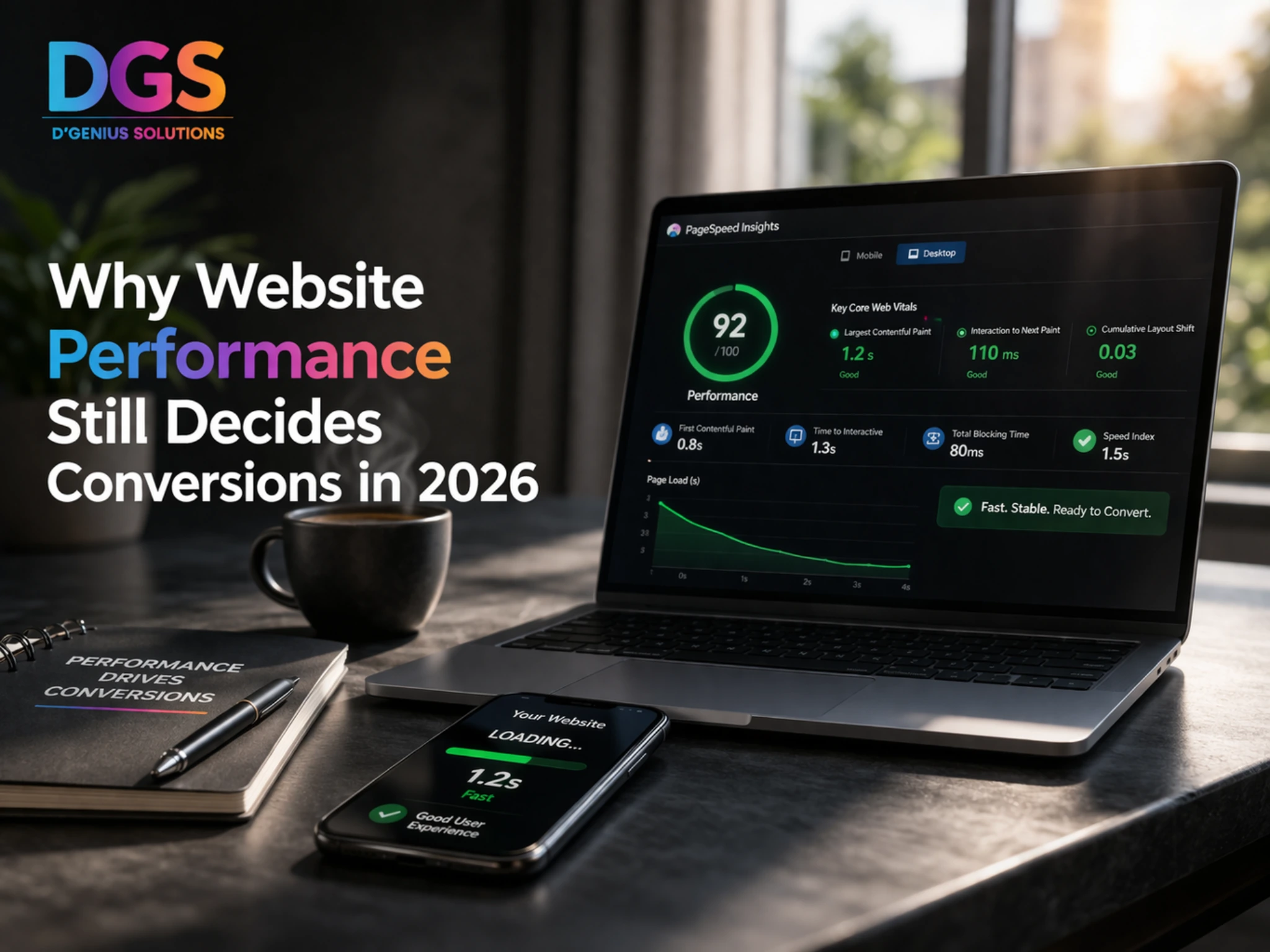
Why Website Performance Still Decides Conversions in 2026
A website can look modern, have strong branding, and even attract good traffic, but if it feels slow, unstable, or frustrating to use, conversions still suffer. In 2026, website performance is not just a technical issue. It is a business issue.
Users expect pages to load quickly, buttons to work smoothly, forms to respond instantly, and the overall experience to feel effortless. The moment a website lags, trust drops. Many visitors leave before they even read the offer. That is why businesses that want better leads, stronger engagement, and higher sales still need to treat performance as a core part of digital growth.
At D’Genius Solutions, website strategy is never only about design. A high-converting site must combine speed, structure, usability, and search readiness. That is exactly why website performance still plays such a big role in conversions today.
Why Website Performance Matters More Than Ever
Website performance affects the first impression a brand makes online. When a page loads quickly and works smoothly, visitors feel more confident exploring the website. When it loads slowly or shifts unexpectedly, the experience feels unreliable.
A user may not always say, “This website has poor performance,” but they feel it. They feel it when images load late, when the page jumps while reading, when the form takes too long, or when the menu becomes hard to use on mobile. These moments create friction, and friction reduces conversions.
In a competitive market, users rarely wait. They compare, click back, and move on. That is why performance still decides whether traffic turns into action.
Performance and Conversions Are Directly Connected
A well-performing website makes it easier for people to take the next step. That next step could be filling out a contact form, booking a call, browsing services, or making a purchase. If the journey feels smooth, users stay longer and interact more.
This is especially important for service-based businesses. A visitor landing on a service page should be able to understand the offer, navigate easily, and respond without delay. If the page is too slow or overloaded, the business may lose that lead before the visitor even reaches the call to action.
That is why strong performance supports not only user experience but also lead generation and revenue growth.
What Website Performance Really Includes in 2026
Website performance is not only about page speed. It is broader than that. In 2026, performance includes how fast the site loads, how stable the layout feels, how responsive the interactions are, and how easily users can move through the content.
A high-performing website usually has clean structure, optimized media, thoughtful code, strong mobile usability, and clear navigation. It also avoids unnecessary clutter that slows down decision-making.
For brands investing in website development services, this means performance should be planned from the beginning rather than fixed later. A website should not only look impressive on launch day. It should perform well for real users every day.
Slow Websites Still Kill Trust
Trust is one of the biggest reasons website performance matters. A slow website often feels outdated, poorly maintained, or less professional. Even if the service is excellent, the digital experience can create doubt.
This becomes even more important when users are comparing multiple providers. A faster, smoother experience often creates a stronger impression than a visually attractive but slow page. That is why performance is closely tied to brand credibility.
A business looking for a strong online presence should not treat speed as a bonus feature. It is part of what makes the brand feel dependable in the first place.
Mobile Performance Decides More Than Desktop Design
In 2026, many users still discover brands first through mobile. That means mobile performance has a major impact on conversions. If a page looks fine on desktop but struggles on mobile, the business may lose a large share of valuable traffic.
Buttons should be easy to tap, layouts should stay clean, and pages should load quickly even on average mobile networks. Good mobile performance is now a standard expectation, not an extra advantage.
This is where responsive web design services become important. A responsive experience is not just about fitting the screen size. It is about making the site feel smooth and usable across different devices.
SEO and Website Performance Work Together
A good website should perform for both users and search engines. Performance affects how people interact with the site, and that often supports better organic results over time. A smooth user experience can improve engagement, reduce drop-offs, and create stronger session quality.
For that reason, website performance should work alongside content strategy and technical optimization. Businesses that invest in professional seo services in mumbai often see better outcomes when their website experience supports the SEO effort rather than slowing it down.
A business may have strong content and relevant search visibility, but if the landing page performs poorly, conversions still fall short. That is why performance and SEO should never be treated separately.
Good Development Builds Better Conversion Paths
The structure behind the website matters just as much as the visible design. A well-built website makes it easier to guide users from landing page to service page to enquiry form. That journey must feel natural and uninterrupted.
This is where the quality of web development services becomes very important. Clean code, logical architecture, better page behavior, and optimized assets all help create smoother journeys for users.
A reliable website development company understands that performance is not just technical maintenance. It shapes how well the website supports business goals.
Design Alone Does Not Convert
Many businesses focus heavily on visual appeal, but design alone does not guarantee results. A site can be beautiful and still perform poorly if it is too heavy, too confusing, or too slow to interact with.
The best results come when website design and development work together. Design should support clarity, while development should support performance. That balance helps users trust the page and move through it comfortably.
This is one reason businesses now look for a professional web design company or a web design and development agency that understands both user experience and functionality, not just aesthetics.
Custom Builds Often Perform Better for Growth
Templates can work for simple needs, but growing businesses often need more flexibility, better structure, and stronger conversion journeys. That is where custom development becomes valuable.
A business that wants better lead quality, easier content control, and smoother page journeys may benefit from custom website development rather than relying on generic layouts. A thoughtful build can remove unnecessary elements, improve speed, and support long-term scalability.
That is why many brands choose a custom website design company when they want a website that matches both their brand and their performance goals.
Why Performance Still Matters for Local Business Growth
For local businesses, website performance can influence whether a visitor becomes a lead. A user searching for a nearby service often wants quick answers and a fast path to contact. If the website delays that journey, the chance of conversion drops.
A locally focused website must load well, present services clearly, and make it easy to enquire. Businesses that use seo consulting services often find that technical and content improvements work better when the site is already built for speed and usability.
This is especially relevant for agencies, consultants, and service providers competing in crowded local markets.
How D’Genius Solutions Approaches Website Performance
D’Genius Solutions looks at performance as part of the full conversion journey. A website should not just exist online. It should help the business grow. That means combining speed, structure, usability, and intent-driven design in one strategy.
Whether the project needs professional website development, cleaner architecture, improved mobile behavior, or stronger conversion flow, the focus stays on building websites that work well for real users. That same approach also supports search visibility, brand trust, and better lead generation.
When businesses invest in smarter development, they create better user experiences and stronger opportunities for conversion.
Conclusion
Website performance still decides conversions in 2026 because users still value speed, ease, and trust. A slow or unstable site creates friction, and friction reduces action. No matter how strong the marketing is, the website still has to complete the job.
Businesses that want better results should treat performance as a core part of growth, not a technical afterthought. A fast, smooth, and well-built website supports user trust, improves conversion journeys, and strengthens the value of every visitor.
For brands that want websites built with both performance and growth in mind, D’Genius Solutions focuses on creating digital experiences that are ready for users, search engines, and real business outcomes.
FAQs
Why is website performance important for conversions?
Website performance is important for conversions because a fast and smooth website helps users trust the brand, stay longer, and take action more easily.
Does website speed still matter in 2026?
Yes, website speed still matters in 2026 because users expect quick-loading pages and smooth browsing experiences across all devices.
How does poor website performance affect lead generation?
Poor website performance can increase drop-offs, reduce trust, and stop users from completing forms, booking calls, or exploring service pages.
Is mobile performance more important than desktop performance?
Mobile performance is extremely important because many users first visit a website on mobile, and a poor mobile experience can reduce conversions quickly.
Can website performance improve SEO results?
Website performance can support SEO by improving user experience, engagement, and the overall quality of landing pages.
What kind of business needs high-performance website development?
Any business that depends on online leads, enquiries, sales, or customer trust benefits from high-performance website development.