3-3-3 Rule in Marketing: 7 Smart Ways to Grow Faster
In this article
- What is the 3-3-3 Rule in Marketing?
- Why the 3-3-3 Rule in Marketing Matters
- 1. It Makes Your Brand Message Clear
- 2. It Helps You Focus on the Right Platforms
- 3. It Improves Customer Actions
- 4. It Supports SEO and Search Visibility
- 5. It Connects Marketing Strategy with Lead Generation
- 6. It Gives Indian Businesses a Stronger Digital Foundation
- 7. It Helps Teams Stay Consistent
- Example of the 3-3-3 Rule in Marketing
- How D'Genius Solutions Uses This Rule for SEO Planning
- Common Mistakes Businesses Should Avoid
- How to Use the 3-3-3 Rule on Your Website
- Why This Rule Works Better with SEO
- Final Thoughts
- FAQs
- What is the 3-3-3 rule in marketing?
- How does the 3-3-3 rule in marketing help SEO?
- Can the 3-3-3 rule improve lead generation?
- Which businesses should use the 3-3-3 rule?
- How do I apply the 3-3-3 rule on my website?
- Why should this blog link to an SEO services page?
- Does the 3-3-3 rule work for Indian businesses?
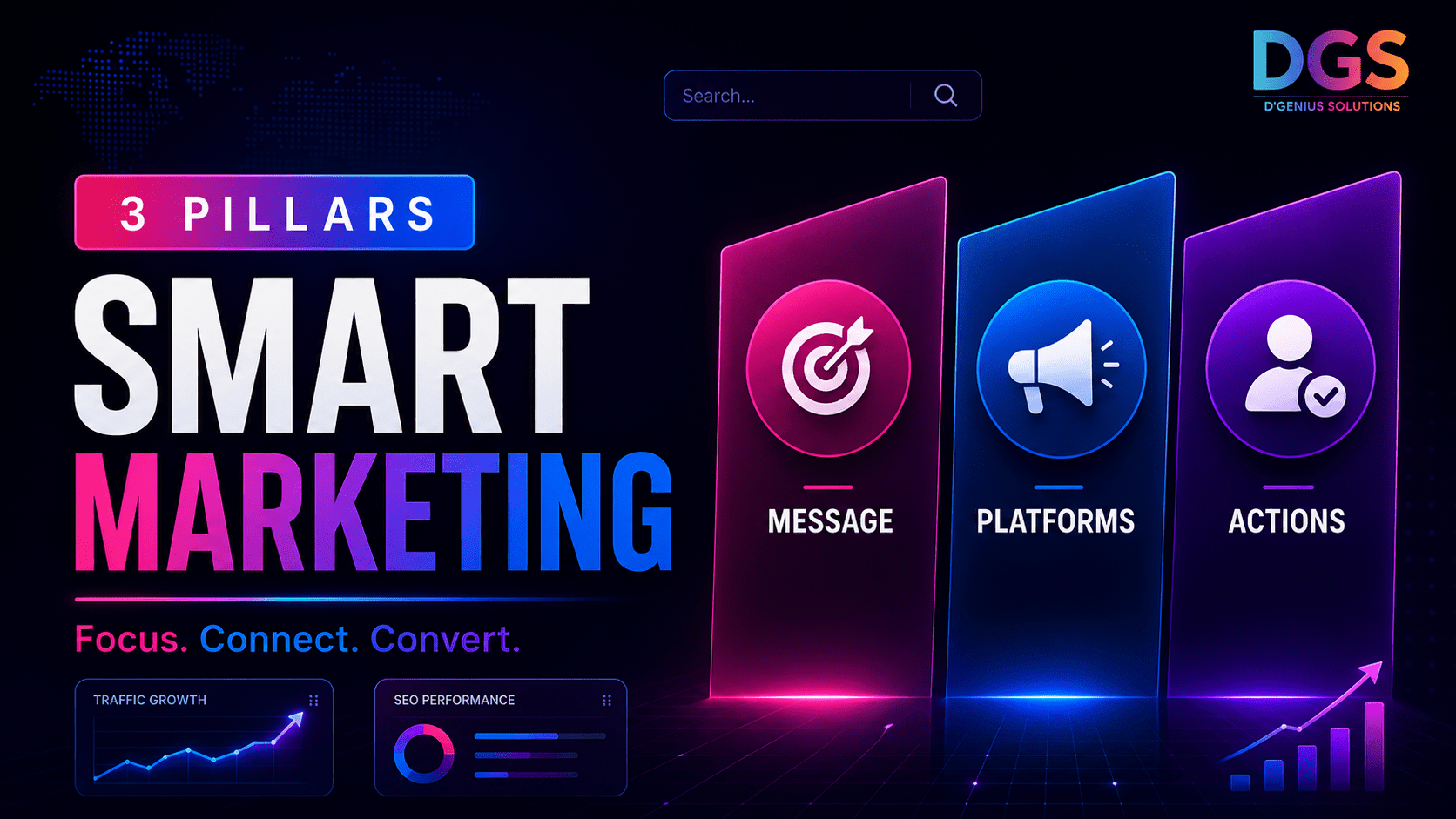
3-3-3 rule in marketing is a practical way to simplify how a business communicates, promotes, and converts customers. It helps brands focus on three clear messages, three important marketing channels, and three direct actions that move people from interest to enquiry.
In today’s digital market, customers do not wait for a brand to explain itself slowly. They compare websites, search results, reviews, social media profiles, and service pages before making a decision. If your message is confusing, people leave. If your message is clear, repeated consistently, and supported with the right call to action, your chances of generating leads become stronger.
For businesses that depend on Google visibility, SEO, website traffic, and lead generation, the 3-3-3 rule in marketing can become a simple but powerful planning framework.
What is the 3-3-3 Rule in Marketing?
The 3-3-3 rule in marketing means building your strategy around three things.
First, define three core messages your audience should remember.
Second, choose three marketing platforms where your audience is most active.
Third, give customers three clear actions they can take after engaging with your brand.
This rule helps your marketing become easier to understand. Instead of saying too many things on too many platforms, your brand becomes focused. Your website, SEO content, social media, Google Business Profile, landing pages, ads, and sales communication start working in the same direction.
A business using this rule should be able to answer three simple questions clearly.
What do we offer?
Who do we help?
What result do we deliver?
When these answers are clear, your brand becomes easier to trust and easier to contact.
Why the 3-3-3 Rule in Marketing Matters
The 3-3-3 rule in marketing matters because most businesses lose potential customers due to unclear communication. A visitor may land on your website, but if they cannot quickly understand your service, benefit, proof, and next step, they may move to another company.
A scattered message creates friction. A focused message creates confidence.
For example, a weak message says:
“We provide complete business solutions.”
A stronger message says:
“We help businesses improve Google visibility, generate qualified leads, and grow through SEO, content, website development, and digital marketing.”
The second message is more useful because it tells the customer what the business does and what outcome they can expect.
This kind of clarity is also helpful for SEO. Search engines need to understand your services, audience, location, expertise, and content structure. A clear website gives both users and Google better context.
You can also review Google’s guidance on creating helpful content through Google Search Central to understand why user-first content matters.
1. It Makes Your Brand Message Clear
The first benefit of the 3-3-3 rule in marketing is message clarity.
Every business should have three main messages that explain its value. These messages should not be random slogans. They should connect directly to customer problems and business outcomes.
For example, a digital marketing agency may use these three messages:
We help businesses become visible on Google.
We help brands convert website visitors into enquiries.
We help companies grow through search-focused digital marketing.
These messages are simple, direct, and outcome-driven. They can be used across the homepage, service pages, blog content, social media profiles, proposals, and advertisements.
When people see the same core message repeatedly, they understand your positioning faster. This improves brand recall and trust.
2. It Helps You Focus on the Right Platforms
The second part of the 3-3-3 rule in marketing is choosing three primary platforms.
Many businesses try to be present everywhere. They post on every social platform, run ads without a clear funnel, publish blogs without internal links, and update their website only occasionally. This spreads effort too thin.
A better approach is to choose the platforms that actually influence your customers.
For many service businesses, the three most important platforms are:
Google Search
Business website
Google Business Profile or social media
For a local service business, Google Search and Google Business Profile can be extremely valuable because customers are already searching for nearby solutions. For a B2B company, the website, Google Search, and LinkedIn may matter more. For ecommerce brands, the website, Google Search, and Instagram may be stronger.
This is where SEO becomes important. If your audience is searching on Google, your website needs strong service pages, technical SEO, helpful blogs, internal links, and clear calls to action.
Businesses looking for stronger organic visibility can work with an experienced SEO agency in Mumbai to build a strategy that supports rankings, traffic, and qualified enquiries.
3. It Improves Customer Actions
The third part of the 3-3-3 rule in marketing is action clarity.
A visitor should never wonder what to do next. Whether they are reading a blog, checking a service page, viewing a social media post, or visiting your Google Business Profile, the next step should be obvious.
Common customer actions include:
Call the business
Fill out an enquiry form
Request a quote
Send a WhatsApp message
Book a consultation
Download a guide
View a service page
Many websites provide information but fail to guide action. This creates missed opportunities.
For example, if someone visits an SEO service page, the page should explain the service, show trust signals, answer common questions, and guide the visitor toward a call, form, audit request, or WhatsApp enquiry.
The 3-3-3 rule in marketing helps connect awareness with action.
4. It Supports SEO and Search Visibility
The 3-3-3 rule in marketing supports SEO because clear messaging improves topical relevance.
When your website explains your services properly, links related pages together, answers customer questions, and uses consistent language, search engines can better understand your business.
For example, a business that wants to rank for SEO services in Mumbai should not depend only on one service page. The website should include supporting blogs, case studies, FAQs, technical SEO information, local SEO content, Google Business Profile relevance, and internal links.
This creates a stronger content ecosystem.
A blog like this supports SEO because it connects marketing clarity, customer journey, Google visibility, lead generation, and business growth. These are all related to search-focused digital marketing.
If your business wants to improve rankings and generate better enquiries, professional SEO services in Mumbai can help structure your website, content, and local search presence more effectively.
5. It Connects Marketing Strategy with Lead Generation
Lead generation becomes easier when your audience understands your value quickly.
The 3-3-3 rule in marketing improves lead generation by creating a smoother journey.
A potential customer may first discover your business on Google. Then they may visit your website. After that, they may check your reviews, case studies, service pages, or social media. If every touchpoint communicates the same value clearly, trust increases.
This trust supports action.
Instead of confusing people with multiple offers, your brand gives them a focused reason to contact you.
For service businesses, this is especially important because buyers usually compare multiple providers before enquiring. A clear message can help your business stand out during that comparison stage.
6. It Gives Indian Businesses a Stronger Digital Foundation
Indian businesses compete in a crowded online space. Whether a company is based in Mumbai, Pune, Delhi, Bengaluru, Hyderabad, Ahmedabad, Chennai, or another city, customers often search online before contacting a brand.
The 3-3-3 rule helps Indian businesses build stronger digital communication by improving consistency across platforms.
A business should not only create generic website content. It should build service relevance, location relevance, trust signals, helpful blogs, local authority, and conversion-focused pages.
This becomes more important when a company wants national visibility.
Professional SEO services in India can help businesses improve website structure, keyword targeting, content planning, technical SEO, internal linking, and search authority.
For growing brands, this means better visibility across local, regional, and national searches.
7. It Helps Teams Stay Consistent
Another major benefit of the 3-3-3 rule in marketing is team alignment.
Marketing teams, sales teams, designers, writers, and business owners often communicate differently. This can weaken the brand message.
When everyone understands the three main messages, three main platforms, and three main customer actions, marketing becomes more consistent.
Writers know what content to create.
Designers know what message to highlight.
Sales teams know what value to explain.
SEO teams know which pages to support.
Social media teams know what themes to repeat.
This consistency creates stronger brand identity and better customer understanding.
Example of the 3-3-3 Rule in Marketing
Let us take an example of a digital marketing agency.
The three core messages could be:
We help businesses rank higher on Google.
We help brands generate qualified leads.
We help companies grow through SEO, content, web design, and digital strategy.
The three main platforms could be:
Website
Google Search
Google Business Profile
The three customer actions could be:
Request a free audit
Book a consultation
Call or WhatsApp the team
This structure makes marketing more focused. The website explains the services. Google Search brings high-intent visitors. Google Business Profile builds local trust. The calls to action convert visitors into leads.
This simple model can be applied to local businesses, consultants, clinics, real estate firms, education brands, ecommerce companies, B2B firms, and agencies.
How D'Genius Solutions Uses This Rule for SEO Planning
At D'Genius Solutions, the 3-3-3 rule can be used to simplify SEO and digital marketing planning.
First, we identify what the business wants to be known for. This may include SEO, local visibility, website development, lead generation, brand awareness, or AI search visibility.
Second, we identify where the audience is searching or engaging. For many businesses, this includes Google Search, the website, and Google Business Profile. For some brands, it may also include LinkedIn, Instagram, YouTube, or paid campaigns.
Third, we connect every important page to a business action. This may include calls, enquiry forms, WhatsApp messages, audit requests, or consultation bookings.
This approach makes SEO more practical. SEO is not only about ranking keywords. It is about helping the right audience find the business, understand the offer, trust the brand, and take action.
Common Mistakes Businesses Should Avoid
Many businesses make the mistake of changing their message too often. One month they promote low pricing. Another month they promote premium quality. Then they focus on speed, discounts, or experience.
This creates confusion.
Another mistake is treating every platform differently. A website may talk about one service, ads may promote another offer, and social media may highlight something unrelated.
The 3-3-3 rule in marketing reduces this confusion.
Businesses also make the mistake of publishing blogs without linking them to important service pages. From an SEO point of view, supporting blogs should guide users and search engines toward relevant service pages.
For example, a blog about marketing strategy should naturally connect with SEO, website visibility, lead generation, and service-page optimization.
How to Use the 3-3-3 Rule on Your Website
Start by checking your homepage and main service pages.
Ask these questions:
Can a visitor understand your business within five seconds?
Are your services explained clearly?
Do your pages show proof, benefits, and next steps?
Do your blogs link to relevant service pages?
Do your CTAs encourage calls, forms, WhatsApp messages, or consultations?
Are your location and service signals clear?
Once you answer these questions, update your website content. Keep your message direct. Add internal links. Improve FAQs. Add proof where possible. Use helpful content that solves real customer questions.
You can also read Google’s official core updates guidance to understand why reliable and useful content matters for long-term visibility.
Why This Rule Works Better with SEO
The 3-3-3 rule in marketing gives your message structure. SEO gives that message visibility.
When both work together, the customer journey becomes stronger.
SEO helps people discover your business.
Clear messaging helps them understand your value.
Strong CTAs help them become leads.
This is why SEO should not be limited to keywords. A good SEO strategy should support positioning, content quality, technical health, local relevance, internal linking, and conversion growth.
A professional SEO agency in India can help businesses build this structure through SEO audits, service page optimization, content planning, and authority building.
Final Thoughts
The 3-3-3 rule in marketing is a simple framework that helps businesses communicate better, focus their platforms, and guide customers toward action.
It works because it removes confusion. Instead of saying everything to everyone, your brand focuses on the messages, platforms, and actions that matter most.
For businesses that want better Google rankings, stronger website traffic, and more qualified leads, this rule becomes even more useful when combined with SEO.
Want to turn marketing clarity into Google rankings and qualified leads? Explore D'Genius Solutions’ SEO services in Mumbai and build a search-focused strategy for better visibility, traffic, and business growth.
FAQs
What is the 3-3-3 rule in marketing?
The 3-3-3 rule in marketing is a framework that helps businesses focus on three core messages, three main marketing platforms, and three clear customer actions. It improves clarity, consistency, and lead generation.
How does the 3-3-3 rule in marketing help SEO?
It helps SEO by making website messaging clearer and more structured. Clear service information, internal links, helpful content, and consistent messaging help search engines understand your business better.
Can the 3-3-3 rule improve lead generation?
Yes. The rule improves lead generation by helping users understand your offer quickly and guiding them toward clear actions such as calling, filling a form, requesting a quote, or booking a consultation.
Which businesses should use the 3-3-3 rule?
Local businesses, consultants, digital agencies, ecommerce brands, B2B companies, startups, clinics, real estate businesses, and service providers can use this rule to improve marketing clarity.
How do I apply the 3-3-3 rule on my website?
Define your three main messages, choose your three most important platforms, and add three clear calls to action across your homepage, service pages, blogs, and landing pages.
Why should this blog link to an SEO services page?
This blog discusses marketing clarity, Google visibility, lead generation, and website performance. Linking to an SEO services page helps users find a relevant solution and helps search engines understand the connection between marketing strategy and SEO.
Does the 3-3-3 rule work for Indian businesses?
Yes. Indian customers often compare brands through Google, websites, reviews, social media, and local listings. The 3-3-3 rule helps businesses create clearer communication across all these touchpoints.
Accelerate Your Digital & Search Growth
Speak directly with our Mumbai-based SEO, AI search, and digital marketing strategists for a bespoke growth audit.
Get a Free Strategy AuditRelated Insights

How AI Is Reshaping Digital Marketing Strategies in 2026
AI marketing strategies are helping brands plan smarter campaigns, understand customers better, and improve digital performance in 2026.
Social Media Marketing Strategy 2026 for Small Businesses
Learn how a social media marketing strategy helps small businesses grow reach, branding, engagement, traffic, and leads with smarter digital marketing.

Top AI Tools for Digital Marketing Agencies in 2026
AI tools help digital marketing agencies create content, manage campaigns, automate workflows, improve SEO, and save time in 2026.