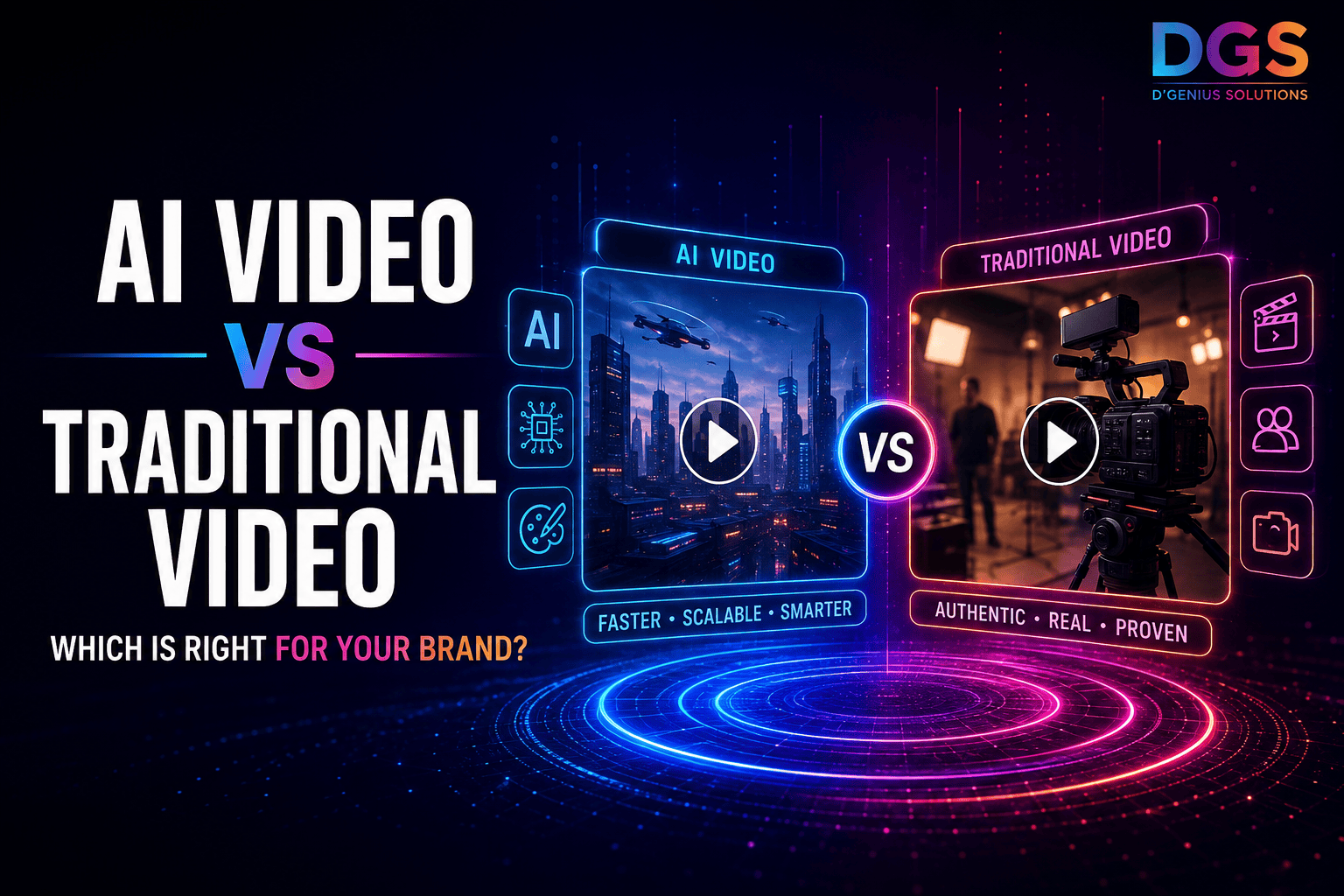
AI Video vs Traditional Video Production: Which Is Right for Your Brand?
In this article
- Quick Answer
- AI Video vs Traditional Video Production: Which Is Right for Your Brand?
- What Is AI Video Production?
- What Is Traditional Video Production?
- AI Video vs Traditional Video in One Comparison
- 1. Production Speed
- 2. Production Cost
- 3. Creative Freedom
- 4. Authenticity and Human Connection
- 5. Scalability for Marketing Campaigns
- 6. Brand Control and Consistency
- 7. Performance Across Search and Digital Platforms
- When Should Your Brand Choose AI Video?
- When Should Your Brand Choose Traditional Video?
- Is a Hybrid Production Model Better?
- How to Choose the Right Video Production Approach
- What is the main objective?
- Does the story require real people?
- How quickly is the content needed?
- How many versions will you need?
- How ambitious is the visual concept?
- Where will the video be published?
- How D'Genius Solutions Approaches AI Video Production
- AI Video vs Traditional Video Which One Wins?
- Frequently Asked Questions
- Is AI video cheaper than traditional video production?
- Is AI video production suitable for professional brands?
- Will AI replace traditional video production?
- What is the biggest advantage of AI video?
- Can AI and traditional video be used together?
- How do I decide between AI Video vs Traditional Video?
Quick Answer
AI Video vs Traditional Video comes down to what your brand needs to achieve. AI video production is usually better for faster content creation, frequent campaigns, creative experimentation, social media videos and scalable variations. Traditional video production remains valuable when real people, physical locations, live performances or highly controlled cinematography are essential. For many modern brands, the strongest approach is not choosing one permanently but using AI, traditional production or a hybrid workflow according to the campaign.
AI Video vs Traditional Video Production: Which Is Right for Your Brand?
AI Video vs Traditional Video has quickly become an important decision for marketing teams.
A few years ago, producing a professional brand video normally meant arranging a location, cameras, lighting, actors, production crews, makeup, travel, editing and multiple rounds of post-production.
That model still has an important place.
What has changed is that brands now have another option.
Modern AI video production can turn concepts, scripts, images, product ideas and campaign messages into professional visual content without requiring every scene to be physically filmed. This gives businesses more freedom to test ideas, create multiple versions and produce content for fast-moving digital channels.
But faster does not automatically mean better for every campaign.
The right choice depends on your objective, audience, creative direction, budget, timeline and how important real-world authenticity is to the story.
Here is how to make that decision.
What Is AI Video Production?
AI video production uses generative AI and AI-assisted creative tools during different stages of video creation.
Depending on the project, this can include concept visualisation, character creation, virtual environments, animation, image-to-video generation, voiceovers, scene generation, visual effects, editing assistance and content adaptation.
Instead of physically shooting every frame, brands can create some or all visual elements digitally.
For example, a jewellery brand could visualise a cinematic campaign in an environment that would be expensive to construct physically. An ecommerce company could create multiple product-focused video variations for different advertising audiences.
Businesses exploring this approach can view D'Genius Solutions’ AI video production services for campaigns, product videos, promotional content and digital creative production, alongside dedicated AI video services for Dubai brands.
AI does not eliminate creative direction. Strong results still depend on the concept, script, storytelling, brand understanding, art direction, editing and human judgement behind the technology.
What Is Traditional Video Production?
Traditional video production is built primarily around physical filming.
It can involve directors, cinematographers, actors, models, cameras, lighting teams, studios, physical locations, props, wardrobe, makeup, sound recording and post-production.
This approach is especially effective when the audience needs to see something genuinely happening.
Think about founder interviews, customer testimonials, manufacturing processes, hospitality experiences, events, real estate walkthroughs or campaigns where an actual human performance is central to the story.
Traditional production gives filmmakers direct control over physical performances, lenses, lighting, locations and interactions.
The trade-off is that changing something after the shoot can be more difficult.
If a scene needs to be recreated, the team may need the same location, talent, equipment and crew again.
AI Video vs Traditional Video in One Comparison
| Factor | AI Video Production | Traditional Video Production |
|---|---|---|
| Production speed | Usually faster | Usually requires more preparation |
| Physical shoot | Can be reduced or avoided | Usually required |
| Creative environments | Highly flexible | Depends on location, sets and VFX |
| Content variations | Easier to scale | Additional versions may require more production |
| Real human authenticity | Depends on the creative approach | Naturally strong |
| Location dependency | Low | Often high |
| Reshoots | Digital revisions may be possible | Can require another shoot |
| Social content scalability | Strong | Can become resource intensive |
| Cinematic realism | Improving rapidly | Strong with experienced production teams |
| Best use | Digital campaigns, concepts, ads and scalable content | Testimonials, real events and physical storytelling |
The important takeaway from AI Video vs Traditional Video is that neither method wins every category.
The production method should serve the campaign rather than forcing the campaign to fit the production method.
1. Production Speed
One of the biggest differences in AI Video vs Traditional Video is speed.
A traditional shoot may require pre-production meetings, scripts, storyboards, talent availability, location permissions, equipment bookings and shoot schedules before the editing process even begins.
AI workflows can reduce several of these dependencies.
A creative team may be able to explore visual directions before committing to a full campaign, generate alternative scenes or build campaign variations without organising another physical shoot.
That can be especially valuable for brands operating in fast-moving markets.
Social media trends, seasonal campaigns and digital advertising opportunities do not always wait for lengthy production schedules.
For brands producing content continuously, pairing video creation with a structured social media marketing strategy can help turn creative production into a more consistent publishing system.
2. Production Cost
Cost is another major consideration when comparing AI Video vs Traditional Video.
Traditional production costs can grow when a project requires multiple locations, large crews, specialised equipment, actors, travel, sets or several shoot days.
AI production can remove or reduce some of these requirements.
That does not mean AI video is automatically cheap.
High-quality AI work still requires professional concept development, prompting, visual direction, generation, compositing, editing, sound design, quality control and revisions.
The difference is where the production budget is being used.
Instead of spending heavily on physical production infrastructure, more resources can sometimes be directed toward creative experimentation and post-production.
For brands producing large numbers of digital assets, this can make AI video production particularly attractive.
3. Creative Freedom
Imagine your campaign needs a product floating above a futuristic city, a model walking through several impossible environments or an entire world that changes around the subject.
Traditional production could create those ideas using sets, green screens, CGI and visual effects.
But the production requirements may become substantial.
AI gives creative teams another way to visualise concepts that would previously have required significant physical or VFX resources.
This is one reason an experienced AI video production agency should not simply generate attractive clips.
The team needs to understand the brand first.
Typography, product appearance, visual language, pacing, colours, storytelling and campaign objective should remain consistent even when AI is doing part of the visual generation.
Creative freedom is useful only when it strengthens the brand message.
4. Authenticity and Human Connection
This is where traditional video production can still be the stronger choice.
If a CEO is explaining the company’s vision, a customer is describing their actual experience or a chef is demonstrating a real process, filming the real person can create a level of credibility that should not be replaced unnecessarily.
The same applies to real events.
If your campaign is about what happened at a launch, conference, store opening or customer experience, audiences may expect genuine footage.
AI should not be used simply because it is available.
A good video marketing strategy decides which moments benefit from AI and which moments should remain real.
That distinction can protect authenticity while still giving the brand access to newer creative possibilities.
5. Scalability for Marketing Campaigns
Modern marketing rarely needs only one video.
A campaign may require:
- One main brand film
- Short social media videos
- Vertical Reels
- Paid advertising creatives
- Product variations
- Regional campaigns
- Retargeting ads
- Website videos
- Multiple hooks
- Different campaign messages
Producing every variation traditionally can increase both time and cost.
This is where AI Video vs Traditional Video becomes particularly relevant for performance-focused campaigns.
AI can make it easier to create or adapt visual concepts for multiple audiences while maintaining the central campaign direction.
These assets can then support performance marketing campaigns where creative testing is important for identifying which messages and visuals generate stronger engagement and conversions.
6. Brand Control and Consistency
AI offers enormous creative flexibility, but uncontrolled generation can also produce inconsistent results.
A character may look slightly different between scenes. A product may lose an important detail. Lighting may change unexpectedly. Brand colours may drift.
Professional AI video production therefore requires quality control.
Every generated scene should be evaluated against the brand’s visual identity and campaign objective.
Traditional production has a different type of consistency challenge. Once a shoot is completed, the available footage determines what editors can build.
AI makes revisions more flexible in some situations, while traditional production provides stronger physical continuity when everything is properly controlled on set.
Neither workflow removes the need for an experienced creative team.
7. Performance Across Search and Digital Platforms
Your video should not stop working after it has been published.
A well-planned brand video production strategy should consider where the content will live and how audiences will discover it.
Videos can support landing pages, service pages, campaign pages, blogs, paid advertising and social media.
For website publishing, brands should also follow Google’s video SEO best practices so search engines can better understand and discover relevant video content.
When appropriate, Google’s VideoObject structured data guidance can also help website owners provide additional information about a video.
This matters because video production and search visibility should not exist in completely separate strategies.
D'Genius Solutions’ SEO services can support the search side of the ecosystem while video builds engagement and visual communication.
When Should Your Brand Choose AI Video?
AI may be the stronger choice when your brand needs frequent visual content, faster experimentation or concepts that are difficult to produce physically.
It works particularly well for:
- Social media campaigns
- Product visualisation
- Digital advertisements
- Concept films
- Promotional videos
- Explainer videos
- Motion-led storytelling
- Multiple campaign variations
- Short-form content
- Creative testing
- Visual environments that do not exist physically
An AI video production agency can be especially useful when your internal marketing team has plenty of ideas but does not have the production bandwidth to turn each concept into polished video content.
When Should Your Brand Choose Traditional Video?
Traditional production remains a strong choice when the subject itself needs to be genuinely captured.
Consider traditional production for:
- Founder interviews
- Customer testimonials
- Event coverage
- Factory or facility videos
- Real estate walkthroughs
- Hospitality experiences
- Documentary-style storytelling
- Employee stories
- Product demonstrations requiring real interaction
- Campaigns centred on real actors and performances
In these situations, the physical reality of the footage is part of the message.
That makes traditional video production strategically valuable rather than outdated.
Is a Hybrid Production Model Better?
For many brands, yes.
A hybrid approach combines real footage with AI-generated or AI-assisted production.
For example, a brand could film its founder or product traditionally and use AI for backgrounds, transitions, conceptual sequences, additional campaign assets or visual effects.
This approach preserves the human authenticity of the original footage while increasing creative flexibility.
It also changes the AI Video vs Traditional Video conversation.
Instead of asking which technology should replace the other, brands can ask a better question.
Which production method gives each part of this story the strongest result?
That is usually a more useful way to build a modern video marketing strategy.
How to Choose the Right Video Production Approach
Before deciding, answer these questions.
What is the main objective?
Brand awareness, engagement, product education, advertising and lead generation may require different production styles.
Does the story require real people?
If credibility depends heavily on seeing a genuine founder, customer, employee or environment, real footage may be important.
How quickly is the content needed?
Short campaign timelines can make AI production particularly valuable.
How many versions will you need?
If the campaign requires many creative variations, AI may provide greater scalability.
How ambitious is the visual concept?
Impossible environments and highly imaginative sequences can be strong candidates for AI.
Where will the video be published?
Social platforms, landing pages, search, ads and websites all require different formats and creative decisions.
Your website should also be capable of presenting video without creating a poor experience for users. Brands improving their digital infrastructure can explore DGS website development and AMC services for performance-focused websites.
How D'Genius Solutions Approaches AI Video Production
D'Genius Solutions approaches AI video production as creative production supported by technology rather than automated content generation without direction.
The process begins with the brand, audience and campaign objective.
From there, the creative direction can include concept development, scripting, visual planning, AI-generated scenes, animation, editing, sound, campaign adaptations and final optimisation.
Our AI video production agency works with businesses that want to create distinctive digital videos without being restricted by the logistics of conventional production for every concept.
The goal is not to use AI simply because it is new.
The goal is to use the production method that helps the idea communicate better.
That approach also aligns with Google’s broader guidance around creating helpful, reliable, people-first content. Technology can support the production process, but the finished content should still exist because it genuinely serves the intended audience.
AI Video vs Traditional Video Which One Wins?
There is no universal winner in AI Video vs Traditional Video.
AI wins when speed, scalability, experimentation and imaginative visual production matter most.
Traditional production wins when physical authenticity, real performances and genuine environments are central to the story.
Hybrid production can deliver the best balance when a campaign needs both.
The smartest brands will not choose a production method because it is fashionable. They will choose it because it solves the creative and commercial problem in front of them.
If your brand needs frequent campaign content, product visuals, social media videos, advertising creatives or ambitious concepts without the limitations of a conventional shoot, professional brand video production powered by AI may open up significantly more possibilities.
Explore D'Genius Solutions’ AI video production services to build videos around your brand, campaign and marketing objectives.
Frequently Asked Questions
Is AI video cheaper than traditional video production?
AI video can reduce expenses connected with physical locations, equipment, travel, sets and large crews. However, professional AI content still requires creative direction, generation, editing and quality control. The final cost depends on the complexity and number of assets required.
Is AI video production suitable for professional brands?
Yes. Professional AI video production can be used for brand campaigns, product content, advertisements, social media videos and conceptual films. Strong art direction and human quality control are important for maintaining brand consistency.
Will AI replace traditional video production?
AI is more likely to expand the available production options than eliminate conventional filmmaking entirely. Real interviews, events, human performances and physical environments continue to make traditional video production valuable.
What is the biggest advantage of AI video?
Speed and creative scalability are major advantages. Brands can explore more visual ideas and create additional campaign variations without recreating every scene through a physical shoot.
Can AI and traditional video be used together?
Yes. Hybrid workflows can combine real footage with AI-generated environments, visual effects, animations or additional creative sequences. This is often one of the most practical approaches for modern brand video production.
How do I decide between AI Video vs Traditional Video?
Start with your campaign objective. Choose AI when speed, scalability and imaginative visuals are priorities. Choose traditional production when real-world authenticity is essential. Use both when the campaign benefits from genuine footage combined with greater digital creative freedom.
Accelerate Your Digital & Search Growth
Speak directly with our Mumbai-based SEO, AI search, and digital marketing strategists for a bespoke growth audit.
Get a Free Strategy AuditRelated Insights
How Much Does AI Video Production Cost in India in 2026? - D'Genius Solutions
AI video production costAI video production cost in India in 2026 depends on the type of video, creative complexity, duration, number of scenes, AI models
11 Ways AI Video Production for Business Helps Create More Content Faster
Learn how AI video production for business helps brands create more content faster, reduce costs, improve marketing, and scale content creation across digital platforms.
AI Search Optimization for E-commerce Brands: 9 Proven Strategies for 2026 - D'Genius Solutions
AI Search Optimization for E-commerce Brands helps online stores appear in Google and AI recommendations. Discover 9 proven strategies for 2026.