AI Search Optimization for E-commerce Brands: 9 Proven Strategies for 2026
In this article
- What Is AI Search Optimization for E-commerce Brands?
- Why AI Search Optimization for E-commerce Brands Matters
- 1. Research Conversational Product Searches
- 2. Create Complete and Original Product Pages
- 3. Add Product Structured Data
- 4. Maintain Accurate Google Merchant Center Data
- 5. Improve E-commerce Category Pages
- 6. Publish Buying Guides and Product Comparisons
- 7. Build Strong Brand and Trust Signals
- 8. Improve Technical SEO and Website Development
- 9. Combine GEO With E-commerce SEO
- How to Measure AI Search Optimization for E-commerce Brands
- Common AI Search Optimisation Mistakes
- Final Thoughts
- Frequently Asked Questions
- What is AI Search Optimization for E-commerce Brands?
- Is GEO different from e-commerce SEO?
- Does product schema guarantee AI recommendations?
- How can an online store improve its AI search visibility?
- How long does AI search optimisation take?
AI Search Optimization for E-commerce Brands is becoming essential as customers increasingly use Google AI Overviews, AI Mode, Gemini, ChatGPT and other AI tools to discover, compare and evaluate products.
A customer may no longer search only for “best running shoes.” They may ask:
Which lightweight running shoes are suitable for beginners with flat feet and cost less than ₹5,000?
AI-powered search experiences can review information from multiple sources and provide a direct response. They may compare product features, prices, reviews, brands and suitability before the customer visits a website.
For e-commerce companies, this creates a new visibility challenge. Product pages must rank in traditional search while also providing clear, accurate and trustworthy information that AI systems can understand.
Google states that its established SEO best practices remain relevant for generative AI features because AI Overviews and AI Mode rely on its existing search ranking and quality systems. Pages must also be indexed and eligible to appear with a search snippet before they can be considered for these experiences.
This guide explains how online retailers can combine SEO, GEO, structured data, product information and website development to improve their visibility across traditional and AI-powered search.
What Is AI Search Optimization for E-commerce Brands?
AI Search Optimization for E-commerce Brands is the process of making an online store and its product information easier for search engines and AI systems to discover, understand, compare and recommend.
It combines traditional e-commerce SEO with Generative Engine Optimization, also known as GEO.
Traditional SEO helps product and category pages rank for relevant searches. GEO focuses on making information clear enough to be extracted, summarised and included in AI-generated answers.
A complete strategy helps search systems understand:
- What the product is
- Who the product is suitable for
- Which problem it solves
- What features make it different
- How much it costs
- Whether it is available
- What sizes, colours or variants exist
- How shipping and returns work
- Why customers can trust the seller
A successful AI Search Optimization for E-commerce Brands strategy does not replace SEO. It builds on technical SEO, useful content, accurate product data, brand authority and a properly developed website.
Why AI Search Optimization for E-commerce Brands Matters
Customers are using longer and more conversational searches when researching products.
Traditional search:
Best office chair
AI-style search:
Which ergonomic office chair is best for working eight hours a day in a small home office?
The second query gives the AI system more context. It includes the product type, use case, working duration and environment.
To answer accurately, the system needs detailed information about:
- Ergonomic support
- Chair dimensions
- Recommended usage duration
- Weight capacity
- Materials
- Adjustability
- Customer reviews
- Price and availability
A thin product page with a title, image, and two-line description may not provide enough information.
AI search optimization for e-commerce Brands helps businesses create complete pages that answer real buying questions and support better product discovery.
1. Research Conversational Product Searches
Keyword research remains important, but e-commerce brands should go beyond short product phrases.
Instead of targeting only:
- Men’s running shoes
- Organic skincare
- Wireless headphones
- Office chairs
Research detailed queries such as:
- Best men’s running shoes for flat feet
- Organic face cream for sensitive skin
- Wireless headphones for office calls
- Ergonomic office chair for small spaces
- Affordable silver jewellery for daily wear
These searches reveal the buyer’s needs, budget, concerns and intended use.
Useful sources for conversational research include:
- Google Search Console queries
- Website search data
- Product reviews
- Sales-team questions
- Customer-support conversations
- Competitor FAQs
- Marketplace reviews
- Social-media comments
Group these questions by customer journey stage:
Awareness: What type of product do I need?
Consideration: Which option is better?
Decision: Is this product suitable for me?
Post-purchase: How do I use or maintain it?
This research creates a stronger foundation for AI search optimization for e-commerce Brands because it reflects how real customers ask for recommendations.
2. Create Complete and Original Product Pages
Product pages are the most important assets on an e-commerce website.
Each major product page should provide enough information for a customer to make an informed decision without searching multiple websites.
Include:
- Clear product name
- Original product description
- Key features
- Practical benefits
- Materials or ingredients
- Dimensions and weight
- Available sizes and colours
- Suitable use cases
- Usage instructions
- Product limitations
- Care information
- Price
- Stock status
- Shipping details
- Return policy
- Customer reviews
- Product FAQs
Avoid copying the manufacturer’s standard description. The same content may already exist on several competing websites.
Add information based on your own experience with the product. Explain how it performs, who it suits and when another option may be more appropriate.
For example, do not write only:
This laptop has a 60 Wh battery.
Explain the practical benefit:
The 60 Wh battery is designed to support extended work sessions, although actual usage depends on screen brightness, applications and connectivity.
Product-page quality is a central part of AI Search Optimization for E-commerce Brands because AI systems need useful context rather than promotional claims.
3. Add Product Structured Data
Product structured data gives Google machine-readable information about products and offers.
Relevant properties can include:
- Product name
- Description
- Brand
- Image
- SKU
- GTIN
- Price
- Currency
- Availability
- Product condition
- Aggregate rating
- Reviews
- Shipping information
- Return policy
Google explains that Product structured data can help product information become eligible for enhanced search appearances containing details such as price, ratings and availability.
Structured data supports AI Search Optimization for E-commerce Brands by making important product attributes easier to interpret.
However, schema markup must match the information visible on the page.
Do not add:
- Fake ratings
- Hidden reviews
- Incorrect prices
- Outdated availability
- Unsupported claims
Use JSON-LD where suitable and test the markup with Google’s Rich Results Test. Google recommends JSON-LD and requires structured-data pages to remain accessible to Googlebot.
For products with multiple sizes, colours or materials, use the appropriate product-variant structure. Google supports ProductGroup and Product markup for eligible product variants.
4. Maintain Accurate Google Merchant Center Data
Google Merchant Center gives Google another structured source of information about an e-commerce catalogue.
Ensure the following details remain accurate:
- Product title
- Product description
- Product URL
- Image URL
- Price
- Sale price
- Availability
- Brand
- GTIN or MPN
- Condition
- Colour
- Size
- Shipping details
The product feed and landing page must show consistent information.
For example, avoid situations where:
- The feed shows ₹2,999 but the page shows ₹3,499
- The feed says “in stock” but the product is unavailable
- The feed uses one product title while the landing page describes another item
Google states that accurate and correctly formatted product data helps match products with relevant searches. Missing or incorrect information can result in reduced eligibility, incorrect displays or product disapprovals.
Google’s 2026 Merchant Center product-data update also confirms that product-data requirements continue to evolve, making regular feed reviews important.
Accurate Merchant Center data strengthens AI Search Optimization for E-commerce Brands by improving product consistency across Google’s shopping and search systems.
5. Improve E-commerce Category Pages
Many category pages contain only a heading, filters and a product grid.
While this may help customers browse, it gives search systems limited information about the category.
Add useful category-level content covering:
- What products are included
- Who the category is designed for
- Important features to compare
- Available materials or variations
- Price ranges
- Common buying concerns
- Links to relevant guides
For example, an office-chair category page could explain:
- Ergonomic versus standard chairs
- Lumbar-support options
- Recommended seat dimensions
- Mesh versus fabric materials
- Suitability for long working hours
- Weight limits
- Space requirements
Keep the content concise and relevant. Avoid placing a large block of repetitive keywords below the product grid.
Well-developed category pages improve AI Search Optimization for E-commerce Brands by giving product collections clearer meaning and context.
6. Publish Buying Guides and Product Comparisons
AI users frequently ask comparison-based questions.
Examples include:
- Which air purifier is best for a small bedroom?
- Is Product A better than Product B?
- Which skincare ingredient is suitable for dry skin?
- What size television is right for a ten-foot viewing distance?
Create content that answers these questions honestly.
Useful formats include:
- Product A versus Product B
- Best products for a specific use
- Beginner buying guides
- Size-selection guides
- Material comparisons
- Gift guides
- Product-care guides
- Product compatibility guides
- Common buying mistakes
- How to select the right product
A comparison page should explain:
- Main differences
- Shared features
- Benefits of each option
- Possible limitations
- Best use case for each product
- Which buyer may prefer each option
Avoid describing every product as the best.
Balanced information can improve customer trust and make the page more useful for recommendation-style searches.
Buying guides are a major component of AI Search Optimization for E-commerce Brands because they provide the explanatory context required for detailed AI-generated answers.
7. Build Strong Brand and Trust Signals
AI search visibility is not based only on product information. Search systems also need to understand the business selling the products.
Your website should clearly display:
- Company name
- Business history
- Founder or leadership information
- Physical or registered location
- Customer-support information
- Contact details
- Shipping policies
- Return and refund policies
- Privacy policy
- Terms and conditions
- Product expertise
- Certifications
- Editorial contributors
Your About page should explain what the brand does, who it serves and why it is qualified to sell or discuss its products.
Add genuine customer reviews and respond to common concerns transparently.
Google’s e-commerce guidance recommends making shipping, return and customer-support information clear to improve customer trust.
Consistent mentions on relevant third-party websites can also help clarify the brand’s identity and reputation.
Strong trust signals support AI Search Optimization for E-commerce Brands because AI-generated recommendations should rely on sources that appear credible and transparent.
8. Improve Technical SEO and Website Development
Even excellent content may not perform if the website is difficult to crawl, render or use.
Technical priorities include:
- Mobile-friendly design
- Fast loading speed
- Secure HTTPS
- Logical site architecture
- Crawlable product links
- Accurate XML sitemap
- Correct canonical tags
- Valid redirects
- Proper pagination
- Controlled filter URLs
- Indexable product descriptions
- Descriptive image alt text
- Clean JavaScript rendering
- No broken links
- Accessible navigation
- Optimised Core Web Vitals
Google states that technically clear site structures remain important for generative AI search. Pages must meet Search technical requirements and be indexed to become eligible for AI features.
E-commerce websites must also manage filters carefully. Colour, price, size and brand filters can create thousands of low-value URLs when they are not controlled correctly.
Professional website development services can help businesses create fast, crawlable and conversion-focused e-commerce websites.
A technically strong website is essential for AI Search Optimization for E-commerce Brands because search systems cannot recommend content they cannot reliably access or understand.
9. Combine GEO With E-commerce SEO
GEO and SEO should work together.
Traditional e-commerce SEO improves:
- Organic rankings
- Crawling and indexing
- Keyword relevance
- Internal linking
- Category-page visibility
- Product-page performance
- Website authority
Generative Engine Optimization improves:
- Entity clarity
- Answer-focused content
- Product context
- Comparison information
- Machine readability
- Brand consistency
- AI citation potential
Google’s current guidance says that optimising for generative AI search remains part of SEO because its AI features use existing ranking and quality systems.
The strongest AI Search Optimization for E-commerce Brands strategy therefore combines:
- Technical SEO
- Product schema
- Helpful content
- Merchant Center optimisation
- Brand authority
- GEO
- Website development
- Conversion optimisation
D'Genius Solutions provides professional GEO services to help businesses structure content and brand information for AI-led search experiences.
Our SEO services in Mumbai help e-commerce brands improve crawling, rankings, product visibility and organic traffic.
E-commerce brands should follow Google’s guide to generative AI search optimization to understand how technical SEO, useful content and product information support visibility in AI Overviews and AI Mode.
How to Measure AI Search Optimization for E-commerce Brands
Do not measure AI visibility through one ranking or one manually tested prompt.
Track multiple indicators:
- Product-page impressions
- Category-page impressions
- Non-branded clicks
- Long-tail query growth
- Brand searches
- Product rich-result performance
- Merchant Center visibility
- AI-platform referral traffic
- Assisted conversions
- Organic revenue
- New referring domains
- Brand mentions
- Conversion rate by landing page
Google reports visits from its generative AI search features within the overall Web search type in Search Console. Businesses should examine queries, landing pages and conversions rather than expecting a separate position report for every AI-generated response.
Also test a controlled group of relevant AI prompts each month.
For example:
- Best product for a specific use
- Product A versus Product B
- Best affordable brands in a category
- Which product is suitable for a particular customer
- Where to buy a product in a certain location
Document whether the brand is mentioned, cited or recommended. Because AI answers can vary by wording, platform, location and time, focus on trends rather than isolated results.
Measuring AI Search Optimization for E-commerce Brands requires combining visibility, traffic, engagement and revenue data.
Common AI Search Optimisation Mistakes
Avoid the following mistakes:
- Copying manufacturer descriptions
- Publishing thin category pages
- Creating repetitive AI-written content
- Adding fake reviews
- Using incorrect schema information
- Hiding marked-up information from customers
- Allowing prices and availability to become outdated
- Blocking important pages from crawlers
- Ignoring Merchant Center errors
- Creating thousands of filter URLs
- Using unsupported product claims
- Focusing only on exact-match keywords
- Expecting one technical file to guarantee AI visibility
Google advises website owners to focus on useful, original and non-commodity content rather than creating content primarily to influence generative systems.
No optimisation method can guarantee inclusion in an AI answer. The goal is to make the website more useful, trustworthy and technically eligible.
Final Thoughts
AI Search Optimization for E-commerce Brands is not about manipulating AI tools. It is about providing complete, accurate and helpful information that customers and search systems can understand.
Begin with strong product pages, category content, structured data, accurate Merchant Center feeds and a technically reliable website.
Then create buying guides, comparison pages and customer-focused answers that reflect how people naturally research products.
The most effective AI Search Optimization for E-commerce Brands approach combines GEO, SEO and website development instead of treating them as separate activities.
D'Genius Solutions helps online retailers improve visibility through GEO services, SEO services and website development services.
Businesses that invest in AI Search Optimization for E-commerce Brands can build stronger visibility across traditional Google results, AI-powered search experiences and conversational product discovery.
Frequently Asked Questions
What is AI Search Optimization for E-commerce Brands?
AI Search Optimization for E-commerce Brands is the process of improving product content, technical SEO, structured data and brand information so search engines and AI systems can understand, compare and potentially recommend an online store’s products.
Is GEO different from e-commerce SEO?
Yes, but they work together. E-commerce SEO focuses on crawling, indexing, rankings and traffic. GEO focuses on making information clear, structured and useful for generative AI answers and recommendations.
Does product schema guarantee AI recommendations?
No. Product schema improves machine understanding and rich-result eligibility, but it cannot guarantee rankings or AI recommendations. Page quality, relevance, authority and technical accessibility also matter.
How can an online store improve its AI search visibility?
Create original product pages, publish buying guides, use accurate structured data, maintain Merchant Center feeds, improve website performance and build clear brand-trust signals.
How long does AI search optimisation take?
The timeline depends on the website’s technical condition, product catalogue, competition, content quality and existing authority. Technical changes may be processed relatively quickly, but sustainable visibility usually requires ongoing work.
Accelerate Your Digital & Search Growth
Speak directly with our Mumbai-based SEO, AI search, and digital marketing strategists for a bespoke growth audit.
Get a Free Strategy AuditRelated Insights
AI-Generated Summaries in Search Ads: What This Means for Advertisers - D'Genius Solutions
Learn how AI-generated summaries in search ads can affect Google Ads, PPC strategy, landing pages, CTR, SEO, brand control, and AI search visibility.
LLM SEO: 9 Smart Ways to Prepare Your Website for AI Tools and Large Language Models - D'Genius Solutions
LLM SEO is becoming important for businesses that want visibility on Google, AI search tools and large language models like ChatGPT, Gemini, Perplexity and
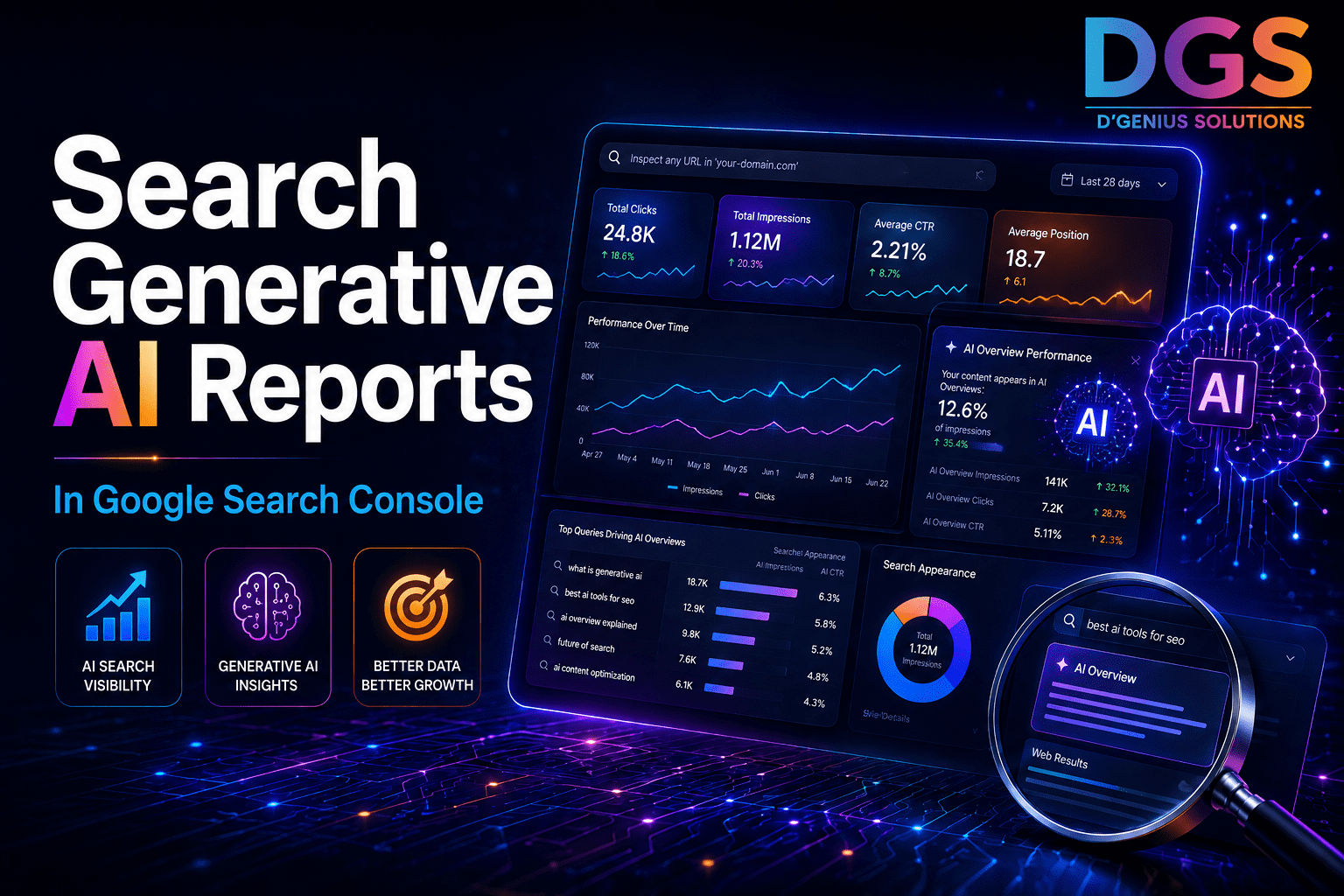
Google Launches Search Generative AI Performance Reports in Search Console: What It Means for SEO, GEO and AI Visibility - D'Genius Solutions
Google has introduced a major new update for website owners, SEO teams, publishers, and digital marketers: dedicated Search Generative AI performance reports