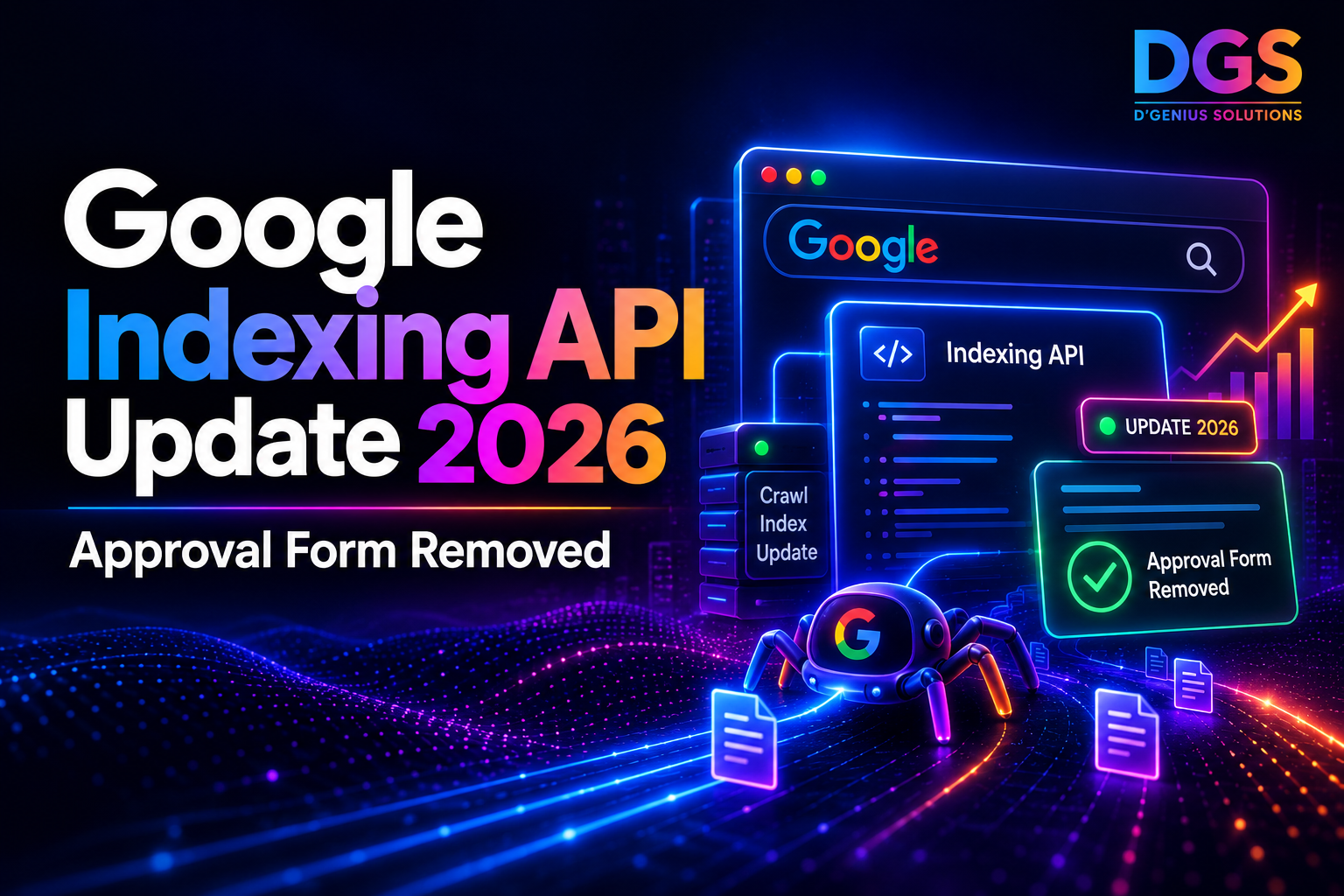
Google Indexing API Update 2026: Approval Form Removed — What It Means for SEO
In this article
- Quick Answer
- Why This Update Is Getting Attention
- What Is the Google Indexing API?
- What Changed on October 16, 2026?
- Google Indexing API Quota Limits in 2026
- Can Blogs, Product Pages and Service Pages Use This API?
- What This Means for SEO Teams and Website Owners
- 1. Indexing is not ranking
- 2. Job portals need a clear URL lifecycle
- 3. Ordinary business websites should diagnose the root cause
- Google Indexing API vs XML Sitemaps vs Search Console
- How to Improve Google Indexing Without Shortcuts
- Audit your XML sitemap
- Review Search Console indexing reports
- Strengthen contextual internal links
- Give each page a distinct reason to exist
- Fix crawl and rendering barriers
- Measure outcomes rather than notifications
- Does the Update Affect AEO, GEO or Google AI Overviews?
- How D’Genius Solutions Helps Businesses Improve Organic Visibility
- Frequently Asked Questions
- 1. Has Google removed Indexing API approval in 2026?
- 2. Can I use the Indexing API for regular blog posts?
- 3. What is the daily quota for the Indexing API?
- 4. Does a successful API request mean my page is indexed?
- 5. Is Google’s Indexing API free?
- 6. What should I do when important website pages are not indexed?
Google Indexing API Update 2026: Approval Form Removed — What It Means for SEO
Google has quietly changed its Indexing API documentation. For developers and SEO teams, the disappearance of an approval form raises fresh questions—but it does not mean every website can now request instant indexing.
Quick Answer
On October 16, 2026, Google removed the Indexing API approval form and related application instructions from its documentation. Google has not confirmed that the approval requirement itself has ended. The API remains limited to eligible JobPosting pages and livestream pages with BroadcastEvent markup within VideoObject. Default quotas, including 200 publish requests per project per day, remain in place.
For most business websites, the practical advice is unchanged: make pages crawlable, maintain a clean XML sitemap, strengthen internal links and use Google Search Console to diagnose indexing issues.
Why This Update Is Getting Attention
Imagine launching an important page and finding that Google still has not indexed it days later. This is a familiar frustration for publishers, marketers and site owners. The Indexing API sounds like the perfect solution because it allows certain site owners to notify Google directly when content changes. But there is an important distinction between notifying Google and securing a place in search results.
Search Engine Journal reported on October 17 that Google had removed the approval request form and instructions from several Indexing API documentation pages. The change followed earlier reports of job board operators waiting for responses to approval requests. The revised documentation, however, offers no clear replacement procedure for requesting higher quotas.
What Is the Google Indexing API?
Google’s Indexing API is a notification tool for specific types of time-sensitive pages. It allows developers to signal when an eligible URL has been added, updated or removed. This is particularly useful for job listings that may close quickly and livestream events that have a short window of relevance.
The API supports URL_UPDATED notifications for new or changed eligible pages, URL_DELETED notifications for removed or non-indexable eligible pages, and metadata requests that report previous notifications. These actions do not guarantee that Google will crawl or index a page.
What Changed on October 16, 2026?
Documentation item | What changed |
|---|---|
Approval form | The former request form was removed from the documentation. |
Approval setup steps | Instructions to request approval and quota were removed. |
Testing language | References describing default quotas as being for initial testing were removed. |
Default limits | The documented daily and per-minute quotas remain unchanged. |
Eligibility | The API is still restricted to supported job and livestream pages. |
The central unanswered question is whether Google has changed its approval policy or simply retired an outdated application path. Its published changelog mentions removal of an outdated form; it does not establish that any website can use the API without restrictions.
Google Indexing API Quota Limits in 2026
Quota | Default limit |
|---|---|
Publish requests per project per day | 200 |
Read-only metadata requests per project per minute | 180 |
Requests across all endpoints per project per minute | 380 |
Both URL_UPDATED and URL_DELETED requests count toward the daily publish limit, which resets at midnight Pacific Time. A batch of 10 URL notifications still counts as 10 requests; batching does not create extra quota. Google lists API use as free of charge, and developers can inspect project quotas in Google API Console.
Can Blogs, Product Pages and Service Pages Use This API?
Not under Google’s documented eligibility rules. Removing an approval form does not extend the Indexing API to ordinary blog posts, e-commerce products, real estate listings or agency service pages. Some plugins advertise rapid indexing for wider content types, but plugin support is not the same as official Google eligibility.
Page type | Supported under current guidance? |
|---|---|
Eligible job listing with JobPosting markup | Yes |
Eligible livestream with BroadcastEvent in VideoObject | Yes |
Standard blog article | No |
Service or location page | No |
E-commerce product page | No |
General landing page | No |
Google also prohibits attempts to bypass submission limits, including using multiple accounts. Businesses should not base an indexing strategy on unsupported API submissions or promises of guaranteed indexing.
What This Means for SEO Teams and Website Owners
1. Indexing is not ranking
An indexed page becomes eligible to appear in search results, but it does not automatically rank for relevant keywords. Search performance still depends on usefulness, relevance, technical health, competition and many other signals. An HTTP 200 API response merely indicates Google accepted a notification; it does not confirm indexing.
2. Job portals need a clear URL lifecycle
A recruitment website should notify Google when eligible jobs go live or change, and handle expired positions accurately. If requesting removal, the relevant page must first return a 404 or 410 response or carry a noindex directive, as specified by Google’s API instructions. Structured data, working URLs and a full-site sitemap remain important.
3. Ordinary business websites should diagnose the root cause
If service pages remain “Crawled – currently not indexed,” submitting more requests is unlikely to solve the problem. Investigate duplicate or thin content, poor internal linking, conflicting canonicals, accidental noindex directives, blocked resources and server issues. Each exclusion pattern requires its own diagnosis.
Google Indexing API vs XML Sitemaps vs Search Console
Tool | Best use | Indexing guaranteed? |
|---|---|---|
Indexing API | Notify Google of supported job/livestream URL changes | No |
XML sitemap | Help Google discover canonical URLs throughout a website | No |
URL Inspection | Inspect an individual page and request indexing when appropriate | No |
For most sites, sitemaps and strong internal navigation are the normal foundation. Search Console provides diagnostics. The Indexing API is a specialized addition for eligible content, not a substitute for either.
How to Improve Google Indexing Without Shortcuts
Audit your XML sitemap
Include only important canonical URLs that return the expected status. Remove broken, redirected and non-indexable entries. Keep your sitemap updated as pages change.
Review Search Console indexing reports
Separate “Discovered – currently not indexed” from “Crawled – currently not indexed,” duplicate canonical issues, noindex exclusions and robots.txt blocks. The correct solution depends on the cause.
Strengthen contextual internal links
Connect supporting articles to their relevant service, category and pillar pages. Use descriptive anchor text that helps visitors understand the destination.
Give each page a distinct reason to exist
Avoid producing dozens of near-identical pages for minor keyword variations. Add first-hand information, useful comparisons, clear answers and relevant detail.
Fix crawl and rendering barriers
Review response codes, canonical tags, JavaScript rendering, redirect chains, mobile usability and server availability. Important content should be readily accessible.
Measure outcomes rather than notifications
Track index coverage, organic impressions, clicks and conversions. Successful submission is an operational signal, not a business result.
Does the Update Affect AEO, GEO or Google AI Overviews?
Google has not announced any direct change to AI Overview selection or generative search rankings as part of this documentation revision. The Indexing API concerns notification of eligible URLs, not a new AI ranking factor. Nonetheless, content that is crawlable, well structured and genuinely useful supports a broader search strategy.
SEO helps users discover a website through organic search. Answer Engine Optimisation (AEO) encourages clear, question-led explanations. Generative Engine Optimisation (GEO) focuses on making a brand’s information easier to understand and reference in AI-powered discovery. None of these disciplines turns the Indexing API into a universal shortcut.
How D’Genius Solutions Helps Businesses Improve Organic Visibility
At D’Genius Solutions, we focus on finding the actual barriers to discoverability: technical crawl issues, weak site architecture, thin content, incomplete structured data and missed search intent. Our work connects technical improvements with content quality and measurable business outcomes.
Explore our SEO services in Mumbai, GEO services and website development and maintenance services to build a stronger search foundation.
Frequently Asked Questions
1. Has Google removed Indexing API approval in 2026?
Google removed the approval form and instructions, but has not clearly stated that the approval requirement has ended. The higher-quota request process is also not clearly documented.
2. Can I use the Indexing API for regular blog posts?
No. The officially documented API remains limited to eligible JobPosting pages and livestream pages with BroadcastEvent embedded in VideoObject.
3. What is the daily quota for the Indexing API?
Google lists 200 publish requests per project per day by default. Updates and removals both count toward that limit.
4. Does a successful API request mean my page is indexed?
No. A successful response confirms receipt of the notification. Google still decides whether and when to crawl, index or remove the URL.
5. Is Google’s Indexing API free?
Yes. Google states that use of the Indexing API is available without payment, subject to its rules and quotas.
6. What should I do when important website pages are not indexed?
Inspect the URL in Search Console, check crawlability, canonical tags, sitemap inclusion, internal links and page quality, then address the cause rather than relying on unsupported submission methods.
Accelerate Your Digital & Search Growth
Speak directly with our Mumbai-based SEO, AI search, and digital marketing strategists for a bespoke growth audit.
Get a Free Strategy AuditRelated Insights
AEO in 2026 How to Rank on ChatGPT and Perplexity - D'Genius Solutions
AEO in 2026 is becoming an important part of search marketing as people increasingly use ChatGPT, Perplexity and other AI-powered platforms to research companies.
Google Ads AI Max 2026 What Advertisers Need to Know Before the September Changes - D'Genius Solutions
Google Ads AI Max 2026 is changing how advertisers manage Search campaigns, targeting, advertising assets and landing pages.
7 Proven Tips to Hire an SEO Agency in Mumbai - D'Genius Solutions
Choosing the right SEO Company in Mumbai can directly affect your website visibility, lead generation and long-term digital growth. Here are 7 proven tips.