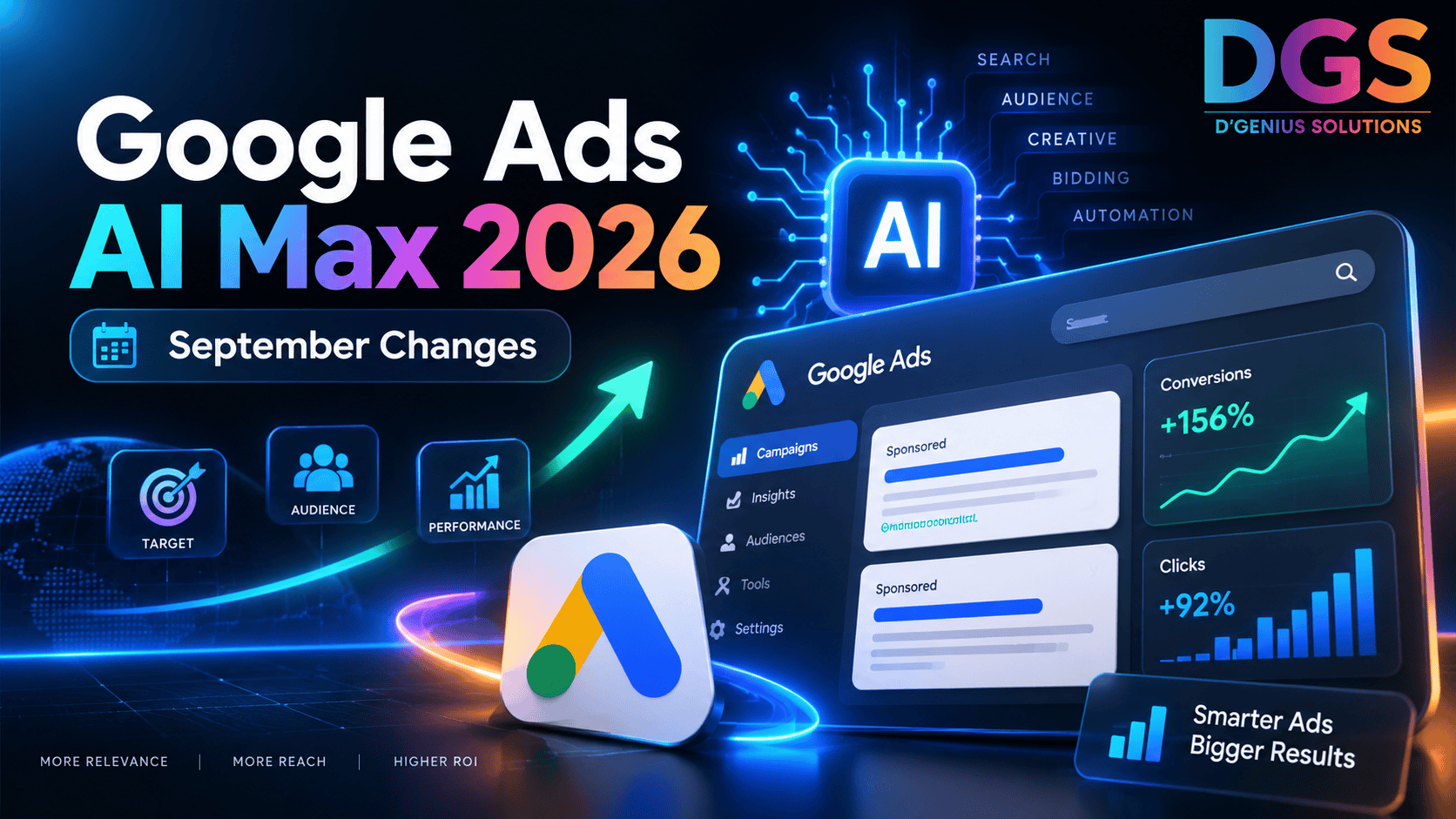
Google Ads AI Max 2026 What Advertisers Need to Know Before the September Changes
In this article
- Quick Answer
- What Is Google Ads AI Max 2026?
- 1. Google Ads AI Max 2026 Expands Search Term Matching
- 2. Keywords Still Matter in Google Ads AI Max
- 3. AI Max Introduces Greater Text Customization
- 4. Final URL Expansion Makes Website Quality More Important
- 5. AI Max Gives Advertisers More Automation but Not Zero Control
- 6. Conversion Tracking Becomes Even More Important
- 7. AI Max Reporting Needs Active Monitoring
- Google Ads AI Max 2026 and SEO Are Becoming More Connected
- AI Max vs Performance Max
- What Advertisers Should Check Before the September Changes
- Review Conversion Tracking
- Audit Search Terms
- Review Landing Pages
- Review Negative Keywords
- Check URL Controls
- Review Automatically Generated Assets
- Track Lead Quality
- Does Google Ads AI Max Replace PPC Specialists?
- Is Google Ads AI Max 2026 Worth Using?
- Final Thoughts
- Frequently Asked Questions
- What is Google Ads AI Max 2026?
- Is AI Max a separate Google Ads campaign type?
- Does Google Ads AI Max replace keywords?
- Why is landing-page quality important for AI Max?
- Should advertisers enable AI Max immediately?
Google Ads AI Max 2026 is changing how advertisers manage Search campaigns, targeting, advertising assets and landing pages.
Instead of depending only on manually selected keywords and fixed landing pages, Google is giving its AI more freedom to understand search intent, expand relevant reach, customise advertising messages and select suitable pages from an advertiser’s website.
For businesses already investing in Performance Marketing, this change is important because campaign performance will increasingly depend on the quality of conversion data, landing pages and business signals provided to Google’s advertising systems.
The September 2026 transition also means advertisers should understand what AI Max changes before allowing more automation into high-spend Search campaigns.
Quick Answer
Google Ads AI Max 2026 is an AI-powered optimisation layer for existing Google Search campaigns.
It combines features such as search term matching, text customization, AI-powered asset optimisation, URL controls and landing-page expansion.
From September 2026, eligible Search campaigns using certain existing automated features can begin moving into the AI Max framework.
AI Max does not replace Search campaigns. Instead, it adds a broader AI optimisation layer within them.
Google’s technical documentation also confirms that AI Max can expand reach, tailor creatives and optimise landing-page selection while still allowing advertisers to apply additional controls through campaign and ad-group settings.
What Is Google Ads AI Max 2026?
Google Ads AI Max 2026 is a collection of AI-powered capabilities designed specifically for Search campaigns.
It is not a separate campaign type.
Advertisers can continue running traditional Google Search campaigns while enabling Google’s AI to perform more optimisation across targeting, creative selection and landing-page relevance.
According to Google for Developers, AI Max can help advertisers expand reach, customise creative messaging, optimise landing pages and improve reporting within existing Search campaigns.
The major capabilities include:
- Search term matching
- Text customization
- Asset optimisation
- Final URL expansion
- URL inclusions and exclusions
- Brand controls
- Additional search-term reporting
This makes AI Max one of Google’s most important Search advertising changes in 2026.
1. Google Ads AI Max 2026 Expands Search Term Matching
Traditional Search advertising has always depended heavily on keywords.
Advertisers create keyword lists, choose match types and allow Google to decide which eligible searches should trigger their ads.
AI Max expands this process.
Google can use broader information from:
- Existing keywords
- Advertisement assets
- Landing-page content
- Search intent
- Campaign context
This allows Search campaigns to identify relevant queries that may not exist inside a manually built keyword list.
For example, a business may offer PPC management but users might search for:
- Google Ads agency
- Paid search management
- PPC campaign optimisation
- Lead generation using Google Ads
- Search advertising services
An advertiser may not manually include every possible variation.
AI Max can help identify additional intent patterns.
This is particularly relevant for agencies and companies operating Performance Marketing campaigns where capturing high-intent searches can directly influence lead generation and acquisition costs.
2. Keywords Still Matter in Google Ads AI Max
One misconception about Google Ads AI Max 2026 is that keywords are becoming irrelevant.
That is not accurate.
Keywords continue to provide important campaign signals.
What is changing is the expectation that advertisers need to manually predict every possible search query.
A useful way to think about AI Max is:
Keywords define direction. AI discovers additional opportunities. Conversion data helps determine which opportunities are valuable.
This makes good campaign architecture more important rather than less important.
Advertisers still need to understand:
- Search intent
- Commercial keywords
- Negative keywords
- Campaign segmentation
- Search-term quality
- Conversion value
The businesses that benefit most from AI-powered targeting will likely be those that already have strong account structure and reliable conversion data.
3. AI Max Introduces Greater Text Customization
Another major element of Google Ads AI Max 2026 is text customization.
Google’s systems can use information from an advertiser’s website, landing pages, existing assets and campaign context to generate or customise Search ad messaging.
This can help advertisements better match individual search intent.
For example, a digital agency may provide several services.
Someone searching specifically for paid media management should ideally see messaging relevant to PPC and paid advertising rather than a generic digital marketing message.
AI Max can potentially make that level of relevance easier to achieve at scale.
However, advertisers should continue reviewing AI-generated text carefully.
Generated advertising content should always be checked for:
- Incorrect claims
- Outdated offers
- Unsupported promises
- Brand inconsistencies
- Compliance issues
- Incorrect service descriptions
AI automation does not remove advertiser responsibility.
4. Final URL Expansion Makes Website Quality More Important
Another important Google Ads AI Max 2026 capability is Final URL Expansion.
Traditionally, advertisers choose a specific landing page for an ad.
With AI Max, Google may identify another relevant URL within the same website when its systems believe that page is more aligned with the user’s search.
Consider a business with pages for:
- PPC services
- SEO services
- Website development
- Lead generation
- Performance marketing
Someone searching specifically for Search advertising may be directed toward the most relevant advertising page instead of a broader service page.
This can create a better user experience.
It also means businesses need stronger websites.
If Google has greater flexibility to select landing pages, every important commercial page should clearly communicate:
- The service
- Customer problem
- Value proposition
- Benefits
- Trust signals
- Conversion action
Businesses improving campaign performance should therefore think beyond the advertising account.
Landing-page experience and technical quality are equally important. A well-built Website Development structure can support better campaign journeys by making service pages faster, clearer and more conversion focused.
5. AI Max Gives Advertisers More Automation but Not Zero Control
One concern around AI advertising is whether Google will completely control campaign decisions.
AI Max increases automation, but advertisers still have important controls.
Depending on campaign configuration, these may include:
- URL inclusions
- URL exclusions
- Brand inclusions
- Brand exclusions
- Search-term controls
- Asset settings
- Ad-group-level AI Max settings
These controls help advertisers create boundaries around automation.
For example, a business may not want paid traffic sent to:
- Career pages
- Privacy pages
- Expired promotions
- Old service pages
- Irrelevant blog articles
- Low-converting URLs
URL exclusions can help prevent those pages from being used as landing destinations.
The goal should not be to give AI unlimited freedom.
The stronger approach is to give Google’s AI enough flexibility to optimise while keeping clear commercial boundaries.
6. Conversion Tracking Becomes Even More Important
AI-powered campaigns are only as useful as the signals they receive.
If a Google Ads account treats every form submission as equally valuable, AI may optimise toward inexpensive but low-quality leads.
That can create strong-looking campaign metrics without producing strong business results.
Advertisers should therefore evaluate what they are actually tracking.
For lead-generation campaigns, consider separating:
- Form submissions
- Qualified leads
- Sales-qualified leads
- Booked meetings
- Opportunities
- Customers
The closer Google’s systems can get to understanding genuine business value, the better automated optimisation can potentially become.
This is one reason businesses managing paid campaigns through Performance Marketing services should connect campaign optimisation with actual lead quality rather than focusing only on clicks and form submissions.
7. AI Max Reporting Needs Active Monitoring
Google Ads AI Max 2026 introduces more automation, but it also makes reporting more important.
Advertisers should regularly evaluate:
- Search terms
- Landing pages
- Asset performance
- Conversion quality
- CPA
- ROAS
- Conversion value
- Lead quality
The key question should not be:
Did AI Max generate more conversions?
The more useful question is:
Did AI Max generate more profitable and relevant conversions?
An automated system can increase conversion volume while still producing weaker business outcomes if tracking and campaign objectives are poorly configured.
Google Ads AI Max 2026 and SEO Are Becoming More Connected
Paid advertising and organic search have traditionally been managed as separate channels.
AI Max makes the connection between them more visible.
Google can use website and landing-page information to better understand what a business offers.
That means service-page structure, content relevance and website architecture can indirectly influence how easily Google’s advertising systems understand available landing pages.
Businesses already investing in SEO Services should therefore maintain clear page topics and service architecture across their websites.
A strong landing page should work for both users and machines.
It should make the service immediately understandable through:
- Clear headings
- Relevant content
- Strong page structure
- Useful FAQs
- Clear internal links
- Consistent entity information
- Strong conversion paths
This benefits both organic discovery and paid campaign relevance.
AI Max vs Performance Max
AI Max and Performance Max both use Google’s artificial intelligence, but they serve different purposes.
AI Max operates within Search campaigns.
It focuses on improving Search targeting, creative relevance and landing-page selection.
Performance Max is designed to distribute advertising across a broader range of Google’s inventory.
Therefore, Google Ads AI Max 2026 should not be considered a replacement for Performance Max.
Advertisers may run both depending on their goals.
Search campaigns can capture users actively expressing specific intent, while Performance Max may support broader multi-channel reach.
A well-planned Performance Marketing strategy should determine how these campaign types work together instead of simply activating every available Google automation feature.
What Advertisers Should Check Before the September Changes
Before relying more heavily on AI Max, advertisers should review the foundations of their accounts.
Review Conversion Tracking
Ensure the campaign is optimising toward meaningful business outcomes.
Avoid treating every micro-conversion as equally important.
Audit Search Terms
Understand which existing searches drive:
- Sales
- Qualified leads
- Revenue
- Wasted spend
This creates a benchmark before AI Max expands targeting.
Review Landing Pages
Check whether every commercial page contains:
- Accurate information
- Strong calls to action
- Mobile-friendly layouts
- Conversion tracking
- Fast loading speeds
- Relevant messaging
Review Negative Keywords
AI does not eliminate the need for negative keyword management.
Continue identifying irrelevant searches that should be excluded.
Check URL Controls
Review which pages Google should and should not use as advertising destinations.
Review Automatically Generated Assets
AI-generated headlines and descriptions should be monitored for accuracy and brand consistency.
Track Lead Quality
Do not evaluate AI Max only through CPA.
Measure whether enquiries become qualified opportunities and customers.
Does Google Ads AI Max Replace PPC Specialists?
AI Max may reduce some repetitive campaign work, but it does not remove the need for strategy.
The role of campaign specialists is changing.
Instead of spending most of their time creating hundreds of keyword variations, advertisers increasingly need expertise in:
- Conversion tracking
- Landing-page strategy
- Data quality
- Customer acquisition economics
- Attribution
- Creative quality
- Search-term analysis
- Testing
- Brand controls
- Revenue optimisation
AI can optimise toward the objective it receives.
It cannot independently determine whether that objective reflects the true value of a customer unless the advertiser provides accurate signals.
Is Google Ads AI Max 2026 Worth Using?
For many businesses, AI Max could become an important part of Google Search advertising.
Its ability to discover additional searches, customise advertising messages and improve landing-page relevance can create new opportunities.
However, automation should not be treated as a replacement for strong campaign foundations.
Poor data plus greater automation can simply produce poor decisions faster.
Before scaling AI Max, businesses should ensure they have:
- Reliable conversion tracking
- Strong landing pages
- Clear campaign objectives
- Accurate business information
- Proper exclusions
- Good account structure
Companies that already combine paid media, website optimisation and organic visibility are likely to be better prepared for this shift.
Final Thoughts
Google Ads AI Max 2026 is another major step toward AI-led Search advertising.
Google is gradually moving from a model where advertisers manually control every keyword and landing-page decision toward a system where AI can understand more of the customer’s intent and optimise accordingly.
That creates more opportunity, but it also raises the importance of good inputs.
Advertisers preparing for the September changes should focus on:
- Conversion accuracy
- Search-term relevance
- Landing-page quality
- Website architecture
- Brand controls
- Reporting
- Lead quality
Businesses running paid acquisition should also consider how their Performance Marketing, SEO Services and Website Development strategies work together rather than managing each channel in isolation. DGS’s current service structure specifically covers Google Ads, PPC, landing-page optimisation and conversion tracking within its performance marketing offering.
The most important question before increasing automation is therefore not simply:
Should we enable AI Max?
It is:
Are we giving Google’s AI the right data, pages and business signals to optimise toward customers that actually create value?
Frequently Asked Questions
What is Google Ads AI Max 2026?
Google Ads AI Max 2026 is an AI-powered optimisation layer within Search campaigns that can expand search-term matching, customise advertising assets and optimise landing-page selection.
Is AI Max a separate Google Ads campaign type?
No. AI Max works within existing Search campaigns rather than operating as a completely separate campaign type.
Does Google Ads AI Max replace keywords?
No. Keywords remain useful Search campaign signals. AI Max expands the system’s ability to identify additional relevant searches beyond manually selected keyword variations.
Why is landing-page quality important for AI Max?
AI Max can use website and landing-page information to determine relevance and, depending on campaign settings, select relevant URLs. Weak or outdated pages can therefore affect the user journey.
Should advertisers enable AI Max immediately?
Advertisers should first check conversion tracking, search terms, landing pages, exclusions and campaign objectives. Testing AI Max against existing campaign performance is generally more useful than relying on automation without a baseline
Accelerate Your Digital & Search Growth
Speak directly with our Mumbai-based SEO, AI search, and digital marketing strategists for a bespoke growth audit.
Get a Free Strategy AuditRelated Insights
AI-Generated Summaries in Search Ads: What This Means for Advertisers - D'Genius Solutions
Learn how AI-generated summaries in search ads can affect Google Ads, PPC strategy, landing pages, CTR, SEO, brand control, and AI search visibility.
Google AI Overviews Image Generation: 7 SEO Actions Brands Should Take - D'Genius Solutions
Google AI Overviews image generation is changing how people discover, create and interact with visual information through Google Search.
Google AI Search Update: 7 Ways Businesses Can Get Better Leads - D'Genius Solutions
Google AI Search Update helps businesses improve AI search visibility, build trust, answer user queries, and generate better leads.