GEO vs SEO: How to Rank in Google and AI Search
In this article
- Quick Answer: What Is the Difference Between GEO and SEO?
- Why GEO Is Becoming Important for Businesses
- GEO Does Not Replace SEO
- Why Traditional Blog Content May Not Be Enough for GEO
- What Type of Content Performs Better in AI Search?
- 1. Original Research and Data
- 2. Answer-First Content
- 3. Strong Service Pages
- 4. Comparison and Decision-Based Content
- 5. Interactive Tools and Checklists
- Why Businesses in Mumbai Need SEO and GEO Together
- How DGS Helps Brands Improve AI Search Visibility
- DGS Recommendation
- GEO Checklist for Business Websites
- SEO and GEO Need Different Content Thinking
- Why AI Search Rewards Clear and Useful Content
- Internal Linking Matters for GEO and SEO
- What Google Says About AI Search Visibility
- Conclusion
- Frequently Asked Questions
- 1. What is GEO in digital marketing?
- 2. Is GEO replacing SEO?
- 3. How is GEO different from SEO?
- 4. What type of content works best for GEO?
- 5. Why are service pages important for GEO?
- 6. Can GEO help local businesses in Mumbai?
- 7. How can DGS help with GEO and AI search visibility?
- 8. How do I start optimizing my website for AI search?
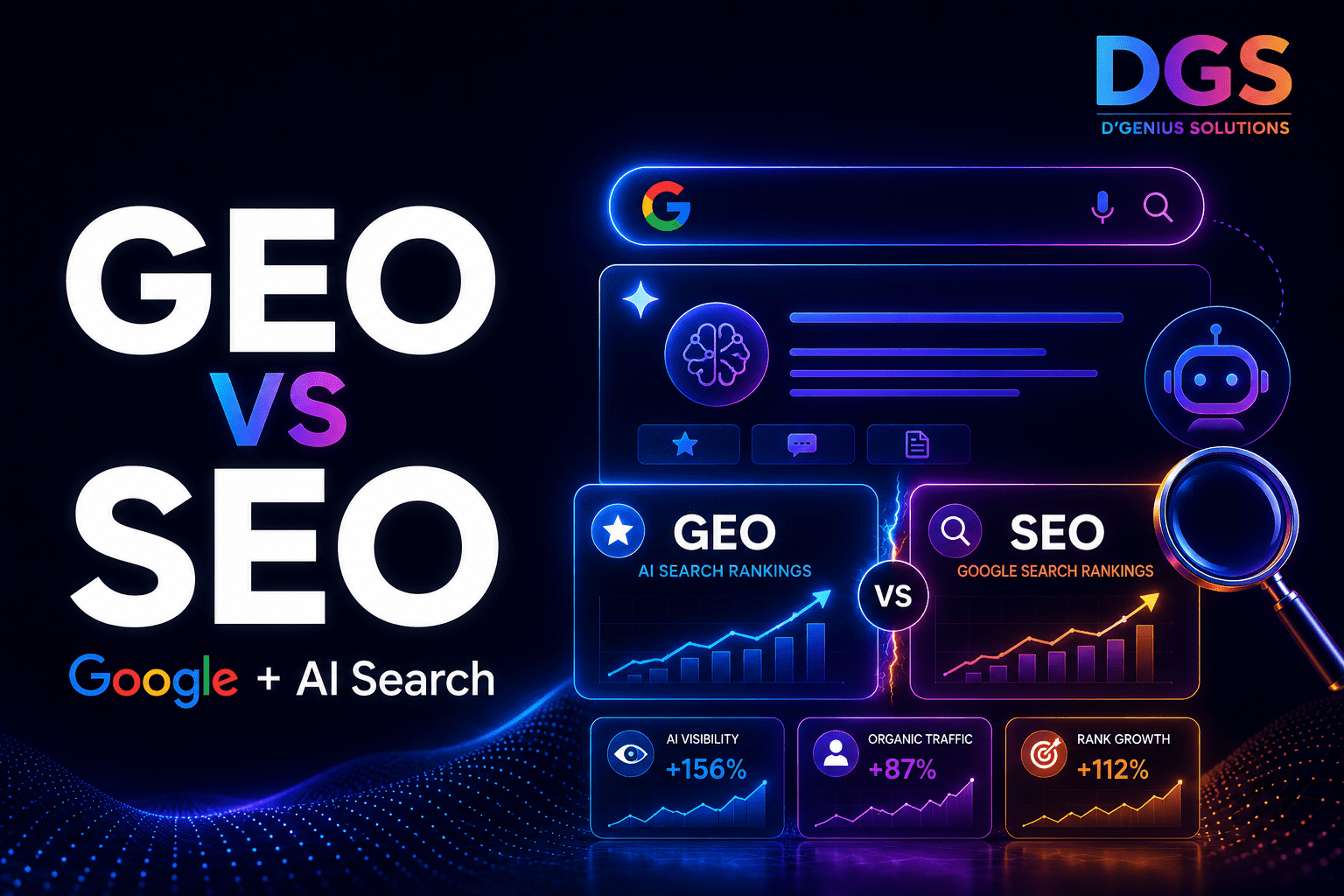
GEO vs SEO is now an important topic for businesses that want visibility in both Google search and AI-generated answers. SEO helps websites rank in traditional search results, while GEO helps brands appear in AI platforms like ChatGPT, Perplexity, Claude, Gemini, Copilot, and Google AI Overviews. For modern businesses, the goal is not to choose between SEO and GEO, but to use both together for stronger search visibility, trust, and lead generation.
Quick Answer: What Is the Difference Between GEO and SEO?
SEO helps your website rank on search engines like Google, while GEO helps your brand appear in AI-generated answers. SEO focuses on keywords, rankings, backlinks, technical performance, and organic traffic. GEO focuses on clear answers, original insights, structured content, service relevance, entity authority, and AI search visibility.
For modern businesses, the best strategy is not SEO vs GEO. The best strategy is SEO plus GEO.
A website should be optimized to rank in Google search results and also appear in AI answers when users ask platforms like ChatGPT, Perplexity, Claude, Copilot, or Google AI Overviews for recommendations.
GEO vs SEO is important because modern search visibility now depends on both traditional rankings and AI-generated recommendations.
Why GEO Is Becoming Important for Businesses
Customer search behavior has changed. People are no longer searching only with short keywords like “SEO agency Mumbai” or “digital marketing services.” They are asking detailed questions such as:
- Which SEO agency can help my business rank on Google and AI search?
- How can I make my website appear in Google AI Overviews?
- What is the difference between SEO, AEO, GEO, and LLM SEO?
- Which type of content gets cited by AI search engines?
- How can my service pages become more visible in AI answers?
These questions are more conversational, more specific, and more decision-focused.
For growing businesses, GEO vs SEO helps explain why ranking on Google and appearing in AI answers require slightly different content strategies.
That is why businesses need to optimize content for both traditional search engines and AI-driven platforms.
At D'Genius Solutions, we see GEO as the next important layer of search visibility. SEO helps your website get discovered. GEO helps your brand get recommended.
GEO Does Not Replace SEO
Many marketers ask whether GEO will replace SEO. The answer is no.
GEO does not replace SEO. It expands it.
SEO is still the foundation of online visibility. Without good SEO, your website may struggle with rankings, indexing, crawlability, content quality, page speed, internal linking, and authority. These are still important for both users and search engines.
However, AI platforms evaluate content differently. They do not only look for pages that rank well. They look for content that provides direct, trustworthy, structured, and useful answers.
That means a page can rank well on Google but still fail to appear in AI-generated answers.
This is why businesses need a combined strategy that includes:
- SEO for Google rankings
- AEO for direct answer optimization
- GEO for AI-generated answer visibility
- LLM SEO for visibility across large language model platforms
- Content strategy for real user questions
- Service page optimization for business intent
If your business wants stronger search performance, start with a strong SEO foundation through professional SEO services in Mumbai and then expand into AI search, AEO, and GEO.
Why Traditional Blog Content May Not Be Enough for GEO
For many years, businesses created blogs mainly around educational topics. These blogs usually answered questions like:
- What is SEO?
- What is digital marketing?
- Benefits of SEO
- How does content marketing work?
- Why is website speed important?
This type of content can still help with traditional SEO when it is written well. But for GEO, generic educational content is becoming less powerful.
A strong GEO vs SEO content plan should move beyond basic educational blogs and focus on useful, specific, and answer-led content.
The reason is simple: AI tools can already explain basic topics by themselves.
If your blog only repeats common information that already exists on hundreds of websites, AI systems may not have a strong reason to cite or recommend your page.
For GEO, your content needs something more valuable.
AI search engines are more likely to notice content that includes:
- Original research
- Practical examples
- Business insights
- Local market knowledge
- Service-specific answers
- Data-backed opinions
- Industry comparisons
- Case studies
- Expert recommendations
- Clear answer sections
- Unique tools or checklists
A generic article on “What is SEO?” may not stand out. But a blog like “How SEO and AI Search Are Changing Lead Generation for Mumbai Businesses” is more specific, more useful, and more aligned with real customer questions.
What Type of Content Performs Better in AI Search?
AI search platforms usually prefer content that helps them give better answers to users. That means your content should not only be long. It should be useful, clear, and original.
When planning GEO vs SEO content, businesses should prioritize pages that answer real questions with clear explanations, examples, and expert insights.
Strong GEO-friendly content often includes:
1. Original Research and Data
Original research gives AI systems something unique to reference. This can include industry trends, business observations, survey results, internal data, case studies, performance comparisons, or market insights.
For example, instead of writing a basic blog on “SEO tips,” a stronger GEO-focused topic would be:
“What We Learned After Auditing 50 Local Business Websites for SEO and AI Search Visibility”
This type of content gives AI something more valuable than a general explanation.
2. Answer-First Content
AI systems prefer content that answers the main question clearly and early.
This is where answer-first writing becomes important. Instead of hiding the answer deep inside the article, place a clear answer near the beginning.
For example:
GEO helps businesses appear in AI-generated answers by making website content clear, structured, authoritative, and easy for AI platforms to understand.
This type of answer is easy for both users and AI systems to extract.
If your website wants to appear in AI Overviews, answer engines, and AI search results, every important page should include a direct answer section. You can also improve this further with AEO services in Mumbai that focus on question-based content and answer visibility.
3. Strong Service Pages
Blogs are useful, but service pages are equally important for GEO.
AI platforms often recommend businesses when users ask for service-based solutions. That means your service pages should clearly explain:
- What service you offer
- Who the service is for
- What problems it solves
- What location you serve
- Why your company is credible
- What process you follow
- What results users can expect
- How your service is different
For example, a weak service page may only say:
“We provide SEO services for businesses.”
A stronger GEO-friendly service page would say:
“D'Genius Solutions provides SEO services in Mumbai for businesses that want to improve Google rankings, organic traffic, local visibility, lead generation, and AI search presence through technical SEO, content optimization, keyword strategy, and authority building.”
The second version gives AI systems more context and makes the service easier to understand.
4. Comparison and Decision-Based Content
AI users often ask comparison questions before making decisions.
Examples include:
- GEO vs SEO: Which one does my business need?
- AEO vs GEO: What is the difference?
- SEO vs paid ads: Which is better for long-term growth?
- Local SEO vs traditional SEO: What works better for Mumbai businesses?
- Google AI Overviews vs organic search: How should websites optimize?
These topics are valuable because they match how users ask AI platforms for help.
A business that creates comparison-based content can improve both SEO and GEO visibility.
5. Interactive Tools and Checklists
Tools are powerful because they provide action, not just information.
A named tool, calculator, checklist, audit sheet, or assessment can become a strong GEO asset.
Examples include:
- SEO audit checklist
- AI visibility checker
- Website performance audit tool
- Local SEO readiness checklist
- Lead generation calculator
- Content quality scorecard
- Google AI Overview optimization checklist
AI platforms are more likely to recommend useful tools when users ask practical questions.
For example, if someone asks, “How can I check whether my website is ready for AI search?” an AI system may prefer to recommend a useful checklist or tool instead of a generic blog.
Why Businesses in Mumbai Need SEO and GEO Together
Mumbai is a competitive market. Whether you run a clinic, real estate business, agency, coaching institute, eCommerce brand, local service company, or B2B business, your customers are searching across multiple platforms.
For service-based businesses, GEO vs SEO works best when service pages clearly explain the offer, location, process, benefits, and business value.
They may search on Google first. Then they may ask ChatGPT or Perplexity for recommendations. Then they may compare businesses using reviews, websites, social media, and AI-generated summaries.
This means your business needs visibility at every stage of the customer journey.
For Mumbai businesses, SEO helps you rank for local and commercial keywords such as:
- SEO agency in Mumbai
- digital marketing agency in Mumbai
- website development company in Mumbai
- local SEO services Mumbai
- AI SEO agency Mumbai
GEO helps your business become visible when users ask AI platforms questions like:
- Which agency can improve my AI search visibility?
- Which company provides SEO and GEO services in Mumbai?
- How can a local business rank in Google AI Overviews?
- What is the best digital strategy for lead generation in Mumbai?
This is why local businesses should not treat GEO as a future trend. It is already becoming part of modern search behavior.
How DGS Helps Brands Improve AI Search Visibility
D'Genius Solutions helps businesses build visibility across Google search and AI-driven search platforms. Our approach is not limited to writing blogs or adding keywords. We focus on creating a complete search visibility system.
Our SEO and GEO approach includes:
- Technical SEO improvement
- Keyword research and search intent mapping
- Service page optimization
- Answer-first content creation
- AI Overview optimization
- AEO content structure
- GEO-focused blog planning
- LLM SEO strategy
- Internal linking
- Local SEO optimization
- Schema and structured content recommendations
- Content audits for AI visibility
- Conversion-focused website improvements
We help businesses create pages that are easier for search engines to rank and easier for AI systems to understand.
If your website already has blogs or service pages, the next step is to audit them for AI search readiness. Some pages may only need better headings, clearer answers, stronger internal links, or more specific service information. Other pages may need a full content rewrite.
You can also read our guide on how to optimize for AI Overviews to understand how AI-powered search results are changing content strategy.
DGS Recommendation
Businesses should not create content only to fill a blog calendar. Every important page should have a clear purpose.
DGS uses a GEO vs SEO strategy to help businesses improve Google rankings, AI search visibility, service page clarity, and lead-generation performance.
Before publishing a page, ask:
- Does this page answer a real customer question?
- Is the main answer visible near the top?
- Does the content include original insight or practical value?
- Is the service clearly explained?
- Are internal links added naturally?
- Can AI systems understand who the page is for?
- Does the page help users take the next step?
If the answer is no, the page may not perform well for either SEO or GEO.
A strong content strategy should combine ranking value, AI visibility, and business conversion.
GEO Checklist for Business Websites
A practical GEO vs SEO checklist should include clear answers, FAQs, internal links, original insights, service details, schema support, and user-focused content.
Use this checklist to make your website more GEO-friendly:
- Add a clear answer section near the top of important pages
- Use simple headings that match real user questions
- Include original examples, insights, or data
- Optimize service pages, not only blogs
- Add FAQs at the end of pages
- Use internal links to related services and blogs
- Include location and service relevance where needed
- Build comparison-based content
- Create practical tools, checklists, or audit resources
- Keep content clear, specific, and easy to summarize
- Add trust signals such as experience, process, reviews, or case studies
- Track organic traffic and AI referral traffic separately
This checklist helps your content become more useful for users and more understandable for AI systems.
SEO and GEO Need Different Content Thinking
Traditional SEO usually starts with the question:
What are people searching on Google?
GEO asks a different question:
What are people asking AI platforms before making a decision?
This difference changes the content strategy.
A Google user may search:
“SEO services Mumbai”
An AI user may ask:
“Which SEO agency in Mumbai can help my business rank on Google and appear in AI search results?”
The second query is more detailed and more intent-driven. To appear in these types of answers, your content must clearly explain your services, expertise, process, location, and value.
This is why service pages, answer-led blogs, FAQs, and expert content are becoming more important.
GEO vs SEO is not a competition. It is a combined strategy for businesses that want visibility in both Google search results and AI-generated answers.
For business owners, understanding GEO vs SEO helps in planning content that works for Google, AI Overviews, ChatGPT, Perplexity, and other AI search platforms.
The biggest difference in GEO vs SEO is how the content is used. SEO improves rankings, while GEO improves the chance of being cited, summarized, or recommended by AI systems.
A strong GEO vs SEO strategy should include service pages, FAQs, answer-first content, original insights, internal links, and clear business information.
When comparing GEO vs SEO, businesses should track Google organic traffic and AI referral traffic separately because both channels may perform differently.
GEO vs SEO also changes how brands plan content. Instead of writing only for keywords, businesses must answer real questions that users ask AI platforms.
For local businesses, GEO vs SEO is especially important because users may search on Google first and then ask AI tools for recommendations before contacting a company.
D'Genius Solutions helps businesses understand GEO vs SEO and build search strategies for Google rankings, AI Overviews, ChatGPT, Perplexity, and other AI-driven platforms.
Why AI Search Rewards Clear and Useful Content
AI systems are designed to provide helpful responses. They prefer content that is easy to interpret.
That means your website should avoid vague claims such as:
- We are the best
- We provide quality services
- We help businesses grow
- We offer complete solutions
These statements are too generic.
Instead, use specific statements such as:
- We help local businesses improve Google rankings through technical SEO, content optimization, local SEO, and authority building.
- We optimize service pages for AI Overviews, answer engines, and LLM-based search platforms.
- We create answer-first content that helps users and AI systems understand your business faster.
Specific content is stronger for users, search engines, and AI platforms.
Internal Linking Matters for GEO and SEO
Internal links help users move through your website. They also help search engines and AI systems understand the relationship between your pages.
For example, a blog about GEO should naturally link to related services and resources such as:
This creates a stronger topical structure around SEO, AEO, GEO, AI Overviews, and LLM SEO.
For DGS, this is especially useful because these topics support the same business goal: helping brands become more visible across Google and AI-powered search platforms.
What Google Says About AI Search Visibility
Google explains that AI-powered search features help users explore helpful information and connect with relevant web sources. This supports the importance of creating useful, people-first content that is clear, trustworthy, and easy for search systems to understand.
In simple terms, GEO vs SEO is not about choosing one channel over another. It is about building a search strategy that works across Google, AI Overviews, ChatGPT, Perplexity, and other AI-driven platforms.
Conclusion
GEO is not replacing SEO, but it is changing how businesses should think about search visibility.
SEO helps your website rank. GEO helps your brand appear in AI-generated answers. AEO helps your content provide direct responses. LLM SEO helps your business become easier for AI platforms to understand and recommend.
The businesses that perform best in the future will not rely only on generic blogs or traditional keyword targeting. They will build content that is clear, original, answer-focused, service-driven, and useful for real decision-making.
For DGS, the future of search is not about choosing between Google and AI. It is about building a digital presence that works across both.
If your business wants better rankings, stronger AI visibility, and more qualified leads, D'Genius Solutions can help you create a search strategy built for modern customer behavior.
SEO gets your website found. GEO helps your brand get recommended. Together, they create stronger digital visibility.
Frequently Asked Questions
1. What is GEO in digital marketing?
GEO stands for Generative Engine Optimization. It is the process of optimizing website content so AI platforms like ChatGPT, Perplexity, Claude, Copilot, Gemini, and Google AI Overviews can understand, cite, and recommend your brand in AI-generated answers.
2. Is GEO replacing SEO?
No, GEO is not replacing SEO. SEO helps websites rank in traditional search engines, while GEO helps brands appear in AI-generated answers. Businesses need both to improve visibility across modern search platforms.
3. How is GEO different from SEO?
SEO focuses on rankings, keywords, backlinks, technical performance, and organic traffic. GEO focuses on clear answers, original insights, structured content, entity relevance, service clarity, and AI search visibility.
4. What type of content works best for GEO?
Original research, answer-first blogs, service pages, comparison content, expert insights, FAQs, case studies, and interactive tools usually work better for GEO than generic educational articles.
5. Why are service pages important for GEO?
Service pages explain what your business offers, who it helps, what problems it solves, and why users should trust your company. This makes them useful for AI platforms when users ask for business or service recommendations.
6. Can GEO help local businesses in Mumbai?
Yes. GEO can help local businesses in Mumbai appear in AI-generated answers when users ask for service recommendations, agency comparisons, local solutions, or expert guidance. It works best when combined with local SEO and strong service page optimization.
7. How can DGS help with GEO and AI search visibility?
D'Genius Solutions helps businesses improve SEO, AEO, GEO, LLM SEO, and AI search visibility through content optimization, service page improvement, technical SEO, answer-first content, internal linking, and AI-focused search strategy.
8. How do I start optimizing my website for AI search?
Start by auditing your important pages. Add clear answers, improve service descriptions, include FAQs, strengthen internal links, publish original insights, and create content around real questions users ask AI platforms.
Accelerate Your Digital & Search Growth
Speak directly with our Mumbai-based SEO, AI search, and digital marketing strategists for a bespoke growth audit.
Get a Free Strategy AuditRelated Insights
Google Launches Search Generative AI Performance Reports in Search Console: What It Means for SEO, GEO and AI Visibility - D'Genius Solutions
Google has introduced a major new update for website owners, SEO teams, publishers, and digital marketers: dedicated Search Generative AI performance reports
Google AI Search Update: 7 Ways Businesses Can Get Better Leads - D'Genius Solutions
Google AI Search Update helps businesses improve AI search visibility, build trust, answer user queries, and generate better leads.
LLM SEO: 9 Smart Ways to Prepare Your Website for AI Tools and Large Language Models - D'Genius Solutions
LLM SEO is becoming important for businesses that want visibility on Google, AI search tools and large language models like ChatGPT, Gemini, Perplexity and