Google Launches Search Generative AI Performance Reports in Search Console: What It Means for SEO, GEO and AI Visibility
In this article
- What Are Search Generative AI Performance Reports?
- Why This Update Matters for Website Owners
- What Data Will the New Report Show?
- Why This Is Important for SEO Strategy
- How This Impacts AI Overviews and AI Mode
- What This Means for Businesses
- How DGS Views This Update
- How to Prepare Your Website for Generative AI Visibility
- The Role of Search Console in AI SEO Reporting
- SEO Is Becoming Search Experience Optimization
- Final Thoughts
- What are Search Generative AI performance reports?
- Why are Search Generative AI performance reports important for SEO?
- What data is shown in Search Generative AI performance reports?
- Do Search Generative AI performance reports include AI Overviews and AI Mode?
- Are Search Generative AI performance reports available for all websites?
- How can businesses improve visibility in generative AI search?
- How do these reports help with GEO and LLM SEO?
- Can D'Genius Solutions help with AI search visibility?
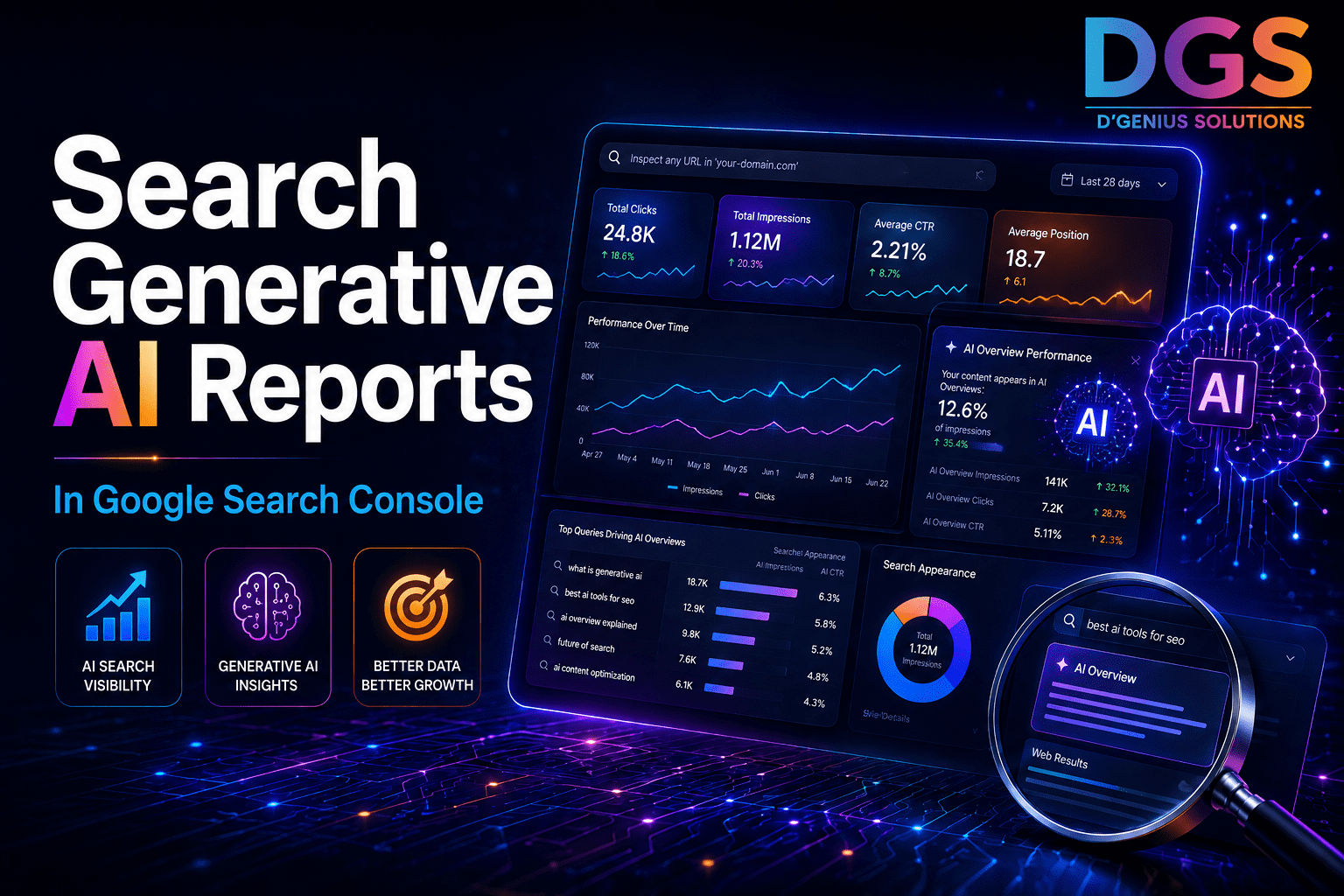
Google has introduced a major new update for website owners, SEO teams, publishers, and digital marketers: dedicated Search Generative AI performance reports inside Google Search Console.
Search Generative AI performance reports are becoming important for businesses that want to understand their visibility inside Google’s AI-powered search results.
This update is important because search is no longer limited to traditional blue links. Google Search now includes AI Overviews, AI Mode, and generative AI features in Discover. These AI-powered search experiences can show content from websites directly inside AI-generated answers, summaries, and discovery surfaces.
For businesses, this means one thing clearly: SEO reporting is changing.
Until now, website owners could track clicks, impressions, pages, countries, devices, and queries through the standard Google Search Console performance report. But there was limited clarity on how a website was performing inside Google’s AI-driven search features. With this new Search Generative AI performance report, Google is giving selected websites a separate view of how their content appears in generative AI experiences.
For agencies like D'Genius Solutions, this update confirms a major shift in digital marketing. Brands now need to optimize not only for Google rankings but also for AI visibility, answer-based search, and generative engine discovery. Businesses that want stronger search visibility can explore DGS SEO services in Mumbai to build a stronger foundation for traditional and AI-driven search performance.
What Are Search Generative AI Performance Reports?
Search Generative AI performance reports are new dedicated reports in Google Search Console that help website owners understand how their URLs appear inside Google’s generative AI features.
These reports include visibility from areas such as:
AI Overviews
AI Mode
Generative AI features in Google Search
Generative AI features in Discover
The data is still included in the overall Search Console performance report, but Google is now creating a separate view focused specifically on generative AI visibility.
This means website owners can better understand whether their content is appearing in AI-generated search experiences, not just traditional search results.
Why This Update Matters for Website Owners
For years, SEO performance was mainly measured through rankings, impressions, clicks, CTR, and organic traffic. But Google’s AI features have changed how users discover information.
A user may now ask a question on Google and receive an AI-generated answer before scrolling through traditional organic results. If your website is used as a source or appears within that AI experience, it creates a new type of visibility.
This visibility may not always behave like traditional SEO traffic. A page may receive impressions inside an AI Overview or AI Mode even if the user does not immediately click through. That makes tracking AI visibility important for understanding the full value of your content.
The new report helps website owners see where their content is appearing in Google’s AI search ecosystem. For businesses preparing for this shift, DGS has also explained the role of Generative Engine Optimization and how it supports visibility across AI-powered platforms.
What Data Will the New Report Show?
Google’s new Search Generative AI performance report is designed to show important visibility data related to AI features.
The report includes:
Impressions: How often URLs from your website appeared in generative AI features across Search and Discover.
Pages: Which website URLs appeared inside AI-powered search experiences.
Countries: Where your AI visibility is coming from geographically.
Devices: Which devices users were using when your website appeared in Search AI features.
Dates: Performance trends over time with hourly, daily, weekly, and monthly data.
This gives SEO teams and business owners a clearer way to understand whether their content is being selected, surfaced, or referenced by Google’s AI systems.
Once Search Generative AI performance reports become widely available, businesses will be able to track which pages are gaining visibility inside Google’s AI search features.
Why This Is Important for SEO Strategy
This update proves that SEO is no longer just about ranking on page one. A website also needs to be eligible, understandable, and useful enough to appear inside AI-generated answers.
Traditional SEO is still important. Technical SEO, crawlability, content quality, backlinks, schema, page experience, and internal linking still matter. But businesses now also need to think about how AI systems understand their brand, services, expertise, and content structure.
For SEO teams, Search Generative AI performance reports can help connect AI visibility data with content performance and optimization decisions.
This is where GEO, AEO, and LLM SEO become important.
GEO, or Generative Engine Optimization, helps websites become more visible in AI-generated search results. To understand this better, read DGS’s detailed guide on GEO vs SEO in Google AI Search.
AEO, or Answer Engine Optimization, helps content answer direct user questions clearly. Businesses that want to appear in answer-based search results can explore DGS AEO services in Mumbai.
LLM SEO helps improve how large language models understand, extract, and recommend brand information. For brands preparing for AI-driven discovery, DGS also provides dedicated LLM SEO services.
The new Search Console report makes these strategies more measurable.
How This Impacts AI Overviews and AI Mode
AI Overviews and AI Mode are changing the search journey. Instead of users only seeing a list of websites, Google can now generate a summarized response and include supporting sources.
This creates a new visibility layer.
A business may not always rank in the traditional top three results, but it may still be surfaced inside an AI-generated response if the content is clear, authoritative, and relevant. On the other hand, a website that ranks traditionally may not always be selected by AI systems if the content lacks structure, depth, or direct answers.
This means brands must now focus on both ranking and AI inclusion.
The new generative AI report gives website owners a better way to monitor this visibility.
What This Means for Businesses
For businesses, this update is a signal to start preparing for AI-first search behavior.
Customers are already using Google, ChatGPT, Gemini, Perplexity, Copilot, and other AI platforms to compare services, find recommendations, ask local business questions, and make buying decisions.
If your business content is not structured for AI visibility, you may lose visibility even if your website has basic SEO in place.
Businesses should now focus on:
Creating direct answer-based content
Improving topical authority
Adding structured data and schema
Strengthening internal linking
Publishing helpful service pages and blogs
Building brand mentions across trusted sources
Improving author, company, and service clarity
Creating FAQ sections that answer real user queries
Optimizing for AI Overviews and generative search results
This is especially important for service-based businesses, local businesses, ecommerce brands, SaaS companies, publishers, and agencies. Companies targeting stronger search visibility can also review DGS digital marketing services to connect SEO, content, brand visibility, and lead generation under one strategy.
How DGS Views This Update
At D'Genius Solutions, we see this as one of the most important search updates for the future of SEO.
Google is making AI visibility measurable. That means SEO campaigns can no longer focus only on keyword rankings and traffic reports. Businesses will need to track how their brand performs across traditional search, AI search, answer engines, and generative discovery platforms.
This update supports the need for a more advanced search strategy that combines:
SEO
Local SEO
AEO
GEO
LLM SEO
Content optimization
Technical SEO
Entity optimization
Brand authority building
The future of search will reward websites that are easy for both users and AI systems to understand.
How to Prepare Your Website for Generative AI Visibility
To improve your chances of appearing in generative AI search features, your website content should be clear, structured, and helpful.
Start by reviewing your most important service pages and blogs. Make sure each page clearly explains what the topic is, who it helps, what problem it solves, and why your business is trustworthy.
Use simple headings, direct answers, FAQs, comparison sections, internal links, and schema markup. Avoid thin content, vague service descriptions, and keyword stuffing.
Your content should answer real questions users ask before making a decision.
For example, instead of only writing “best SEO agency,” your content should also answer:
What does an SEO agency do?
How does SEO help business growth?
How long does SEO take to show results?
What is the difference between SEO and GEO?
How can a business appear in AI Overviews?
Why is technical SEO important for AI search visibility?
This type of content is more useful for users and easier for AI systems to extract. If your website is struggling to rank or appear in search results, you can also read DGS’s guide on Google ranking fixes to understand common SEO issues and improvements.
The Role of Search Console in AI SEO Reporting
Google Search Console has always been one of the most important SEO tools. With this new update, it becomes even more valuable for AI search tracking.
Once the report becomes available to more websites, businesses will be able to check which pages are gaining AI visibility, which countries are seeing those impressions, and how performance changes over time.
This can help businesses make better content decisions.
For example, if a blog post is getting AI impressions but low clicks, it may need stronger calls to action, better internal links, or clearer service connections. If a service page is not appearing in AI features, it may need better content depth, schema, FAQs, and topical support from related blogs.
This report can help SEO teams move from guessing to measuring.
SEO Is Becoming Search Experience Optimization
The launch of Search Generative AI performance reports shows that SEO is evolving into something bigger.
It is no longer only about ranking keywords. It is about being visible wherever users search, ask, compare, and discover.
That includes:
Google Search results
Google AI Overviews
Google AI Mode
Google Discover
ChatGPT
Gemini
Perplexity
Copilot
Voice search
Answer engines
AI recommendation systems
Businesses that adapt early will have a stronger advantage as AI search becomes more common.
Final Thoughts
Google’s new Search Generative AI performance reports are a major step toward making AI search visibility measurable.
For website owners, this update provides a clearer view of how content appears inside Google’s generative AI features. For marketers, it confirms that SEO, GEO, AEO, and LLM SEO are no longer optional future concepts. They are becoming part of modern search strategy.
Businesses that want to stay visible must optimize for both traditional search engines and AI-powered search experiences.
At D'Genius Solutions, we help businesses build search strategies that improve visibility across Google Search, AI Overviews, answer engines, and generative AI platforms.
If your business wants to prepare for the future of search, now is the right time to strengthen your SEO, GEO, and AI visibility strategy with DGS SEO services, AEO services, and LLM SEO services.
Search Generative AI performance reports are a strong signal that Google is making AI search visibility more measurable for website owners.
What are Search Generative AI performance reports?
Search Generative AI performance reports are Google Search Console reports that show how website pages appear in Google’s AI-powered search features, including AI Overviews, AI Mode, Search, and Discover.
Why are Search Generative AI performance reports important for SEO?
They are important because they help website owners understand AI search visibility beyond normal rankings, clicks, and impressions. These reports show whether your content is appearing inside Google’s generative AI search experiences.
What data is shown in Search Generative AI performance reports?
Search Generative AI performance reports can show impressions, appearing pages, countries, devices, and date-based performance. This helps SEO teams understand which pages are getting visibility in AI search features.
Do Search Generative AI performance reports include AI Overviews and AI Mode?
Yes. These reports are designed to show visibility from Google’s generative AI features, including AI Overviews, AI Mode, and generative AI experiences in Search and Discover.
Are Search Generative AI performance reports available for all websites?
No. Google is currently rolling out Search Generative AI performance reports to a subset of websites first before making them more widely available.
How can businesses improve visibility in generative AI search?
Businesses can improve visibility in generative AI search by creating helpful content, adding FAQs, using schema, improving technical SEO, building topical authority, strengthening internal links, and optimizing for GEO, AEO, and LLM SEO.
How do these reports help with GEO and LLM SEO?
These reports help businesses understand which pages are visible in AI-powered search features. This supports GEO and LLM SEO because brands can use the data to improve content structure, answer quality, entity clarity, and AI search visibility.
Can D'Genius Solutions help with AI search visibility?
Yes. D'Genius Solutions helps businesses improve visibility across Google Search, AI Overviews, answer engines, and generative AI platforms through SEO, AEO, GEO, LLM SEO, and content optimization.
Accelerate Your Digital & Search Growth
Speak directly with our Mumbai-based SEO, AI search, and digital marketing strategists for a bespoke growth audit.
Get a Free Strategy AuditRelated Insights
GEO vs SEO: 7 Powerful Ways Businesses Can Rank in Google and AI Search
GEO vs SEO explains how businesses can improve visibility in Google search, AI Overviews, ChatGPT, Perplexity, and other AI search platforms with SEO and Generative Engine Optimization.
Google AI Search Update: 7 Ways Businesses Can Get Better Leads - D'Genius Solutions
Google AI Search Update helps businesses improve AI search visibility, build trust, answer user queries, and generate better leads.
LLM SEO: 9 Smart Ways to Prepare Your Website for AI Tools and Large Language Models - D'Genius Solutions
LLM SEO is becoming important for businesses that want visibility on Google, AI search tools and large language models like ChatGPT, Gemini, Perplexity and