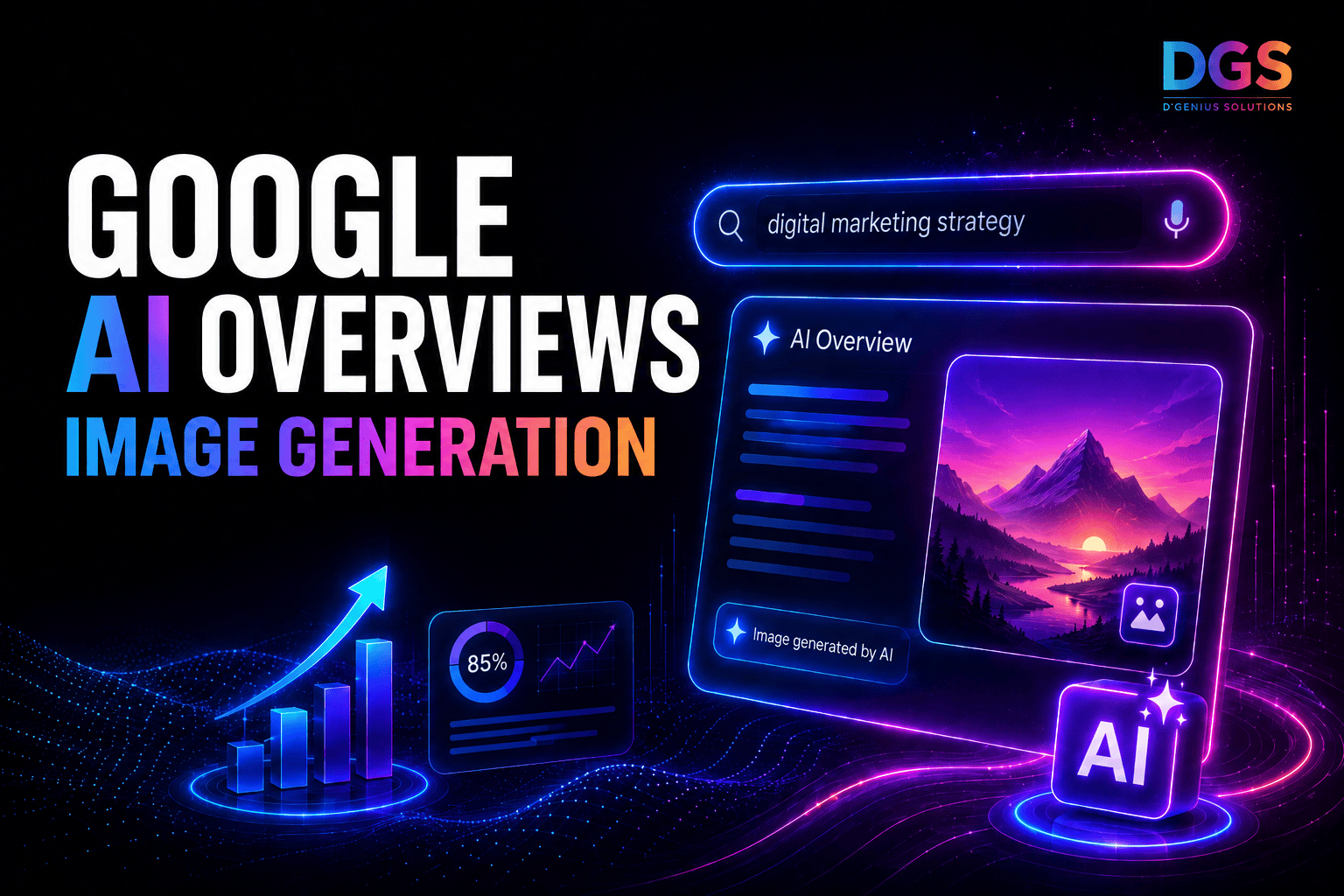
Google AI Overviews Image Generation: 7 SEO Actions Brands Should Take
In this article
- Quick Answer
- What Is Changing in Google Search?
- Why Google AI Overviews Image Generation Matters for SEO
- 1. Replace Decorative Images With Useful Visual Evidence
- 2. Build Each Image Around a Clear Search Intent
- 3. Optimise the Image Landing Page, Not Just the File
- 4. Use Accurate File Names and Alt Text
- 5. Make Image Ownership Clear
- 6. Balance AI-Generated Images With Real Business Assets
- 7. Measure Visibility Beyond Traditional Image Clicks
- Which Images Are Most Likely to Remain Valuable?
- Real Product Images
- Original Research Graphics
- Case-Study Screenshots
- Instructional Visuals
- Location-Specific Photographs
- Technical Diagrams
- Authentic Team and Workplace Images
- Will AI-Generated Results Reduce Organic Traffic?
- How DGS Can Prepare for Visual AI Search
- Final Thoughts
- Frequently Asked Questions
- What is Google AI Overviews image generation?
- Is image SEO still important after this update?
- Can AI-generated images rank in Google Images?
- Should every image contain the focus keyword in its alt text?
- How can businesses protect image traffic?
- Does Google require special schema for AI Overviews?
Google AI Overviews image generation is changing how people discover, create and interact with visual information through Google Search.
Until recently, users searching for visual inspiration had to browse images published by websites. Google can now generate a new image directly from a written prompt within its AI-powered search experience. This means people may receive a customised visual without visiting several external pages.
For businesses, Google AI Overviews image generation is more than a creative search feature. It could influence image visibility, organic click-through rates, content discovery and the type of visual assets that attract qualified website visitors.
Brands should not respond by publishing hundreds of generic AI images. They should focus on original visuals, real business evidence, accurate image optimisation and landing pages that provide information Google cannot easily reproduce.
Quick Answer
Google AI Overviews image generation allows Google Search to create customised visuals from written prompts. As visual search becomes more interactive, businesses should publish original images, optimise image file names and alt text, improve page relevance and use authentic visual evidence such as product photographs, case-study screenshots, research charts and real project images.
What Is Changing in Google Search?
Google AI Overviews image generation is an AI-powered search capability that can convert a written request into a newly created visual.
A user may describe a room design, product concept, outfit, advertising idea or creative comparison. Google can interpret the request and generate a relevant image within the search experience.
The user may then refine the result by changing the colours, layout, style, background or individual elements.
This moves Google Search beyond simply finding existing images. It allows the search engine to participate directly in the visual creation process.
Why Google AI Overviews Image Generation Matters for SEO
The introduction of Google AI Overviews image generation may change the way users respond to image-based search results.
When Google can produce a satisfactory visual directly in Search, users may not need to open a website for basic inspiration. This could affect pages that rely heavily on generic stock photographs, decorative graphics or visuals that provide little additional information.
However, image SEO is not becoming irrelevant.
Google still needs trustworthy webpages, accurate information and crawlable content to understand topics and support its wider search ecosystem. Google’s official AI features and website guidance confirms that established SEO fundamentals continue to apply to AI-powered search experiences.
The real opportunity is to publish images that offer value beyond what a basic AI-generated visual can provide.
1. Replace Decorative Images With Useful Visual Evidence
Many websites use images only to make a page look attractive. These visuals add colour but rarely improve the reader’s understanding.
Under the new visual-search environment, that approach is unlikely to create a meaningful advantage.
Businesses should create images that explain or prove something, such as:
- Original campaign screenshots
- Product photographs from different angles
- Before-and-after project results
- Step-by-step process visuals
- Charts built from first-party data
- Location photographs
- Interface demonstrations
- Comparison graphics
- Client-approved case-study images
For example, an AI tool can generate a generic image of a digital marketing dashboard. It cannot accurately reproduce the real performance improvement achieved during a client campaign.
That difference gives original business visuals lasting value.
2. Build Each Image Around a Clear Search Intent
A useful image begins with a useful question.
Before designing or uploading a visual, identify what the user is trying to understand. The image should help complete that task faster or more clearly.
For example:
- A user searching for “technical SEO audit process” may value a flowchart.
- A user searching for “website redesign before and after” may value a comparison image.
- A user searching for “local SEO reporting example” may value an annotated dashboard.
- A user researching a service may value photographs or screenshots of real work.
This approach aligns visual content with search intent instead of treating images as separate design elements.
At D'Genius Solutions, this principle can be applied across SEO services, AEO services, website development and AI-led marketing campaigns.
Google AI Overviews image generation makes search intent particularly important because Google may be able to satisfy broad visual requests independently. Businesses should therefore target searches where users need accuracy, proof, instructions, comparison, product information or real-world experience.
3. Optimise the Image Landing Page, Not Just the File
Image SEO is not limited to writing alt text.
Google uses the surrounding page to understand an image’s purpose and relevance. The heading, nearby paragraph, caption, page topic and internal links all help establish context.
Google’s official image SEO guidance recommends creating useful landing pages, embedding images through supported HTML elements, using responsive images and helping Google discover important media through image sitemaps when necessary.
For every important image:
- Place it near the most relevant paragraph.
- Add a helpful caption when explanation is required.
- Ensure the surrounding heading matches the image topic.
- Link to the page from related content.
- Avoid placing the same image on many unrelated pages.
- Keep the page indexable and accessible to Googlebot.
A well-optimised image on a weak, thin or unrelated page will still struggle to perform.
A page discussing Google AI Overviews image generation should not depend on image metadata alone. Its heading structure, supporting paragraphs, captions, internal links and overall topical relevance should all help search engines understand why the image belongs on the page.
Google’s official image SEO best-practice guide recommends using high-quality images, relevant surrounding text, descriptive alt attributes and technically accessible image files.
4. Use Accurate File Names and Alt Text
Image file names should briefly explain what the visual contains.
Avoid uploading files with names such as:
IMG_20260715_1035.jpg
A more useful file name would be:
google-ai-overviews-image-generation-seo.webp
Alt text should describe the visual for users who cannot see it. It should not become a place to force the focus keyword repeatedly.
A natural example is:
Google AI Overview creating a customised visual from a written search prompt.
An inaccurate example is:
Google AI Overviews image generation Google images update image SEO Google AI search.
The second version is difficult to read and provides little accessibility value.
Use the primary keyword in the featured image alt text where it accurately describes the image. For supporting visuals, write unique alt text based on what each image shows.
This gives Google and users a clearer indication of the image topic than an automatically generated file name.
Do not use the focus keyword in every supporting image. Only use Google AI Overviews image generation where the visual genuinely represents that topic.
5. Make Image Ownership Clear
As AI-generated visuals become more common, ownership and authenticity will matter more.
Businesses should make it easy for Google and users to understand who created an image, where it came from and how it may be used.
Possible ownership signals include:
- A consistent brand style
- A subtle logo or watermark
- An informative image caption
- Author or organisation details
- Copyright information
- Image licensing metadata
- Structured data
- A clear source page
Google supports image metadata that can communicate creator, credit and licensing information in Google Images.
These signals will not guarantee rankings, but they can strengthen attribution and reduce ambiguity around original work.
6. Balance AI-Generated Images With Real Business Assets
AI-generated images can be useful for concept visualisation, illustrations, mood boards and creative storytelling.
The risk begins when synthetic visuals are presented as proof of actual experience.
A website development company should not show a fabricated interface as a completed client project. A manufacturer should not present an AI-created factory as its real facility. A service provider should not use generated customer photographs as genuine testimonials.
Google’s guidance does not reject content simply because AI helped create it. The focus remains on accuracy, usefulness, quality and compliance with spam policies. Publishing large amounts of generated content without adding value can still create quality and scaled-content concerns.
A sensible approach is:
- Use real visuals to demonstrate work, people, products and results.
- Use AI images to illustrate ideas that cannot be photographed easily.
- Review generated visuals for factual or visual errors.
- Avoid presenting imagined scenes as real events.
- Add original commentary and practical context.
Human review remains essential.
The growth of Google AI Overviews image generation does not mean businesses should replace authentic photographs and project visuals with artificial alternatives.
AI images are suitable for conceptual illustrations, creative ideas and subjects that are difficult to photograph. Real images remain more appropriate for customer results, products, offices, employees, completed projects and other claims requiring evidence.
Google’s guidance on generative AI content advises publishers to prioritise accuracy, quality and usefulness rather than producing content at scale without meaningful value.
7. Measure Visibility Beyond Traditional Image Clicks
Visual-search performance should not be judged only by the number of clicks from Google Images.
Personalised feeds and AI-generated results may influence users before they visit a website. A person may first see a brand image, remember the company and later search for the brand directly.
Businesses should therefore monitor:
- Google Images impressions and clicks
- Branded search growth
- Landing-page engagement
- Assisted conversions
- Enquiries from visual pages
- Image-rich result visibility
- Discover impressions
- Changes in click-through rate
- Performance of pages containing original media
Google Search Console reports can help identify whether image-focused pages are gaining impressions even when clicks do not grow at the same rate.
The business objective should remain qualified visibility and conversions, not merely a high number of image impressions.
Which Images Are Most Likely to Remain Valuable?
AI can create attractive visuals quickly, but it cannot replace every category of image.
The following assets can continue to provide strong organic-search value:
Real Product Images
Customers often want to inspect dimensions, texture, packaging, variations and real-life usage before making a purchase.
Original Research Graphics
Charts built from proprietary surveys or internal data cannot be reproduced accurately without access to the source information.
Case-Study Screenshots
Analytics dashboards, campaign results and project interfaces offer evidence of actual work.
Instructional Visuals
Step-by-step images can help users complete a task and encourage them to visit the full guide.
Location-Specific Photographs
Real offices, landmarks, facilities and service areas support local relevance and business credibility.
Technical Diagrams
Accurate diagrams created by subject-matter experts can explain systems, workflows and complex services better than generic generated art.
Authentic Team and Workplace Images
Real people and real environments build trust in a way that polished stock images rarely achieve.
Will AI-Generated Results Reduce Organic Traffic?
Google AI Overviews image generation may reduce clicks for some broad, inspiration-based searches because users can receive an immediate visual answer.
However, the impact will depend on the search intent.
Someone asking Google to create an imaginary living room may not need to visit another website. A user comparing furniture prices, materials, availability, dimensions or professional installation services will still need reliable commercial information.
The same principle applies to most industries. AI can create an illustration, but it cannot automatically replace current pricing, verified results, live inventory, real customer experience or original research.
How DGS Can Prepare for Visual AI Search
As Google AI Overviews image generation develops, businesses will need closer coordination between SEO, content, design and website development teams.
A visual-search audit should identify images that are:
- Generic or repeatedly used
- Missing useful alt text
- Too large and slow to load
- Unrelated to the surrounding content
- Unsupported by captions
- Poorly branded
- Unable to prove genuine experience
D'Genius Solutions can support this process through an integrated strategy covering SEO services in Mumbai, AEO services in Mumbai, AI video production and content optimisation for AI search.
The objective is not simply to gain image impressions. It is to create visual assets that improve brand recognition, communicate expertise and encourage qualified users to take action.
Final Thoughts
Google AI Overviews image generation signals a larger shift towards visual, personalised and interactive search.
Businesses should not attempt to compete by creating a high volume of generic AI images. Google can already generate basic visual concepts quickly. Brands need to provide what automated image generation cannot easily replace:
- Real project evidence
- Authentic product information
- Original research
- Firsthand experience
- Expert explanations
- Recognisable brand identity
- Accurate technical visuals
As Google AI Overviews image generation becomes more widely used, original visual assets may become a stronger competitive advantage.
The brands most likely to perform well will not necessarily publish the highest number of images. They will publish visuals with a clear purpose, strong supporting content and a genuine reason for users to visit the source website.
Frequently Asked Questions
What is Google AI Overviews image generation?
Google AI Overviews image generation is a search feature that can create a new image from a written prompt inside an AI-generated search response. It allows users to visualise ideas without first visiting an external image website.
Is image SEO still important after this update?
Yes. Google still needs to discover, crawl and understand website images. Original media, descriptive alt text, relevant landing pages, responsive delivery and strong technical SEO remain important.
Can AI-generated images rank in Google Images?
AI-generated images may appear in search when they are accessible, relevant and published on useful pages. However, using AI does not automatically improve rankings, and low-value mass-generated content may perform poorly.
Should every image contain the focus keyword in its alt text?
No. Use the focus keyword only when it accurately describes the image. Every alt attribute should be written for accessibility and should reflect the actual visual.
How can businesses protect image traffic?
Businesses should publish original images that provide real evidence or information, optimise the surrounding page, improve image speed, use accurate metadata and track conversions rather than relying only on image clicks.
Does Google require special schema for AI Overviews?
Google does not provide special AI Overview schema. Standard SEO, indexability, helpful content, structured data where appropriate and compliance with Google Search policies remain the foundation.
Accelerate Your Digital & Search Growth
Speak directly with our Mumbai-based SEO, AI search, and digital marketing strategists for a bespoke growth audit.
Get a Free Strategy AuditRelated Insights
AI Overview SEO: 9 Powerful Ways to Rank in Google AI Overviews - D'Genius Solutions
AI Overview SEO helps websites rank in Google AI Overviews with helpful content, AEO, GEO, FAQs, technical SEO, trust signals, and internal links.
GEO vs SEO: 7 Powerful Ways Businesses Can Rank in Google and AI Search
GEO vs SEO explains how businesses can improve visibility in Google search, AI Overviews, ChatGPT, Perplexity, and other AI search platforms with SEO and Generative Engine Optimization.