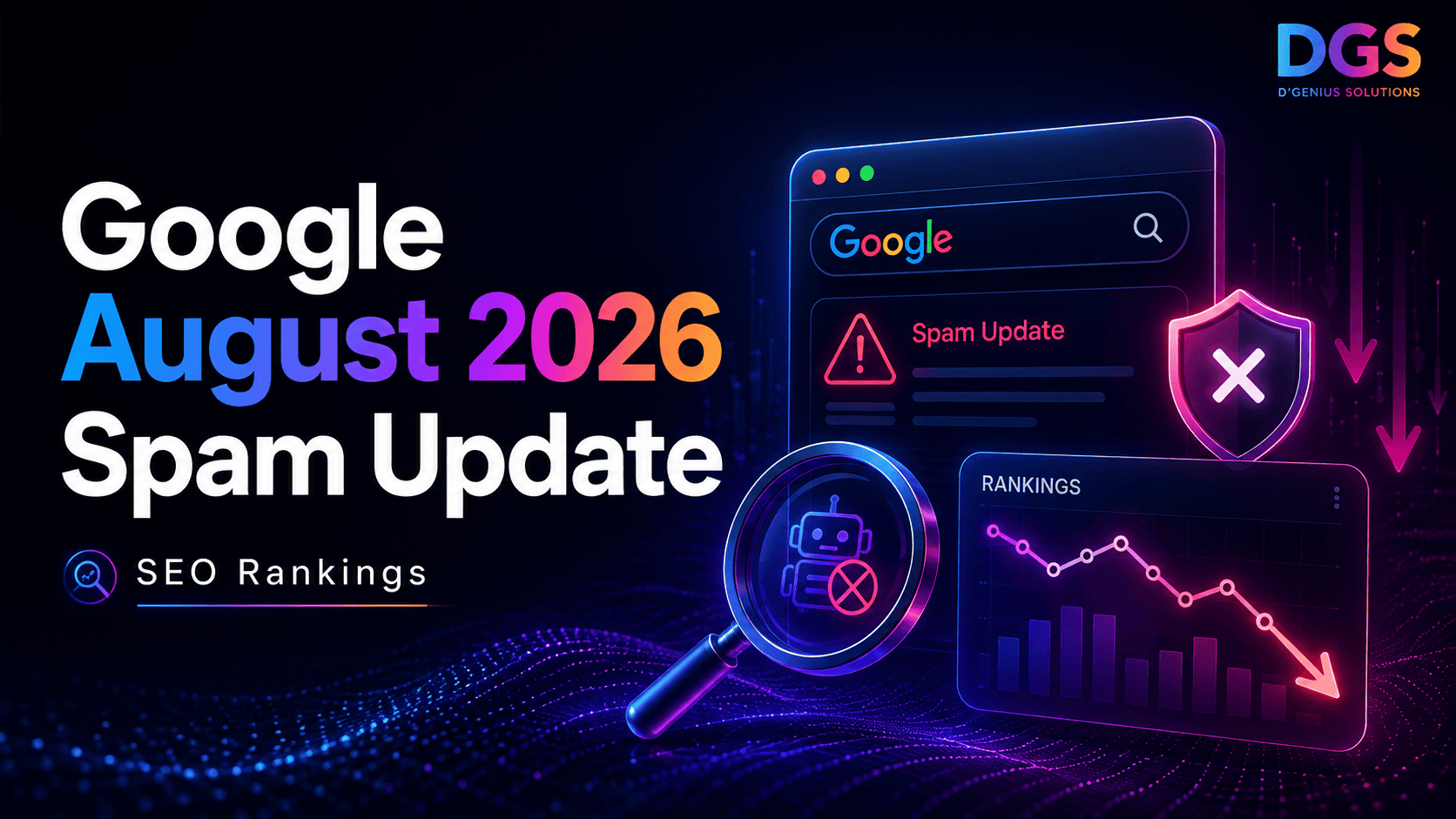
Google August 2026 Spam Update What Businesses Need to Know About SEO Rankings
In this article
- What Is the Google August 2026 Spam Update?
- Is the August 2026 Spam Update a Core Update?
- 7 SEO Areas Businesses Should Review After the Google August 2026 Spam Update
- 1. Mass-Produced Pages With Very Little Original Value
- 2. AI Content Published Without Proper Human Input
- 3. Pages Written Around Keywords Instead of Customers
- 4. Backlinks Created Only to Manipulate Rankings
- 5. Third-Party Content That Does Not Fit the Website
- 6. Weak Trust and Experience Signals
- 7. Thin Content That Does Not Fully Answer the Search
- What Should You Do If Your Google Rankings Dropped?
- How Can Businesses Improve Content After the Update?
- Does the Google August 2026 Spam Update Target AI-Generated Content?
- How Long Does Recovery From a Spam Update Take?
- What Does This Mean for AI Overviews, AEO and GEO?
- What the Google August 2026 Spam Update Really Means for Businesses
- Frequently Asked Questions
- What is the Google August 2026 spam update?
- Did Google penalise AI content in the August 2026 spam update?
- What should I check if my rankings dropped after the update?
- Can a website recover after the Google August 2026 spam update?
- Should I stop using AI for SEO content?
The Google August 2026 spam update has put website quality back under the spotlight. For businesses that depend on Google for enquiries, sales and organic visibility, even a small ranking shift can have a noticeable impact on website performance.
Google started rolling out the update on August 18, 2026, and completed it on August 21. The update applied globally and across languages. Unlike a broad core update, this release was specifically related to Google’s systems for identifying search spam.
That distinction matters. If your impressions or rankings dropped during the rollout, it does not automatically mean your content is poor or your entire SEO strategy has failed. It does mean this is a good time to examine how your website is being built, how content is being produced and whether any part of the SEO strategy looks designed more for algorithms than for real users.
Google’s own documentation explains that its automated spam-detection systems, including SpamBrain, are continuously improved to identify old and emerging forms of search manipulation.
Businesses therefore need to look beyond individual keywords and focus on whether their website genuinely deserves the visibility it is trying to earn.
What Is the Google August 2026 Spam Update?
The Google August 2026 spam update was an improvement to Google’s systems for detecting websites and content that may violate its spam policies.
Google did not announce that the update was designed to target one particular SEO technique. There was no statement saying that it was specifically an AI-content update, backlink update or thin-content update.
That is important because ranking drops are often followed by rushed conclusions. A website owner may immediately blame backlinks, remove AI-assisted articles or rewrite hundreds of pages when the actual problem may sit somewhere else.
Google recommends reviewing its official spam policies for Google Search when a website appears to have been affected by a spam update.
The practical approach is to examine the pages that actually lost visibility and understand what they have in common.
Is the August 2026 Spam Update a Core Update?
No. The Google August 2026 spam update and a Google core update are not the same thing.
A core update makes broader changes to the way Google’s ranking systems assess and surface useful results. A spam update is more directly connected with Google’s ability to recognise practices that attempt to manipulate search rankings.
The two can still overlap from a business perspective because both ultimately reward websites that provide genuine value and make it harder for low-quality strategies to succeed consistently.
This is also why chasing every algorithm update rarely works as a long-term SEO strategy. Businesses are better served by building pages around customer needs, first-hand expertise, useful information and strong technical foundations.
7 SEO Areas Businesses Should Review After the Google August 2026 Spam Update
1. Mass-Produced Pages With Very Little Original Value
One of the first areas worth reviewing is content created at scale.
Publishing frequently is not a problem. The risk begins when dozens or hundreds of pages are produced mainly because more indexed URLs are expected to bring more rankings.
For example, a business may create almost identical service pages for different cities while changing only the location name. Another site may publish several articles answering almost the same question with slightly different keywords.
That kind of approach can create a large website without creating a particularly useful one.
Google refers to this type of behaviour as scaled content abuse when pages are produced primarily to manipulate rankings rather than help users.
Businesses should therefore ask whether every important page offers something genuinely useful that cannot simply be replaced by another page on the same website.
2. AI Content Published Without Proper Human Input
AI has become part of normal content workflows, and using AI itself is not an SEO violation.
The problem is what happens after the tool produces the draft.
If businesses generate hundreds of pages, publish them without checking facts and add little original knowledge, the final content may offer no reason for Google or a user to prefer it over dozens of similar pages.
Google’s guidance on generative AI content makes the distinction fairly clear. AI can support content creation, but using automation primarily to manipulate rankings can conflict with Google’s spam policies.
A better workflow uses AI as an assistant rather than the final authority. Human experience, examples, opinions, client situations, original data and subject-matter knowledge should shape the finished page.
That also makes the content noticeably more useful to the reader.
3. Pages Written Around Keywords Instead of Customers
SEO still requires keywords. The mistake is allowing the keyword to control every paragraph.
A page can include the right search term 20 times and still fail to answer what the customer actually wants to know.
For example, someone searching for SEO services may want to understand whether their traffic decline is technical, algorithmic or content related. Repeating “SEO services” throughout the page does not answer that concern.
Effective SEO services in Mumbai should start with search intent and business problems before deciding where keywords belong.
Keywords should help Google understand a page. They should not make the page uncomfortable for humans to read.
This principle becomes particularly important after the Google August 2026 spam update, because search-first content that offers little additional value is becoming increasingly difficult to justify as a sustainable strategy.
4. Backlinks Created Only to Manipulate Rankings
Backlinks remain an important part of the web, but not every backlink is useful.
There is a major difference between being mentioned by a relevant publication because the content deserves a reference and creating hundreds of links through unrelated websites simply because they allow submissions.
Businesses should review whether their backlink profile includes excessive exact-match anchors, unrelated placements, low-quality guest posts, bulk directories or websites that appear to exist mainly for selling SEO links.
A large backlink number can look impressive in a report while contributing very little real authority.
A stronger approach focuses on relevance. Industry articles, original research, case studies, digital PR, useful resources and genuine business mentions create links for a reason rather than simply for a ranking metric.
5. Third-Party Content That Does Not Fit the Website
Another area businesses should examine is content created or supplied by third parties.
An established website naturally builds authority over time. Problems can arise when unrelated third-party content is placed on that website primarily to benefit from the strength of the main domain.
Google refers to certain versions of this practice as site reputation abuse.
That does not mean businesses cannot publish guest contributions, sponsored information or partner content. The important question is whether the content genuinely belongs on the website and benefits its audience.
If a company’s entire website discusses digital marketing and suddenly starts hosting pages about unrelated financial products purely because those pages can rank, the connection becomes difficult to justify.
Topical consistency matters for both users and search engines.
6. Weak Trust and Experience Signals
People want to know who they are dealing with before they contact a business. Google also encourages website owners to make authorship, expertise and the purpose of content clear.
That means trust should not be treated as something that belongs only on the About Us page.
Service pages can show relevant projects, processes and outcomes. Blog articles can identify knowledgeable authors. Company information should be easy to verify. Important claims should be supported with evidence rather than marketing language.
Google’s guidance around helpful content discusses the importance of experience, expertise, authoritativeness and trust, commonly discussed as E-E-A-T.
Trust becomes even more important as search moves beyond traditional blue links. Businesses now want visibility in AI Overviews, answer engines and AI assistants as well.
Services such as Answer Engine Optimization, Generative Engine Optimization and LLM SEO work best when the underlying website already contains credible, well-structured information.
There is no shortcut that can compensate for weak source content.
7. Thin Content That Does Not Fully Answer the Search
A page does not have to be spam to be weak.
Many websites contain articles that technically target the right keyword but say very little once the introduction and generic explanations are removed.
A useful test is simple: after reading the page, does the visitor understand the subject well enough to make the next decision, or do they immediately need to search Google again?
If they still need five more websites to understand the basic answer, the original content probably has room for improvement.
Businesses should review older articles for shallow explanations, duplicate FAQs, outdated information, unnecessary introductions and sections that exist only to increase word count.
More words do not automatically create more value.
What Should You Do If Your Google Rankings Dropped?
If rankings fell around the Google August 2026 spam update, avoid changing the entire website overnight.
Start with Google Search Console and compare performance before and after August 18. Look at individual landing pages rather than only total traffic.
Check which pages lost impressions, which keywords declined, whether entire directories were affected and whether the decline is limited to one particular content type.
A useful review should cover:
- Repetitive or automatically produced pages
- Thin service and location content
- Articles created mainly around keyword variations
- Unoriginal or lightly rewritten information
- Suspicious backlink patterns
- Third-party content unrelated to the main website
- Weak author or company credibility signals
- Outdated information
- Poor internal linking
- Pages that no longer match search intent
Do not delete a page simply because its ranking fell. A valuable page may need improvement rather than removal.
The objective should be to understand the pattern behind the decline before deciding what needs to change.
How Can Businesses Improve Content After the Update?
The strongest response is not to write “more SEO content.” It is to make existing content more useful.
Start by asking what a real customer would need from the page.
If it is a service page, explain the problem, approach, process, expected outcomes and relevant experience. If it is an informational article, answer the topic thoroughly enough that someone can actually use what they have learned.
Original examples can make a significant difference. So can screenshots, data, practical observations, comparisons and lessons learned from real work.
Google’s helpful content guidance repeatedly encourages website owners to create content for people rather than content primarily intended to attract search traffic.
That is a much more useful benchmark than trying to determine the “perfect” number of keywords or words.
Does the Google August 2026 Spam Update Target AI-Generated Content?
There is no reason to treat every AI-assisted article as spam simply because AI was involved in creating it.
The better question is whether the finished content deserves to exist.
An AI-assisted article that has been fact-checked, rewritten by an experienced person, supported by genuine examples and created to answer a real customer question can be valuable.
A thousand automated articles generated solely because a keyword tool found a thousand search queries are a very different proposition.
The difference is intent and value, not simply the software used to produce the first draft.
For businesses using AI regularly, human editorial review is now even more important.
How Long Does Recovery From a Spam Update Take?
Recovery is unlikely to happen immediately after fixing one page.
Google explains that its automated systems may need time to recognise that a website has made lasting changes. In some cases, that can take months.
Businesses should therefore avoid treating SEO recovery like a checklist that produces an instant ranking return.
Improvements should be made because they strengthen the website as a whole, not because someone expects rankings to return the following week.
If the content becomes clearer, more accurate and more useful to customers, those improvements remain valuable even before rankings fully respond.
What Does This Mean for AI Overviews, AEO and GEO?
Google Search is no longer limited to the traditional list of ten blue links.
Businesses increasingly want to appear in AI-generated answers, AI Overviews and conversational search experiences as well.
The underlying requirement, however, has not changed as dramatically as some marketing discussions suggest. Search systems still need clear information, trusted entities, crawlable pages, relevant content and evidence that supports claims.
That means businesses should not create separate low-quality pages purely for AEO or GEO.
Traditional SEO, AEO, GEO and LLM SEO should support one another. A strong page can be technically accessible to Google, answer common questions directly, clearly explain business entities and provide information that AI systems can confidently interpret.
That is far more sustainable than trying to manipulate every new search interface independently.
What the Google August 2026 Spam Update Really Means for Businesses
The Google August 2026 spam update is another reminder that SEO strategies built mainly around volume are becoming increasingly fragile.
Publishing more pages, inserting more keywords or acquiring more links can look productive, but those numbers matter only when they improve the value and authority of the website.
Businesses should concentrate on pages that solve genuine customer problems, demonstrate real expertise and give users a reason to trust the company behind the content.
Technical SEO still matters. Keywords still matter. Internal links still matter. Backlinks still matter. The difference is that none of them should exist in isolation from usefulness.
The websites most likely to build sustainable organic visibility are not necessarily those publishing the most content. They are the ones making it easier for both people and search engines to understand why their information deserves attention.
Frequently Asked Questions
What is the Google August 2026 spam update?
The Google August 2026 spam update was an improvement to Google’s automated systems for detecting search spam. The rollout began on August 18, 2026, applied globally and was completed on August 21.
Did Google penalise AI content in the August 2026 spam update?
Google did not announce a blanket penalty against AI-generated content. The concern is low-value or scaled content created mainly to manipulate search rankings, regardless of whether it was produced by AI or by people.
What should I check if my rankings dropped after the update?
Review the landing pages and search queries that actually lost visibility. Check content quality, duplication, search intent, backlinks, internal linking, trust signals and any large-scale content production patterns before making major changes.
Can a website recover after the Google August 2026 spam update?
Yes. Websites can improve after correcting genuine quality or spam-policy problems, although Google may need time to reassess those changes. Recovery can therefore take considerably longer than a few days.
Should I stop using AI for SEO content?
No. AI can support research, planning and content production. The important part is having knowledgeable human review, fact-checking, original insight and a clear reason for publishing each page.
Accelerate Your Digital & Search Growth
Speak directly with our Mumbai-based SEO, AI search, and digital marketing strategists for a bespoke growth audit.
Get a Free Strategy AuditRelated Insights
Google Spam Update: 7 Smart Ways to Protect Your Website Ranking
A Google spam update can affect your website ranking, traffic, and leads. Learn why rankings drop and how DGS helps businesses recover with clean SEO, content, and backlink fixes.
Google AI Search Update: 7 Ways Businesses Can Get Better Leads - D'Genius Solutions
Google AI Search Update helps businesses improve AI search visibility, build trust, answer user queries, and generate better leads.
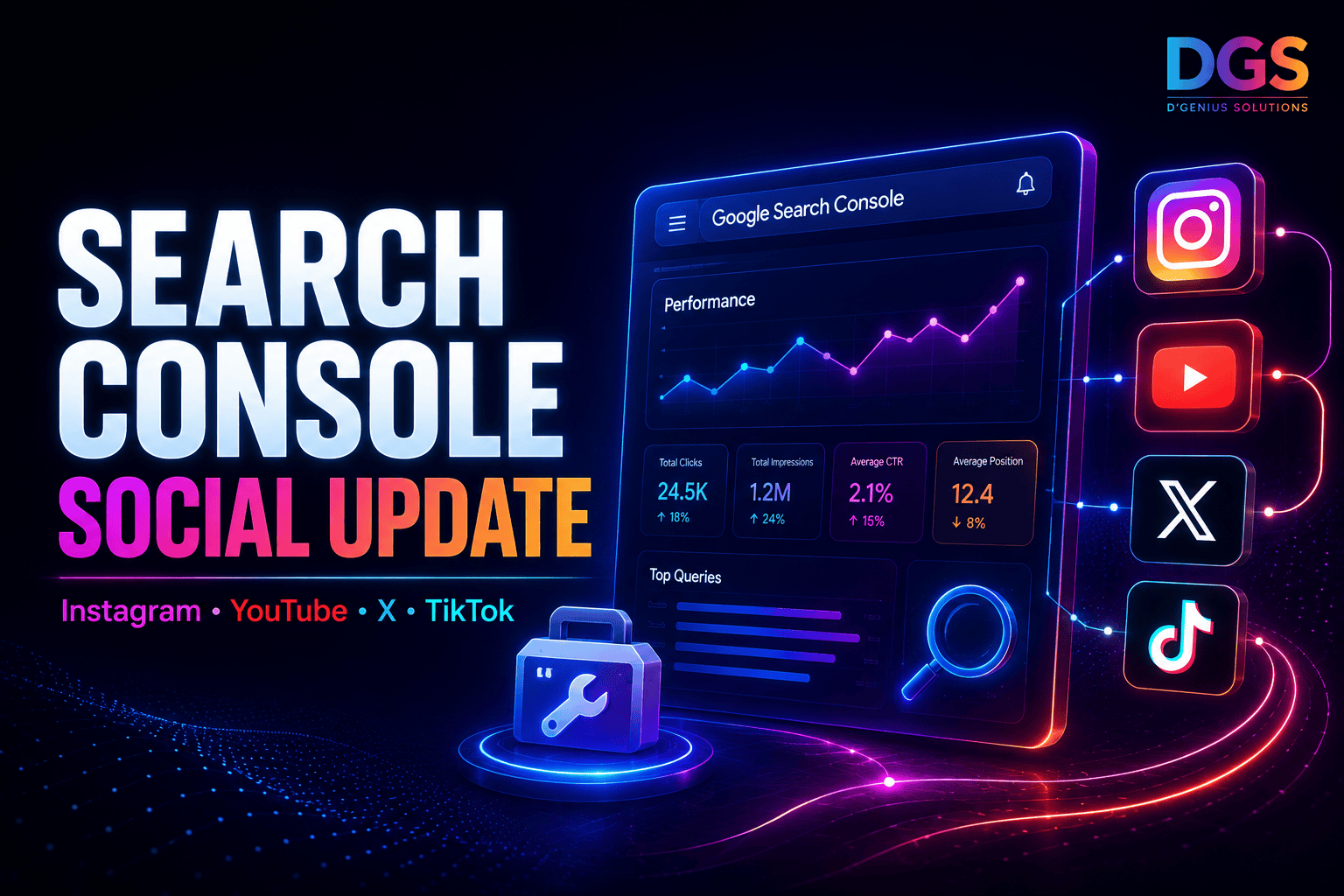
Google Search Console Social Media Update: 7 Key Changes for Brands in 2026 - D'Genius Solutions
Google Search Console social media tracking is becoming an important topic for businesses, marketers, creators and SEO teams. Google Search is no longer