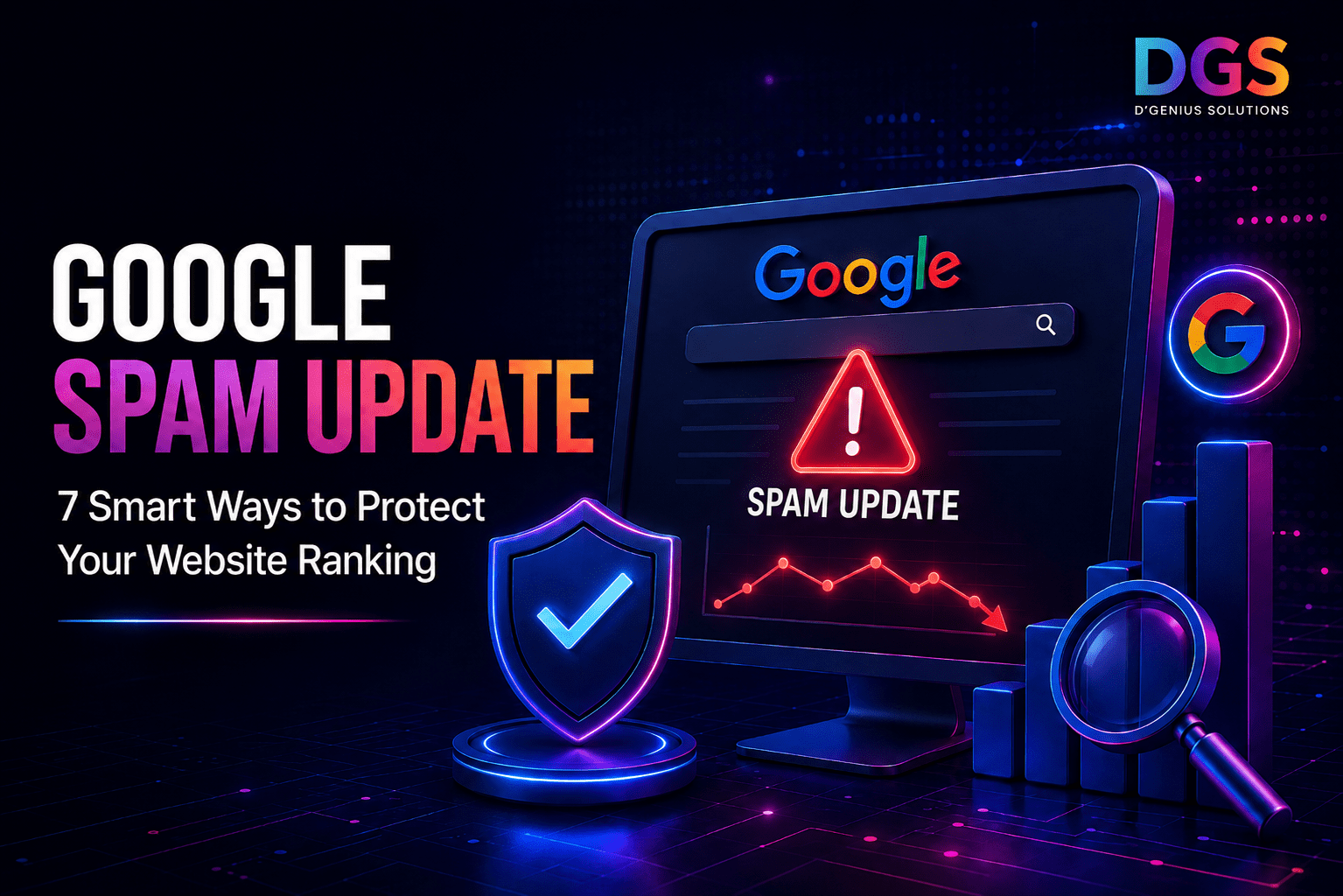
Google Spam Update: 7 Smart Ways to Protect Your Website Ranking
In this article
- Quick Answer
- Introduction
- What Is a Google Spam Update?
- Why Website Rankings Drop After a Google Spam Update
- 7 Smart Ways to Protect Your Website from a Google Spam Update
- 1. Write Helpful Content for Real Users
- 2. Avoid Keyword Stuffing
- 3. Check Your Backlink Quality
- 4. Improve Thin and Weak Pages
- 5. Fix Technical SEO Problems
- 6. Add Strong Internal Links
- 7. Build Trust and EEAT
- How DGS Helps After a Google Spam Update
- Why You Should Not Ignore a Google Spam Update
- Final Thoughts
- FAQs
- 1. What is a Google spam update?
- 2. Why did my ranking drop after a Google spam update?
- 3. Can my website recover after a Google spam update?
- 4. How long does recovery take?
- 5. How can DGS help my website?
Quick Answer
A Google spam update is a search ranking update where Google improves its systems to detect websites using spammy SEO methods. If your website traffic or ranking drops after this update, your content, backlinks, technical SEO, or overall website quality may need a proper review.
Introduction
Many businesses notice a sudden ranking drop after a Google spam update. A page that was ranking well may move down, traffic may reduce, and leads may slow down.
This can feel stressful, especially when nothing was changed on the website. But in many cases, the issue is not a single page or one keyword. Google may recheck the quality of your content, backlinks, website structure, and trust signals.
At D'Genius Solutions, we help businesses understand why their rankings dropped and what needs to be fixed. Our team checks your website from every important SEO angle, including content quality, backlinks, technical SEO, internal links, user experience, and AI search readiness.
For complete SEO support, you can explore our SEO services in Mumbai.
What Is a Google Spam Update?
A Google spam update is an update that helps Google find websites using unfair or low-quality SEO practices. These practices can include keyword stuffing, poor backlinks, copied content, hidden text, doorway pages, auto-generated pages, or content created only to manipulate search ranking.
Google wants to show useful and trustworthy pages to users. So when a website looks like it is made only for ranking and not for real people, its visibility can drop.
This is why websites need clean SEO, helpful content, and strong trust signals.
Why Website Rankings Drop After a Google Spam Update
A ranking drop after a Google spam update can happen for different reasons. Sometimes, your website may not be directly punished. Instead, Google may simply stop giving value to weak backlinks, repeated content, or low-quality pages.
Common reasons include:
Poor-quality backlinks from irrelevant websites, thin content with very little useful information, repeated keywords, duplicate content, weak internal linking, slow website speed, broken pages, missing trust signals, and content that does not answer the user’s search intent.
This is why random changes do not help. A full SEO audit is needed to understand the real problem.
7 Smart Ways to Protect Your Website from a Google Spam Update
1. Write Helpful Content for Real Users
Your content should answer what people are actually searching for. Do not write only to add keywords.
A good page should explain the topic clearly, answer common questions, show your service value, and guide the reader to the next step.
For example, if your page is about SEO services, explain what you do, how you do it, who it helps, and why your process is better.
2. Avoid Keyword Stuffing
Using the same keyword too many times makes the content look forced. Google can understand related words and natural language.
Instead of repeating one phrase again and again, use simple supporting terms like search ranking, website traffic, SEO audit, backlink quality, technical SEO, and content improvement.
The focus keyword should be used naturally, not forcefully.
3. Check Your Backlink Quality
Backlinks can help your website rank, but only when they come from relevant and trusted sources.
Spammy backlinks from unrelated websites, copied article sites, low-quality directories, or bulk link-building platforms can hurt your SEO value. After a Google spam update, these links may stop helping your website.
DGS reviews your backlink profile, checks anchor text, finds low-quality links, and helps you build a safer link strategy.
4. Improve Thin and Weak Pages
Pages with very little content may not perform well after Google updates. If a page has only a few lines, Google may not understand its real value.
Every important service page should include clear headings, useful explanations, FAQs, internal links, images with alt text, and trust-building information.
This improves both SEO and user experience.
5. Fix Technical SEO Problems
Even strong content can struggle if the website has technical issues.
Problems like slow loading speed, broken links, wrong canonical tags, poor mobile layout, missing schema, duplicate URLs, and indexing errors can affect ranking.
Our website development and AMC service helps businesses keep their website technically clean, fast, secure, and search-friendly.
6. Add Strong Internal Links
Internal links help Google understand which pages are important on your website. They also help users move from one topic to another without confusion.
For example, this blog can naturally connect to SEO services, website maintenance, AI search optimization, and LLM SEO.
You can also explore our LLM SEO services to improve visibility across AI-powered search results.
7. Build Trust and EEAT
Google looks for signals that show your business is real, experienced, and trustworthy.
Add details such as case studies, client work, service process, business location, team experience, testimonials, FAQs, and clear contact options.
These signals help users trust your brand and help search engines understand your authority.
How DGS Helps After a Google Spam Update
DGS helps businesses recover and improve after a Google spam update with a practical SEO process.
We first study your website and ranking changes. Then we check your content, backlinks, technical errors, page structure, internal links, and Google Search Console data.
After that, we create a clear action plan. This may include rewriting weak content, improving service pages, fixing technical issues, cleaning link signals, adding schema, improving EEAT, and preparing the website for AI search visibility.
Our goal is not short-term ranking tricks. We focus on clean SEO that can support long-term growth.
Why You Should Not Ignore a Google Spam Update
Ignoring a Google spam update can make the ranking problem worse. If your website has weak content, poor links, or technical issues, competitors may move ahead while your traffic keeps falling.
The best step is to review your website early. A proper audit can show what is working, what is risky, and what needs improvement.
DGS helps you take the right action instead of guessing.
Final Thoughts
A Google spam update is a strong reminder that SEO should be clean, useful, and user-focused. Websites that depend on shortcuts may lose visibility, while websites with helpful content and strong trust signals have a better chance to grow.
If your website ranking has dropped, DGS can help you find the reason and improve your search visibility with better SEO, stronger content, technical fixes, and AI-ready optimization.
To start improving your rankings, visit our SEO services in Mumbai or explore our LLM SEO services.
FAQs
1. What is a Google spam update?
A Google spam update is an update where Google improves its systems to detect spammy or manipulative SEO practices.
2. Why did my ranking drop after a Google spam update?
Your ranking may drop because of poor backlinks, thin content, keyword stuffing, duplicate pages, technical issues, or weak trust signals.
3. Can my website recover after a Google spam update?
Yes, recovery is possible if you fix the actual issues. This may include content improvement, backlink review, technical SEO fixes, and better internal linking.
4. How long does recovery take?
Recovery can take weeks or months. It depends on the issue, the quality of fixes, and how Google re-evaluates your website over time.
5. How can DGS help my website?
DGS helps with SEO audits, content optimization, backlink review, technical SEO, internal linking, EEAT improvement, and AI search readiness.
Accelerate Your Digital & Search Growth
Speak directly with our Mumbai-based SEO, AI search, and digital marketing strategists for a bespoke growth audit.
Get a Free Strategy AuditRelated Insights
Google August 2026 Spam Update What Businesses Need to Know About SEO Rankings - D'Genius Solutions
The Google August 2026 spam update has put website quality back under the spotlight. Learn what businesses need to know about SEO rankings.
Google AI Search Update: 7 Ways Businesses Can Get Better Leads - D'Genius Solutions
Google AI Search Update helps businesses improve AI search visibility, build trust, answer user queries, and generate better leads.
Google Ranking: 7 Proven Fixes for Better Visibility
Google ranking can improve when your website SEO, technical issues, content quality, backlinks, and local SEO signals are properly optimized. Learn how to fix it.