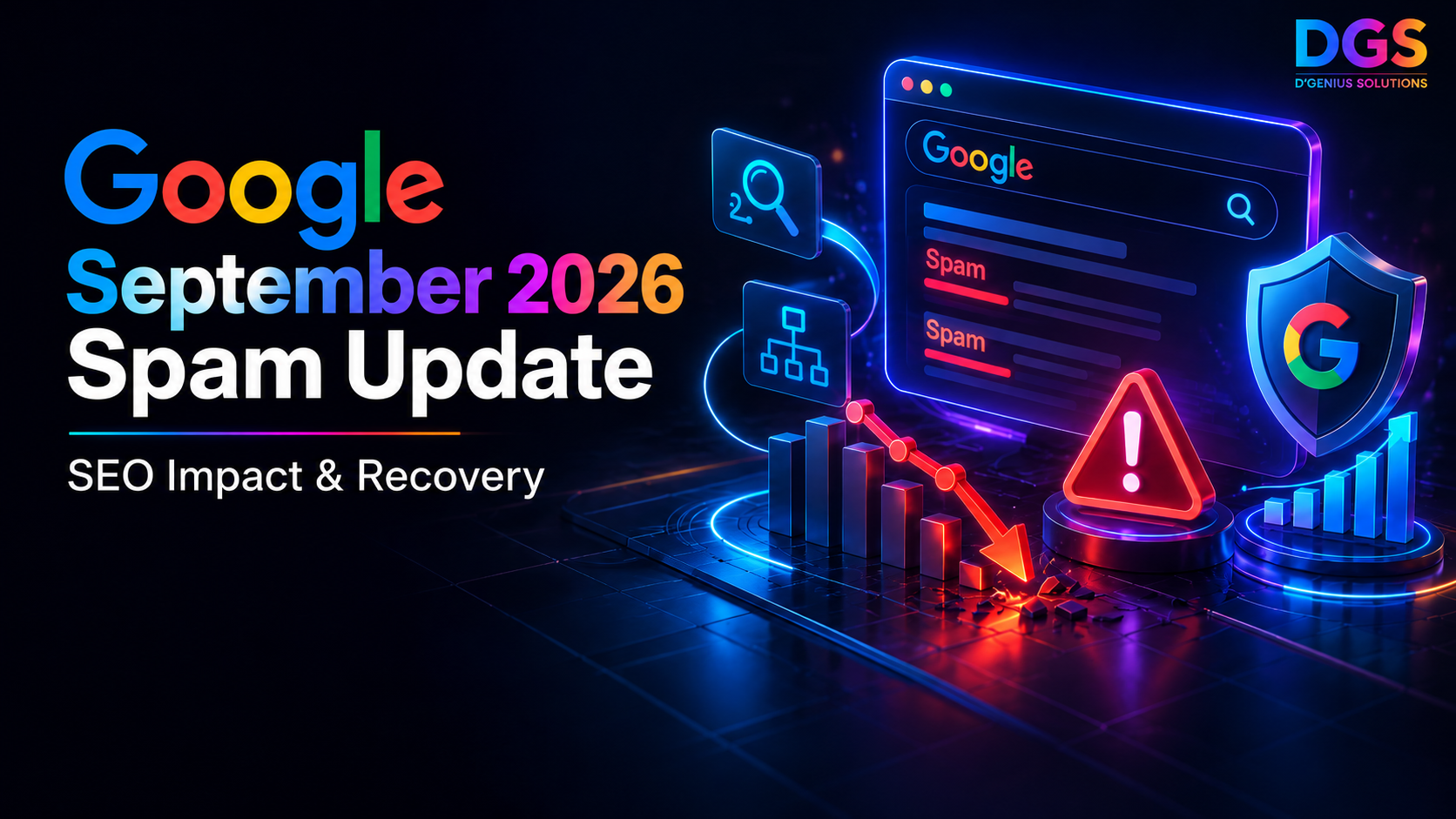
Google September 2026 Spam Update: What Changed, Why Rankings Fluctuated, and What Businesses Should Do Next
In this article
- Google September 2026 Spam Update: What Changed, Why Rankings Fluctuated, and What Businesses Should Do Next
- What Happened During Google's September 2026 Spam Update?
- Why Did SEO Rankings Fluctuate During the Update?
- What Types of Websites Could Be Affected by Google's Spam Updates?
- Google Shares New Insights Into Crawling and Indexing Timelines
- Why Crawling and Indexing Are Not the Same as Ranking
- How Long Does SEO Recovery Take After a Google Update?
- Google Search Console Makes International SEO Reporting Easier
- Google Raises Concerns About Fake Author Profiles
- What Google's Latest Changes Mean for AI Search and GEO
- What Should Businesses Do After the September 2026 Spam Update?
- Why Sustainable SEO Matters More Than Chasing Algorithm Updates
- Final Thoughts
- 1. What is the Google September 2026 Spam Update?
- 2. When did the Google September 2026 Spam Update start and end?
- 3. How can I tell if my website was affected by Google's spam update?
- 4. How long does it take to recover from a Google spam update?
- 5. Does AI-generated content affect Google rankings after the spam update?
Google September 2026 Spam Update: What Changed, Why Rankings Fluctuated, and What Businesses Should Do Next
Google has completed another major spam update, and if you've been keeping an eye on your website's rankings, you might have noticed some unusual movements in search results.
Some websites experienced fluctuations in keyword positions, while others saw changes in organic visibility. Naturally, this raised questions among business owners and SEO professionals. Was Google penalizing websites? Were the changes temporary? And most importantly, what should businesses do to protect their rankings?
The September 2026 Google Spam Update, which rolled out between September 24 and October 8, 2026, brought renewed attention to spam policies, search quality, and the way Google evaluates websites.
But the update wasn't the only important SEO development.
Google also shared insights into how long it can take to discover, crawl, and index webpages, process website migrations, and recognize improvements after algorithm updates.
These developments matter because many businesses expect SEO results almost immediately. They publish a blog, optimize a service page, or fix a technical issue and anticipate higher rankings within days.
Search engines don't always work that way.
Let's explore what happened during Google's latest spam update, what it means for your website, and how businesses can approach SEO more effectively in 2026.
What Happened During Google's September 2026 Spam Update?
Google officially began rolling out its September 2026 spam update on September 24. The rollout continued for nearly two weeks before finishing on October 8, 2026.
Compared with several earlier spam updates in 2026, which reportedly completed within three days, this rollout took considerably longer.
That immediately caught the attention of the SEO community.
Google's spam updates are designed to improve how its automated systems identify websites and content that violate its search spam policies.
These systems work to prevent manipulative practices from influencing search results and help users find more useful, relevant, and trustworthy information.
For example, imagine searching for reliable information about choosing a digital marketing agency.
You would expect to find websites that explain services, showcase relevant experience, and answer your questions. Instead, some websites attempt to improve rankings through mass-produced pages, unnatural backlinks, or content designed primarily for search engines.
Spam updates are intended to make these tactics less effective.
However, one important distinction needs to be made: a website losing rankings during a spam update does not automatically mean Google has penalized it.
Ranking changes can happen for several reasons, including competition, changes in search demand, technical issues, content relevance, or inaccurate reporting from third-party tools.
That's why understanding the data behind a ranking change is just as important as knowing that an algorithm update occurred.
Why Did SEO Rankings Fluctuate During the Update?
One of the most interesting developments surrounding Google's September spam update was the discussion about ranking-tracking accuracy.
According to the Search Engine Journal report, SEOmonitor raised concerns about incomplete or inconsistent data being returned to automated ranking systems during the rollout.
This matters more than it might initially seem.
Many businesses use SEO tools to monitor their target keywords. When those tools suddenly report that an important keyword has dropped from position four to position fifteen, the immediate reaction is often to assume something has gone wrong with the website.
But ranking-tracking tools are not the same as Google Search Console.
Third-party platforms collect search results through their own systems, and reporting discrepancies can occasionally make ranking changes appear more dramatic than they actually are.
Consider a business targeting the keyword "SEO services in Mumbai."
Its ranking tool shows a sudden decline, but Google Search Console indicates that impressions and clicks have remained relatively stable.
In that situation, making major changes to the website based solely on the tracking tool could create more problems than it solves.
The smarter approach is to investigate the trend across several data sources.
Look at organic clicks, impressions, average positions, landing-page performance, and conversions. If multiple indicators show a consistent decline, there may be a genuine issue worth investigating.
This is where a structured SEO strategy and website audit becomes valuable. Rather than reacting to every ranking movement, businesses can identify whether the problem is technical, content-related, competitive, or potentially connected to Google's search policies.
What Types of Websites Could Be Affected by Google's Spam Updates?
Google's spam systems are not designed to punish websites simply because they publish frequently, use AI tools, or compete for popular keywords.
The underlying concern is whether websites are using practices that manipulate search rankings instead of providing genuine value.
One area businesses should pay attention to is scaled content production.
With AI writing tools becoming widely available, creating hundreds of articles has become easier than ever. But publishing a large volume of content does not automatically make a website authoritative.
Imagine two websites covering the same industry.
The first publishes 100 articles that repeat information already available online, offer little original insight, and exist mainly to target keyword variations.
The second publishes 20 carefully researched articles that address real customer questions, explain complex topics clearly, and offer practical recommendations based on industry experience.
The second website may provide a more useful experience, even though it publishes considerably less content.
Another concern is manipulative link building.
Backlinks can support a website's reputation, but buying links to pass ranking credit, participating in excessive link exchanges, or building automated link networks can violate Google's spam policies.
Businesses also need to be cautious about doorway pages, deceptive redirects, and content created primarily to attract search traffic without satisfying the visitor's needs.
The lesson is simple: SEO should make a website more useful and discoverable, not merely create signals intended to influence search engines.
Google Shares New Insights Into Crawling and Indexing Timelines
While the spam update attracted attention, another important development could change how businesses think about SEO timelines.
During Google's Search Central Live Deep Dive event in Barcelona on October 2, 2026, Google's Gary Illyes discussed approximate time ranges associated with several search processes.
The information, subsequently covered by Search Engine Journal, offered insight into how long Google may take to discover URLs, refresh existing pages, process sitemaps, recognize canonical changes, and handle website migrations.
For example, the event recap indicated that discovering a new URL might typically take around 20 hours, while refreshing a known page could take approximately 30 days.
Sitemap processing was discussed in terms of roughly 24 hours, while canonicalization changes could take one to three weeks.
Website migrations, meanwhile, may require one to three months to be processed more fully.
These numbers are not guarantees. A webpage might be discovered much sooner or much later depending on its accessibility, importance, internal linking, crawl demand, and other factors.
Some pages might never be indexed at all.
Still, these insights help explain a common frustration businesses experience.
They make a change to their website on Monday and expect Google to recognize it by Tuesday.
In reality, Google's systems need time to discover the updated URL, crawl its content, process the information, and potentially reconsider how the page should appear in search results.
Understanding this process can prevent businesses from making unnecessary changes simply because their rankings haven't improved immediately.
Why Crawling and Indexing Are Not the Same as Ranking
One of the biggest misunderstandings in SEO is assuming that once Google indexes a webpage, it should immediately start ranking.
That isn't how search works.
Crawling is the process through which Googlebot discovers and accesses website content. Indexing happens when Google processes that information and decides whether to include the page in its search index.
Ranking comes later, when Google's systems evaluate which indexed pages are most relevant and useful for a particular search query.
Let's say a business publishes a detailed article about improving online visibility.
Google might crawl the article within a day and index it shortly afterward. But that doesn't mean it will rank above websites that have been covering the subject for years.
Those competing pages may already have strong internal linking, established reputations, useful examples, and content that closely matches what users are searching for.
The newly published article needs to compete on relevance and quality.
This is also why technical SEO matters.
If important pages are difficult to discover, blocked from crawling, incorrectly canonicalized, or disconnected from the website's internal linking structure, their search performance can suffer.
A website's technical foundation makes its content accessible. The quality and relevance of that content help determine whether it deserves visibility.
Both need to work together.
How Long Does SEO Recovery Take After a Google Update?
Perhaps the most frustrating part of an algorithm update is not knowing when rankings might recover.
During the October Search Central Live event, the attendee-reported timing ranges suggested that recovery associated with core updates could commonly take three to six months, with more complicated cases taking longer.
However, those estimates are not official recovery deadlines, and they should not be applied automatically to spam updates.
The distinction matters.
A core update can change how Google's systems assess the relevance and quality of content across search results. A spam update focuses on detecting and addressing practices that violate Google's spam policies.
If a website has genuinely violated those policies, improving its content, removing manipulative practices, and resolving underlying issues may help it become eligible for better visibility over time.
But recovery is not guaranteed.
In some cases, rankings previously supported by unnatural links may not return because Google is no longer counting those links.
For other websites, the problem might not be spam-related at all. It could be stronger competitors, outdated information, changing user intent, or technical issues.
This is why businesses shouldn't respond to an update by immediately deleting articles, changing every title tag, or rebuilding their websites.
The first priority should be understanding what actually changed.
An evidence-based SEO audit can identify which pages lost traffic, which search queries were affected, and whether the decline reflects a temporary fluctuation or a sustained performance problem.
Google Search Console Makes International SEO Reporting Easier
Google also introduced a useful improvement to Search Console's Performance report in October 2026.
Website owners can now select multiple countries within the same filter and review their combined search performance.
Previously, analyzing traffic across several markets often required additional comparisons or external reporting tools.
This may sound like a relatively small update, but it is particularly helpful for businesses targeting multiple geographic markets.
Consider an Indian company offering services to customers in India, the UAE, and the UK.
Instead of reviewing each country's performance separately to understand its combined search visibility, the marketing team can now group these countries within Search Console.
The feature makes it easier to understand how selected markets are performing collectively.
However, businesses should still examine country-level trends.
An increase in overall impressions might look positive, even when visibility is declining in a strategically important market.
SEO reporting becomes useful when it connects search performance with business objectives, not simply when it displays larger numbers.
For companies expanding into new regions, combining international SEO planning with localized content and market-specific keyword research remains important.
Google Raises Concerns About Fake Author Profiles
Another development highlighted in the Search Engine Journal report involved Google's updated guidance on people-first content.
Google has explicitly warned against fabricated author profiles that create a misleading impression of expertise.
This includes made-up author names, AI-generated profile pictures presented as real individuals, and false professional credentials.
The concern is not the use of AI-generated imagery itself. It is the deliberate attempt to convince readers that content has been written or reviewed by an expert who does not actually exist.
Think about a website publishing financial advice under the name of a fictional investment consultant with an impressive-looking biography.
Visitors might trust the content because they believe a qualified professional created it.
When that expertise is fabricated, the website is misleading its audience.
For businesses, the solution is straightforward: be transparent about content ownership and expertise.
If an article is written by an internal marketing team, it can be published under that team's name. If an industry specialist reviews technical content, their actual involvement can be disclosed.
Real experience, reliable information, and accurate authorship are more valuable than manufactured credentials.
This also highlights the importance of E-E-A-T: Experience, Expertise, Authoritativeness, and Trustworthiness.
E-E-A-T is a framework reflected in Google's quality guidance, not a separate numerical ranking score. It helps explain the characteristics of content that users should be able to trust.
What Google's Latest Changes Mean for AI Search and GEO
Search is no longer limited to the familiar list of blue links.
People increasingly use AI-powered tools to research products, compare service providers, and ask detailed questions before making decisions.
This has led businesses to explore Answer Engine Optimization (AEO) and Generative Engine Optimization (GEO) alongside traditional SEO.
The October SEO developments provide an interesting perspective on this shift.
Google's John Mueller discussed how some AI crawlers access XML sitemaps and RSS feeds to discover website content.
Unlike Google Search Console, many AI crawlers do not offer a dedicated system through which website owners can submit their sitemaps.
That makes technical accessibility and conventional discovery methods worth maintaining.
However, making a sitemap accessible does not guarantee that an AI system will crawl, cite, or recommend a website.
The broader lesson is that websites should build a strong foundation of accessible, useful, and clearly organized information.
Traditional SEO services help improve website accessibility and organic search performance.
Answer Engine Optimization services focus on structuring useful information around the questions people ask, while Generative Engine Optimization services aim to strengthen how brands and their content are discovered and represented in AI-powered search environments.
These disciplines are not identical, but they share an important principle: content should be useful, credible, easy to understand, and technically accessible.
What Should Businesses Do After the September 2026 Spam Update?
Now that Google's latest spam update has finished rolling out, businesses have an opportunity to review their SEO performance with more context.
The first step is to compare Google Search Console data from before, during, and after the September 24 to October 8 rollout.
Look beyond individual keyword rankings.
Has organic traffic declined across the entire website, or only on specific pages? Are impressions falling while clicks remain stable? Have important commercial keywords lost visibility? Are enquiries and conversions being affected?
These questions help distinguish genuine business impact from ordinary ranking movements.
Next, review the pages showing the largest sustained declines.
For content-heavy websites, this may involve evaluating whether articles provide original insights, answer search queries effectively, and remain accurate.
For service-based businesses, the focus might include improving service descriptions, internal links, page structure, and explanations of the value offered to customers.
Technical problems also deserve attention.
A website with broken internal links, unnecessary redirects, incorrect canonical tags, or inaccessible pages may struggle to maintain visibility regardless of how well its content is written.
Businesses should also examine their backlink strategies, particularly if they have relied heavily on paid placements, automated submissions, or unnatural link exchanges.
Rather than attempting to reverse every ranking decline immediately, prioritize improvements supported by clear evidence.
Most importantly, give Google sufficient time to recrawl and reassess meaningful changes.
Consistent SEO improvements are generally more sustainable than reacting impulsively to every algorithm announcement.
Why Sustainable SEO Matters More Than Chasing Algorithm Updates
Every major Google update generates the same familiar questions.
Which websites won? Which websites lost? What changed in the algorithm? And what is the quickest way to recover?
Those questions are understandable, especially when organic traffic contributes directly to business revenue.
But businesses that build their entire SEO strategy around reacting to individual updates often lose sight of what their customers actually need.
Consider a company that consistently publishes helpful resources, keeps its website technically healthy, updates outdated information, and improves its service pages based on genuine customer questions.
Its website is not immune to ranking fluctuations.
However, those practices create a stronger foundation for long-term search performance than constantly chasing shortcuts.
The same principle applies as AI-powered search becomes more prominent.
Instead of publishing content exclusively to target a keyword or trigger an AI citation, businesses should focus on becoming credible sources of information within their industries.
At D'Genius Solutions, we approach search visibility as an ongoing process rather than a one-time ranking exercise. By combining technical SEO, content strategy, AEO, and GEO, businesses can work toward stronger discoverability across traditional and AI-powered search platforms.
Ultimately, the objective is not simply to appear in more search results. It is to reach the right audience, answer their questions, and turn relevant visibility into meaningful business opportunities.
Final Thoughts
Google's September 2026 spam update is another reminder that search visibility is continuously evolving.
The update itself lasted nearly 14 days, but its implications go beyond the rollout period.
The accompanying discussions about crawling timelines, indexing, ranking recovery, Search Console reporting, author authenticity, and AI crawler behavior reveal how many different factors contribute to a website's search performance.
For businesses, the biggest takeaway is not to panic whenever rankings fluctuate.
A decline in an SEO tracking tool does not automatically mean a penalty. A newly published page not ranking immediately does not necessarily mean something is broken. And a technical fix does not guarantee overnight recovery.
Successful SEO requires understanding the data, identifying genuine problems, and making improvements that serve users.
As Google continues refining its search systems and AI-powered discovery grows, businesses that invest in technically sound websites, trustworthy content, and sustainable optimization practices will be better prepared to compete.
If your website has experienced declining organic traffic or inconsistent keyword rankings, a detailed SEO assessment can help identify potential issues and opportunities for improvement.
Frequently Asked Questions (FAQs)
1. What is the Google September 2026 Spam Update?
The Google September 2026 Spam Update is an algorithm update designed to improve Google's ability to detect websites and content that violate its search spam policies. It focuses on reducing the influence of manipulative SEO practices, such as scaled content abuse, unnatural link building, and misleading website content, to improve the quality of search results.
2. When did the Google September 2026 Spam Update start and end?
Google's September 2026 Spam Update started on September 24, 2026, and finished rolling out on October 8, 2026. The rollout lasted approximately 13 days and 16 hours, making it longer than several earlier spam updates released in 2026.
3. How can I tell if my website was affected by Google's spam update?
Start by reviewing your website's performance in Google Search Console. Compare organic clicks, impressions, average positions, and landing-page performance before and after the update. A sustained decline across multiple important pages may indicate an issue worth investigating. However, ranking fluctuations alone do not confirm that a website has been affected by Google's spam-detection systems.
4. How long does it take to recover from a Google spam update?
Recovery from a Google spam update can take several months, depending on the underlying issues and the improvements implemented. Websites should review Google's spam policies, address violations, and maintain compliance. Recovery is not guaranteed, particularly when previous rankings benefited from manipulative backlinks that Google has stopped counting.
5. Does AI-generated content affect Google rankings after the spam update?
AI-generated content is not automatically penalized by Google. What matters is the purpose, quality, accuracy, and usefulness of the content. Websites that publish large volumes of low-value AI-generated articles primarily to manipulate search rankings may violate Google's scaled content abuse policy. Businesses should prioritize original insights, accurate information, and content that addresses genuine user needs.
Accelerate Your Digital & Search Growth
Speak directly with our Mumbai-based SEO, AI search, and digital marketing strategists for a bespoke growth audit.
Get a Free Strategy AuditRelated Insights
AEO in 2026 How to Rank on ChatGPT and Perplexity - D'Genius Solutions
AEO in 2026 is becoming an important part of search marketing as people increasingly use ChatGPT, Perplexity and other AI-powered platforms to research companies.
Google Ads AI Max 2026 What Advertisers Need to Know Before the September Changes - D'Genius Solutions
Google Ads AI Max 2026 is changing how advertisers manage Search campaigns, targeting, advertising assets and landing pages.
7 Proven Tips to Hire an SEO Agency in Mumbai - D'Genius Solutions
Choosing the right SEO Company in Mumbai can directly affect your website visibility, lead generation and long-term digital growth. Here are 7 proven tips.