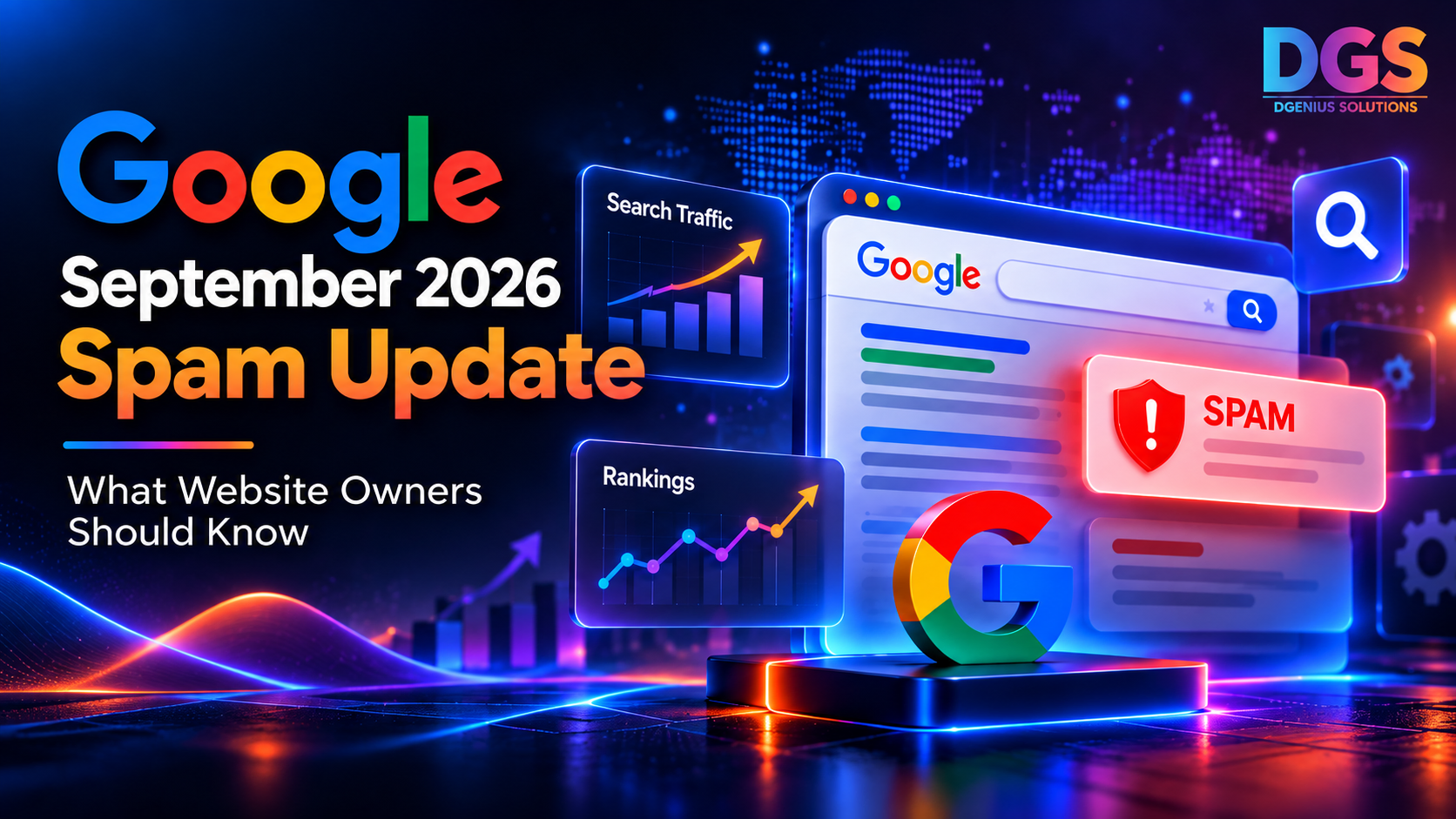
Google September 2026 Spam Update What Website Owners Should Know
In this article
- Google September 2026 Spam Update What Website Owners Should Know
- Quick Answer
- What Is the September 2026 Spam Update?
- A Ranking Drop Does Not Automatically Mean Your Website Is Spam
- What Types of Website Practices Should Be Reviewed?
- Why Repetitive AI Content Can Become a Problem
- Humanised Content Matters More Than Ever
- What Should You Check If Traffic Dropped After September 24?
- Review Your Most Important Service Pages
- Backlinks Still Need to Make Sense
- Technical SEO Can Still Be the Real Problem
- Spam Updates Now Matter Beyond Traditional SEO
- What Businesses Should Do During the Rollout
- Can Rankings Recover After a Spam Update?
- How DGS Approaches SEO After Google Updates
- FAQs
- When did the Google September 2026 Spam Update start?
- Is the September 2026 Spam Update global?
- Does a traffic drop mean my site has been penalised?
- Is AI-generated content against Google guidelines?
- Should I rewrite my entire website during the update?
Google September 2026 Spam Update What Website Owners Should Know
Google has started rolling out its September 2026 Spam Update, and websites across industries are already seeing movement in rankings, impressions and organic traffic.
The update began on September 24, 2026 and is being rolled out globally across all languages. Google has said that the rollout may take up to two weeks to complete.
For businesses, marketers and website owners, the important question is not simply whether rankings have moved.
The bigger question is whether the website is built on strong enough foundations to remain visible when Google improves the way it detects low-quality or manipulative search practices.
Quick Answer
The Google September 2026 Spam Update is a global search update designed to improve Google’s spam-detection systems.
Google has not announced that the update is focused on one particular type of spam. Instead, website owners should review overall content quality, backlinks, technical SEO, duplicate pages, scaled content and compliance with Google’s spam policies.
If rankings have dropped since September 24, avoid making rushed changes based on a few days of volatility. Analyse the actual pages and queries affected before deciding what needs improvement.
What Is the September 2026 Spam Update?
Google runs automated systems that help identify websites or pages that appear to manipulate search rankings.
These systems are updated regularly.
When Google makes a significant improvement to them, it may release what it calls a spam update.
The September 2026 update is one such rollout.
It applies globally and across all languages, which means businesses in India are just as likely to notice ranking fluctuations as websites operating in other markets.
The update is also important because Google has not publicly said that it is targeting one narrow tactic.
That makes it more useful to look at the broader quality of a website rather than trying to guess one specific algorithmic trigger.
A Ranking Drop Does Not Automatically Mean Your Website Is Spam
This is one of the biggest misunderstandings during any Google update.
If rankings decline during the rollout, it does not automatically mean Google has labelled the website as spam.
Organic visibility can change for many reasons.
A competitor may have improved its content.
A page may no longer match search intent as closely as before.
Google may be showing more AI-generated search experiences.
A technical indexing problem may have appeared.
Or a website may genuinely have quality issues that are becoming easier for Google to detect.
This is why businesses should focus on diagnosis rather than panic.
A structured SEO audit through DGS SEO Services in Mumbai can help identify whether ranking losses are linked to content quality, technical SEO, backlinks, indexing or broader search changes.
What Types of Website Practices Should Be Reviewed?
Google’s spam policies cover a wide range of practices.
Some of the most important areas businesses should review include:
- large volumes of weak or repetitive content
- pages created only to target minor keyword variations
- manipulative link-building
- hidden text or links
- keyword stuffing
- misleading redirects
- doorway pages
- low-value affiliate pages
- site reputation abuse
- content produced mainly for search engines rather than users
The important point is that Google is becoming better at evaluating overall value.
A website cannot rely forever on publishing more pages, adding more keywords or creating more backlinks if those activities do not genuinely help users.
Why Repetitive AI Content Can Become a Problem
AI has made content production much faster.
That is useful.
But speed can become a problem when businesses start publishing hundreds of pages that all sound similar.
For example, a website may create:
“SEO Company in Mumbai”
“Best SEO Company in Mumbai”
“SEO Agency in Mumbai”
“Top SEO Agency Mumbai”
“Affordable SEO Services Mumbai”
If each page says almost the same thing, the website may be creating volume without adding meaningful value.
The same issue can happen with AI-generated blogs.
If every article is produced from the same structure, contains generic explanations and adds no original experience, it becomes harder for the content to stand out.
AI should support content teams.
It should not replace judgement, expertise and genuine information.
Humanised Content Matters More Than Ever
Good SEO content should feel like it was written for a real person.
That means answering the actual question quickly.
It also means avoiding unnecessary repetition, keyword stuffing and robotic introductions.
A humanised page usually contains:
- clear answers
- natural language
- practical examples
- genuine business knowledge
- realistic recommendations
- useful supporting details
- a clear reason for the page to exist
This kind of content also works better beyond traditional search.
It is easier for AI search systems to interpret, summarise and reference.
What Should You Check If Traffic Dropped After September 24?
Start with Google Search Console.
Do not judge the entire website using only total traffic.
Look deeper.
Compare performance before and after the update began.
Check which pages lost impressions.
Check which keywords lost positions.
Check whether the decline is sitewide or limited to one section.
For example, if only blog traffic drops, the issue may be related to content quality or search demand.
If service pages drop, search intent or competition may have changed.
If impressions remain stable but clicks decline, search-result layouts may be changing.
This page-level analysis is far more useful than simply saying, “The spam update affected us.”
Review Your Most Important Service Pages
Service pages often become overloaded with keywords over time.
Businesses sometimes keep adding phrases because they want to rank for every possible variation.
Eventually, the page becomes repetitive.
Instead of repeating the same service phrase again and again, explain the service properly.
Cover what the service includes.
Explain who it is for.
Answer common buying questions.
Add proof, process and relevant expertise.
DGS follows this broader approach through its SEO Services in Mumbai rather than treating SEO as keyword insertion alone.
Backlinks Still Need to Make Sense
Backlinks remain useful, but quality matters more than raw volume.
A website with hundreds of low-quality links from unrelated platforms may not be in a stronger position than a site with fewer, more relevant mentions.
Businesses should review whether their links come from:
- relevant websites
- genuine editorial placements
- industry publications
- trusted directories
- useful content partnerships
- brand mentions
A backlink should make sense even if Google rankings were removed from the equation.
That is a good way to judge whether the link has real value.
Technical SEO Can Still Be the Real Problem
Not every ranking decline is about content.
Sometimes the issue is technical.
Common problems include:
- accidental noindex tags
- broken canonical tags
- sitemap errors
- redirect chains
- duplicate URLs
- slow rendering
- JavaScript issues
- broken internal links
- crawl problems
- incorrect robots.txt rules
A strong content strategy cannot perform properly if Google struggles to crawl or understand the website.
DGS combines SEO with Website Development and AMC services so technical recommendations can actually be implemented rather than remaining in an audit document.
Spam Updates Now Matter Beyond Traditional SEO
Search visibility in 2026 is no longer limited to standard Google rankings.
Businesses are increasingly being discovered through:
- Google AI Overviews
- Google AI Mode
- ChatGPT
- Gemini
- Perplexity
- featured snippets
- conversational search
This means website content needs to be understandable for both search engines and AI-driven systems.
Clear answers, strong topical relevance, structured content and trusted brand signals matter across all of these environments.
DGS supports this broader search ecosystem through AEO Services, GEO Services and LLM SEO Services.
What Businesses Should Do During the Rollout
The best response to a spam update is not to make random SEO changes.
Instead, review the website logically.
Start with the pages that generate the most traffic, leads or revenue.
Look for thin content.
Remove unnecessary duplication.
Improve pages that exist only to target slight keyword variations.
Review suspicious or irrelevant backlinks.
Check indexing and technical health.
Strengthen internal linking.
Add real expertise and first-hand information wherever possible.
The goal should be to improve the website itself, not simply react to an algorithm.
Can Rankings Recover After a Spam Update?
Yes, rankings can improve after genuine issues are corrected.
But recovery may not happen immediately.
Google needs time to recrawl pages, reassess the website and process wider changes across its systems.
This is why businesses should avoid expecting rankings to return the day after a page is rewritten.
SEO recovery usually requires consistency.
Fix the issue.
Improve the content.
Keep the site technically healthy.
Continue building real authority.
Then allow search systems enough time to reassess the website.
How DGS Approaches SEO After Google Updates
D'Genius Solutions does not treat every ranking fluctuation as a reason to rebuild an entire website.
The first step is understanding what changed.
That includes reviewing:
- Google Search Console
- affected queries
- affected landing pages
- technical SEO
- internal linking
- backlinks
- search intent
- content quality
- AI search visibility
From there, the SEO strategy can focus on actual weaknesses rather than assumptions.
DGS combines SEO Services, AEO, GEO and LLM SEO to help businesses build visibility across both traditional search and emerging AI-driven discovery platforms.
FAQs
When did the Google September 2026 Spam Update start?
The update began rolling out on September 24, 2026.
Is the September 2026 Spam Update global?
Yes. Google has confirmed that the update applies globally and across all languages.
Does a traffic drop mean my site has been penalised?
No. Traffic and ranking declines can happen for several reasons. The affected pages and queries should be reviewed before drawing conclusions.
Is AI-generated content against Google guidelines?
No. AI-generated content is not automatically a problem. The risk increases when content is produced at scale primarily to manipulate search rankings without adding genuine value.
Should I rewrite my entire website during the update?
Usually no. Fix obvious technical or policy issues immediately, but avoid large-scale changes without understanding which pages are actually affected.
Accelerate Your Digital & Search Growth
Speak directly with our Mumbai-based SEO, AI search, and digital marketing strategists for a bespoke growth audit.
Get a Free Strategy AuditRelated Insights
AEO in 2026 How to Rank on ChatGPT and Perplexity
AEO in 2026 is becoming an important part of search marketing as people increasingly use ChatGPT, Perplexity and other AI-powered platforms to research companies, compare services and find direct answers. Traditional Google rankings still matter, but visibility is no longer limited to ten blue links. Businesses now nee
Google Ads AI Max 2026 What Advertisers Need to Know Before the September Changes
Google Ads AI Max 2026 is changing how advertisers manage Search campaigns, targeting, advertising assets and landing pages. Instead of depending only on manually selected keywords and fixed landing pages, Google is giving its AI more freedom to understand search intent, expand relevant reach, customise advertising mes
7 Proven Tips to Hire an SEO Agency in Mumbai
Choosing the right SEO Company in Mumbai can directly affect your website visibility, lead generation and long-term digital growth. The challenge is that many SEO providers make similar promises around rankings, traffic and backlinks, which makes it difficult for businesses to identify the right partner. A strong SEO c