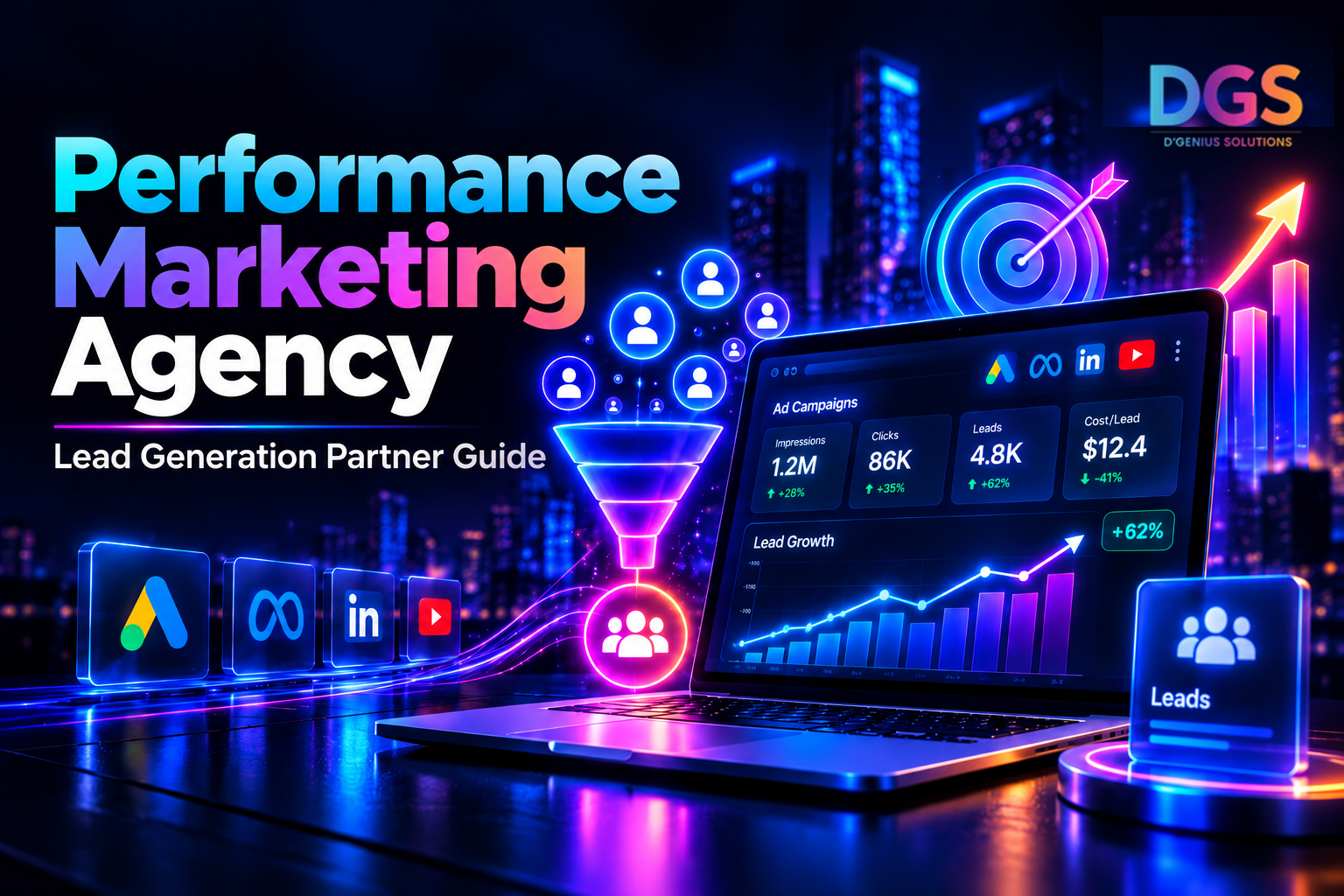
Performance Marketing Agency: How to Choose the Right Partner for Lead Generation
In this article
- Performance Marketing Agency: How to Choose the Right Partner for Lead Generation
- What Does a Performance Marketing Agency Do?
- Why Choosing the Right Performance Marketing Agency Matters
- 1. Start With Your Lead Generation Goals
- 2. Look for Experience Across the Complete Funnel
- 3. Ask How They Measure Lead Quality
- 4. Check Their Google Ads and Meta Ads Capabilities
- Google Ads
- Meta Ads
- 5. Evaluate Their Landing Page Strategy
- 6. Ask About Conversion Tracking Before Campaign Launch
- 7. Look for Transparent Reporting
- 8. Understand Their Creative Testing Process
- 9. Ask How the Agency Handles Remarketing
- 10. Avoid Agencies That Promise a Fixed Number of Leads Without Context
- 11. Check Whether the Agency Understands Your Industry
- 12. Understand How Budget Scaling Works
- 13. Ensure Sales and Marketing Data Are Connected
- Red Flags to Watch for Before Hiring a Performance Marketing Agency
- Questions to Ask a Performance Marketing Agency
- What Does a Good Performance Marketing Partnership Look Like?
- How D'Genius Solutions Approaches Performance Marketing
- Final Thoughts
- FAQs
- What is a performance marketing agency?
- How does a performance marketing agency generate leads?
- How do I choose the best performance marketing company?
- What is the difference between a lead generation agency and a performance marketing agency?
- Is performance marketing suitable for businesses in India?
Performance Marketing Agency: How to Choose the Right Partner for Lead Generation
Generating leads through paid advertising sounds simple: create an ad, choose an audience, set a budget and wait for enquiries.
In reality, profitable lead generation requires much more.
Businesses today are competing for attention across Google, Instagram, Facebook, YouTube and multiple digital touchpoints. Advertising costs are rising, audiences are becoming more selective, and generating a large number of leads means very little if those leads never convert into customers.
This is where choosing the right performance marketing agency becomes important.
A capable agency should not simply manage your advertising budget. It should understand your business, identify the right audience, improve your campaign funnel, track conversions accurately and continuously optimise campaigns around measurable outcomes.
If you are considering hiring a performance marketing company, here is how to evaluate the right partner for sustainable lead generation.
What Does a Performance Marketing Agency Do?
A performance marketing agency manages digital campaigns with a strong focus on measurable business outcomes.
Instead of concentrating only on impressions, followers or website visits, performance marketing is built around actions such as:
- Qualified leads
- Phone calls
- Form submissions
- Product enquiries
- App registrations
- Purchases
- Bookings
- Revenue
- Cost per acquisition
A professional performance marketing agency may work across Google Ads, Meta Ads, PPC campaigns, remarketing, landing page optimisation, conversion tracking and campaign reporting.
The key difference is accountability.
Every campaign should answer a simple question:
What business result did the advertising investment generate?
Why Choosing the Right Performance Marketing Agency Matters
Two agencies can run campaigns on the same advertising platform with very different outcomes.
One may generate hundreds of inexpensive leads that rarely convert.
Another may generate fewer leads at a slightly higher cost but deliver significantly stronger sales opportunities.
That difference usually comes from strategy.
An experienced performance marketing company looks beyond the cost per lead. It evaluates the entire journey from the advertisement to the final conversion.
This includes:
Audience → Advertisement → Landing Page → Enquiry → Lead Quality → Sales
If one stage of this journey is weak, increasing the advertising budget may simply increase wasted spend.
The right agency should therefore focus on improving the complete conversion system rather than only managing advertisements.
1. Start With Your Lead Generation Goals
Before evaluating any lead generation agency, you need clarity about what you want the campaigns to achieve.
For example, your objective may be:
- Generate B2B enquiries
- Increase appointment bookings
- Generate property enquiries
- Acquire education leads
- Generate loan applications
- Increase ecommerce sales
- Drive dealership enquiries
- Generate software demo requests
These goals require different campaign structures.
A B2B campaign targeting enterprise decision-makers cannot be approached in the same way as an ecommerce campaign selling consumer products.
A good performance marketing agency should ask about your business objectives before discussing advertising platforms.
If the first conversation is only about ad budgets, impressions and clicks, the strategy may be too platform-focused.
2. Look for Experience Across the Complete Funnel
Performance marketing is not only about running Google Ads or Meta Ads.
Campaign performance depends on multiple interconnected elements.
A strong digital performance marketing strategy usually includes:
Audience Research
Understanding who is most likely to become a customer.
Campaign Strategy
Selecting the right combination of Google, Meta and other relevant channels.
Creative Strategy
Developing advertising messages and visuals that attract the right audience.
Landing Page Experience
Ensuring users immediately understand the offer after clicking the advertisement.
Conversion Tracking
Measuring calls, forms, purchases and other meaningful actions.
Remarketing
Reconnecting with users who showed interest but did not convert.
Optimisation
Improving targeting, bids, creatives, keywords and landing pages based on campaign data.
Your agency should therefore understand the complete customer journey instead of functioning purely as a paid media agency.
3. Ask How They Measure Lead Quality
One of the biggest mistakes businesses make is judging campaigns entirely by cost per lead.
Imagine two campaigns.
Campaign A generates 100 leads at ₹300 each.
Campaign B generates 60 leads at ₹450 each.
At first glance, Campaign A appears better.
But suppose only five leads from Campaign A become genuine sales opportunities, while twenty leads from Campaign B become qualified prospects.
Campaign B is actually delivering more business value.
This is why your performance marketing agency should measure metrics beyond CPL.
Important metrics may include:
- Qualified lead percentage
- Cost per qualified lead
- Appointment rate
- Lead-to-sale conversion rate
- Customer acquisition cost
- Revenue generated
- Return on advertising spend
The objective is not necessarily to generate the cheapest lead.
It is to generate leads that have a realistic possibility of becoming customers.
4. Check Their Google Ads and Meta Ads Capabilities
Different platforms solve different marketing challenges.
Google Ads
Google Search campaigns are particularly useful when potential customers are actively looking for your product or service.
For example, someone searching for:
“corporate event management company Mumbai”
or
“contract staffing company India”
already has visible intent.
A capable performance marketing company should understand:
- Search campaigns
- Keyword strategy
- Negative keywords
- Performance Max
- Remarketing
- Conversion tracking
- Campaign bidding
- Landing page relevance
Meta Ads
Facebook and Instagram campaigns are useful for reaching audiences based on interests, behaviour, demographics and previous interactions.
Meta advertising often performs well when strong creative communication is required to create interest.
A strong agency should understand:
- Audience segmentation
- Creative testing
- Lead forms
- Website conversion campaigns
- Retargeting
- Lookalike audiences
- Placement optimisation
- Campaign scaling
The right platform depends on your business model rather than whichever platform the agency prefers using.
5. Evaluate Their Landing Page Strategy
Many businesses assume poor campaign performance means the advertisements need improvement.
Sometimes the real problem is the landing page.
A user may click an advertisement because the message is relevant, but leave the website because:
- The page loads slowly
- The headline is confusing
- The form is too long
- There is no clear CTA
- The page lacks credibility
- The mobile experience is poor
- The advertisement and landing page communicate different messages
Good performance marketing services should therefore include landing page analysis.
Even small improvements to the page can significantly improve campaign efficiency without increasing the advertising budget.
6. Ask About Conversion Tracking Before Campaign Launch
You cannot optimise what you cannot measure.
Before campaigns begin, the agency should clearly define which actions count as conversions.
These may include:
- Website forms
- Calls
- WhatsApp enquiries
- Ecommerce transactions
- Appointment bookings
- Demo requests
Tracking may involve platforms such as Google Analytics 4, Google Ads conversion tracking and Meta Pixel, depending on the campaign environment.
Without reliable measurement, a business may continue spending money on campaigns without knowing which channels are producing meaningful results.
A serious performance marketing agency India partner should treat tracking as part of campaign infrastructure, not something added later.
7. Look for Transparent Reporting
Performance reports should help business owners make decisions.
They should not simply contain dozens of graphs without interpretation.
A useful performance marketing report should clearly explain:
- How much was spent?
- How many leads were generated?
- What was the cost per lead?
- Which campaign performed best?
- Which audience generated better leads?
- Which keywords wasted spend?
- Which creatives performed better?
- What changes were made?
- What will be tested next?
Transparency also means discussing underperforming campaigns instead of hiding them.
Performance marketing involves continuous testing. Not every campaign, audience or advertisement will perform equally well.
What matters is how quickly the agency identifies weak areas and improves them.
8. Understand Their Creative Testing Process
Advertising fatigue is common.
An advertisement that performs extremely well today may gradually become less effective as the target audience sees it repeatedly.
That is why creative testing is important.
A capable paid media agency should continuously experiment with elements such as:
- Headlines
- Offers
- Visuals
- Video advertisements
- Static creatives
- Calls-to-action
- Hooks
- Landing page messaging
Testing helps determine what actually influences customer behaviour instead of relying on assumptions.
For Meta advertising in particular, creative quality can have a major impact on campaign results.
9. Ask How the Agency Handles Remarketing
Most users do not convert after their first interaction with a brand.
Someone may visit your website today, compare competitors tomorrow and make a decision several days later.
Without remarketing, the opportunity may disappear.
Remarketing campaigns allow businesses to reconnect with audiences who have already shown interest.
These may include users who:
- Visited your website
- Viewed a product
- Opened a lead form
- Watched a video
- Engaged with your social content
- Added a product to the cart
- Previously interacted with an advertisement
A good lead generation agency should have a clear strategy for nurturing warm audiences instead of focusing entirely on first-time visitors.
10. Avoid Agencies That Promise a Fixed Number of Leads Without Context
Statements such as:
“We guarantee 1,000 leads.”
may sound attractive.
But there are important questions behind that promise.
What type of leads?
From which audience?
At what qualification level?
With what advertising budget?
For which location?
At what acquisition cost?
A professional performance marketing agency should avoid making unrealistic promises before analysing the market, competition, audience and existing campaign data.
Forecasting is useful.
Guaranteeing outcomes without sufficient data is very different.
11. Check Whether the Agency Understands Your Industry
Industry experience can help because customer behaviour differs significantly across sectors.
Lead generation for real estate may require a completely different strategy from recruitment, financial services, healthcare or ecommerce.
An experienced agency will usually begin by understanding:
- Your sales cycle
- Target geography
- Average transaction value
- Customer profile
- Competitors
- Previous campaign performance
- Lead qualification criteria
The better the agency understands the commercial side of your business, the easier it becomes to build campaigns around actual revenue opportunities.
12. Understand How Budget Scaling Works
Campaign scaling should be based on evidence.
Increasing a budget from ₹1 lakh to ₹5 lakh does not automatically produce five times more qualified leads.
As campaigns scale, audience size, keyword competition, frequency and conversion rates may change.
A good performance marketing company typically increases budgets after identifying campaigns that demonstrate consistent performance.
Before scaling, it may evaluate:
- Cost per lead
- Lead quality
- Conversion rate
- Search impression share
- Audience saturation
- Creative performance
- Sales feedback
Scaling based on performance signals is usually more sustainable than increasing budgets aggressively without supporting data.
13. Ensure Sales and Marketing Data Are Connected
Advertising platforms can tell you that a lead was generated.
Your sales team can tell you whether the lead was actually useful.
Those two pieces of information need to connect.
Suppose one campaign generates 50 leads but your sales team says almost all of them are irrelevant.
That feedback should immediately influence the campaign strategy.
Maybe the targeting is too broad.
Maybe the advertisement is attracting the wrong audience.
Maybe the landing page messaging is unclear.
A strong digital performance marketing approach uses both marketing data and sales feedback to improve campaigns.
Red Flags to Watch for Before Hiring a Performance Marketing Agency
Be cautious if an agency:
- Guarantees unrealistic outcomes immediately
- Refuses to explain campaign strategy
- Focuses only on impressions and clicks
- Does not discuss conversion tracking
- Has no process for measuring lead quality
- Avoids sharing campaign data
- Never discusses landing pages
- Uses the same strategy for every business
- Cannot explain how budgets are optimised
The relationship should feel like a strategic partnership, not simply outsourced advertising execution.
Questions to Ask a Performance Marketing Agency
Before finalising a partner, ask questions such as:
How will you understand our target customer?
The answer should involve research rather than assumptions.
Which advertising platforms would you recommend and why?
The recommendation should be based on audience behaviour and campaign goals.
How will you measure lead quality?
Look for answers beyond basic cost-per-lead reporting.
Will you review our landing pages?
Campaign and landing-page optimisation should work together.
How frequently will campaigns be optimised?
Performance marketing should be actively managed.
What does your reporting include?
Reports should explain both performance and next steps.
How do you scale campaigns?
Budgets should increase based on performance signals.
What Does a Good Performance Marketing Partnership Look Like?
The best agency relationships are collaborative.
Your business provides customer insights, sales feedback and product knowledge.
The agency contributes campaign strategy, platform expertise, creative thinking, tracking and optimisation.
Together, both sides continuously improve the funnel.
A strong partnership typically includes:
Clear Goals
Everyone understands the required business outcome.
Reliable Tracking
Conversions are measured accurately.
Regular Optimisation
Campaign decisions are based on real data.
Transparent Communication
Performance problems are discussed openly.
Sales Feedback
Lead quality information reaches the marketing team.
Continuous Testing
New audiences, creatives and campaign structures are regularly explored.
How D'Genius Solutions Approaches Performance Marketing
D'Genius Solutions provides performance marketing services built around qualified leads, sales opportunities and measurable campaign performance.
The approach connects Google Ads, Meta Ads, PPC campaigns, landing page optimisation, remarketing, conversion tracking and campaign reporting rather than treating each activity separately.
Instead of optimising only for traffic, campaigns are structured around buyer intent and meaningful conversion actions.
This allows businesses to understand where their advertising budget is being used, which campaigns are contributing to enquiries and where the funnel needs improvement.
Final Thoughts
Choosing the right performance marketing agency is not about finding someone who can simply launch advertisements.
The right partner should understand your audience, your offer, your sales cycle and your definition of a qualified lead.
Look for a team that combines campaign strategy, creative testing, landing page optimisation, tracking, remarketing and transparent reporting.
Most importantly, judge the agency by business outcomes rather than surface-level advertising numbers.
When the entire funnel works together, performance marketing becomes much more than paid advertising.
It becomes a measurable system for generating consistent business growth.
FAQs
What is a performance marketing agency?
A performance marketing agency manages digital advertising campaigns around measurable actions such as leads, enquiries, calls, bookings, sales and conversions. Campaigns are continuously tracked and optimised using performance data.
How does a performance marketing agency generate leads?
Agencies may use Google Ads, Meta Ads, PPC campaigns, audience targeting, landing pages, conversion tracking and remarketing to reach potential customers and generate enquiries.
How do I choose the best performance marketing company?
Look for an agency that understands your business goals, measures lead quality, uses proper conversion tracking, optimises landing pages, provides transparent reporting and continuously tests campaigns.
What is the difference between a lead generation agency and a performance marketing agency?
A lead generation agency primarily focuses on generating potential customer enquiries. A performance marketing agency may manage the broader acquisition funnel, including paid advertising, conversion optimisation, remarketing, tracking and ROI measurement.
Is performance marketing suitable for businesses in India?
Yes. A capable performance marketing agency India partner can use channels such as Google Ads and Meta Ads to target audiences by location, intent, demographics and online behaviour. The right strategy depends on the industry, customer profile, budget and business objective.
Accelerate Your Digital & Search Growth
Speak directly with our Mumbai-based SEO, AI search, and digital marketing strategists for a bespoke growth audit.
Get a Free Strategy AuditRelated Insights

AEO in 2026 How to Rank on ChatGPT and Perplexity - D'Genius Solutions
AEO in 2026 is becoming an important part of search marketing as people increasingly use ChatGPT, Perplexity and other AI-powered platforms to research companies.
Google Ads AI Max 2026 What Advertisers Need to Know Before the September Changes - D'Genius Solutions
Google Ads AI Max 2026 is changing how advertisers manage Search campaigns, targeting, advertising assets and landing pages.
7 Proven Tips to Hire an SEO Agency in Mumbai - D'Genius Solutions
Choosing the right SEO Company in Mumbai can directly affect your website visibility, lead generation and long-term digital growth. Here are 7 proven tips.