Schema SEO for Small Business: 7 Easy Steps for 2026
In this article
- Quick Answer
- What Is Schema Markup?
- Why Schema SEO for Small Business Is Important
- It explains what your business does
- It improves local business clarity
- It supports richer search features
- It improves website organisation
- Best Schema Types for Small Businesses
- 1. LocalBusiness Schema
- 2. Organization Schema
- 3. Service Schema
- 4. Article or BlogPosting Schema
- 5. BreadcrumbList Schema
- 6. Product Schema
- 7. FAQPage Schema
- How to Implement Schema SEO for Small Business
- Step 1: Check the schema already on your website
- Step 2: Choose schema according to the page
- Step 3: Use JSON-LD
- Step 4: Keep the markup accurate
- Step 5: Test the schema
- Step 6: Submit the page for indexing
- Step 7: Review the markup regularly
- How to Measure Schema SEO for Small Business Performance
- Common Schema Mistakes Small Businesses Should Avoid
- Adding every schema type to every page
- Creating fake ratings
- Using LocalBusiness schema without a real location
- Allowing duplicate schema
- Expecting schema to fix poor content
- Schema SEO and Google Core Updates
- Schema SEO Checklist for Small Businesses
- Frequently Asked Questions
- What is schema SEO for small business?
- Does schema markup improve rankings?
- Which schema type should a small business use?
- Can schema be added through Rank Math?
- How can I check whether schema is working?
- Should schema be added to every page?
- Conclusion
Schema SEO for small business helps search engines understand what a company does, where it operates and what information is available on its website.
A visitor can easily understand a sentence such as “We provide website development services in Mumbai.” Search engines, however, may need clearer signals to identify the business, service, location, contact details and relationship between different pages.
Schema markup provides those signals in a structured format.
For small businesses, correct structured data can improve how business information is interpreted across search results. It can also make eligible pages suitable for enhanced search features such as breadcrumbs, product information, article details and local business data.
Schema markup does not guarantee higher rankings. However, it can support a stronger technical SEO foundation when combined with useful content, a well-built website and accurate business information.
Quick Answer
Schema SEO for small business means adding structured data to a website so search engines can clearly identify the business name, services, location, contact details, products, articles and page structure. Common schema types include LocalBusiness, Organization, Service, Article and BreadcrumbList.
What Is Schema Markup?
Schema markup is code that describes the meaning of information on a webpage.
Regular website text is written mainly for people. Schema markup presents selected information in a machine-readable format that search engines can process more efficiently.
For example, a local business website may display:
- Business name
- Phone number
- Office address
- Opening hours
- Services
- Social media profiles
- Customer reviews
- Service areas
Schema markup identifies what each piece of information represents.
Instead of seeing an address as ordinary text, a search engine can understand that it is the official address of the business. It can also understand whether a page is a service page, article, product page, contact page or location page.
Why Schema SEO for Small Business Is Important
Small businesses often compete against larger brands, directories, marketplaces and established local competitors.
Clear structured data can help search engines understand important details without relying only on visible text.
It explains what your business does
A website may contain several services, blog posts and landing pages. Schema helps identify the main business entity and the purpose of individual pages.
For example, a digital agency website may contain pages for:
- SEO services
- Website development
- Social media marketing
- Branding
- Google Ads
- AI video production
Service schema can help connect each service with the company offering it.
It improves local business clarity
Local businesses need consistent information across their website, Google Business Profile and online listings.
LocalBusiness schema can describe:
- Business name
- Physical address
- Phone number
- Opening hours
- Service area
- Website
- Business category
This is especially useful for clinics, agencies, salons, restaurants, consultants, retailers and professional service providers.
It supports richer search features
Some structured data types can make pages eligible for enhanced appearances in search results.
These may include:
- Breadcrumb navigation
- Product prices
- Product availability
- Article details
- Event information
- Recipe information
- Local business details
Eligibility does not mean Google will always display an enhanced result. The page must also follow search guidelines and provide accurate information.
It improves website organisation
Schema markup can show how different pages and entities are connected.
For example:
- The homepage represents the company
- The service page represents a specific service
- The blog post has an author and publisher
- The breadcrumb shows the page hierarchy
- The contact page belongs to the same organisation
This creates a clearer structure for both users and search engines.
Best Schema Types for Small Businesses
Not every website needs every schema type. The markup should match the actual purpose and visible content of the page.
1. LocalBusiness Schema
LocalBusiness schema is useful for companies that serve customers from a physical location or defined local area.
It can include:
- Business name
- Address
- Phone number
- Email address
- Opening hours
- Location coordinates
- Price range
- Service area
- Website URL
- Business image
Use the most relevant business category available.
For example:
- Dentist
- Restaurant
- LegalService
- Store
- RealEstateAgent
- ProfessionalService
Avoid adding a false office address only to target another city.
2. Organization Schema
Organization schema identifies the company operating the website.
It can include:
- Official business name
- Alternate business name
- Website URL
- Logo
- Contact details
- Address
- Founding date
- Social profiles
This schema type is commonly added to the homepage or About page.
It is suitable for local, national and online businesses.
3. Service Schema
Service schema explains a service offered by the business.
A website development company, for example, may use Service schema for:
- Business website development
- Ecommerce development
- Website maintenance
- Landing page development
- WordPress development
The service description in the schema should match the information visible on the page.
Do not add unrelated service names only to target more keywords.
4. Article or BlogPosting Schema
Article and BlogPosting schema are suitable for educational content, industry updates, guides and company blogs.
Important properties may include:
- Article headline
- Author name
- Publisher
- Publish date
- Modified date
- Featured image
- Page URL
This markup helps search engines understand who created the content and when it was published or updated.
5. BreadcrumbList Schema
Breadcrumb schema explains where a page sits within the website.
A breadcrumb for this article may look like:
Home > Blogs > SEO > Schema SEO for Small Business
Breadcrumbs improve navigation and help users understand the website structure.
6. Product Schema
Product schema is useful for ecommerce websites and product-based businesses.
It may include:
- Product name
- Brand
- Product image
- Price
- Availability
- SKU
- Offer information
- Valid review details
The information in the schema must match the visible product page.
Do not display one price on the page and a different price in the structured data.
7. FAQPage Schema
FAQPage schema can identify questions and answers appearing on a page.
However, adding FAQ schema does not guarantee that Google will display FAQ results.
The questions and answers must be visible to visitors. They should also provide useful information rather than repeat keywords unnaturally.
How to Implement Schema SEO for Small Business
Step 1: Check the schema already on your website
Many WordPress themes, SEO plugins and page builders automatically generate schema.
Before adding new markup, check whether the website already includes:
- Organization schema
- Article schema
- Breadcrumb schema
- WebPage schema
- LocalBusiness schema
Adding another plugin without checking the existing code can create duplicate or conflicting markup.
Use a structured data testing tool to review the current setup.
Step 2: Choose schema according to the page
The schema should describe the actual role of the page.
| Page Type | Recommended Schema |
|---|---|
| Homepage | Organization or LocalBusiness |
| About page | Organization and AboutPage |
| Service page | Service and WebPage |
| Blog post | BlogPosting and BreadcrumbList |
| Contact page | ContactPage and Organization |
| Product page | Product and BreadcrumbList |
| Location page | LocalBusiness and WebPage |
Avoid using Product schema on a service page or Article schema on the homepage.
Step 3: Use JSON-LD
JSON-LD is one of the easiest formats to manage because it can be added without changing visible page content.
Here is a simple LocalBusiness example:
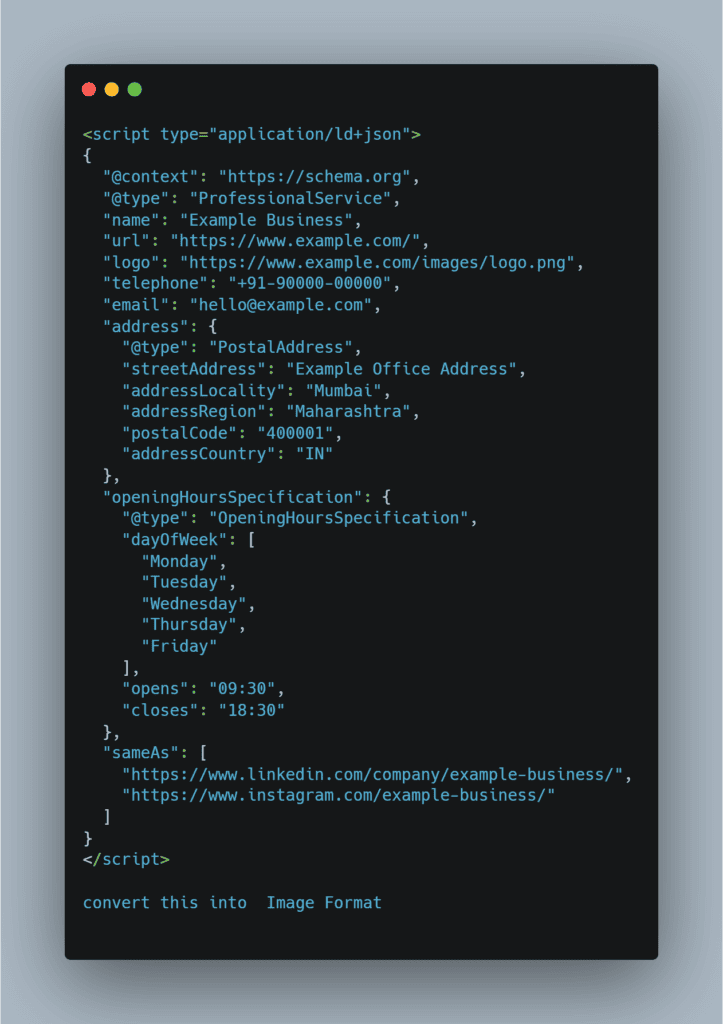
Replace every example value with accurate business information.
Step 4: Keep the markup accurate
Search engines expect structured data to reflect the content visible on the page.
Do not add:
- Fake reviews
- Incorrect ratings
- Hidden prices
- False business locations
- Services that are not offered
- Outdated phone numbers
- Misleading opening hours
- Irrelevant keywords
Schema should clarify real information, not create information that does not exist.
Step 5: Test the schema
After adding structured data, test the page before publishing it.
Check for:
- Missing required fields
- Invalid URLs
- Incorrect date formats
- Broken image links
- Duplicate entities
- Wrong schema types
- Syntax errors
Warnings do not always stop the schema from working, but critical errors should be fixed.
Step 6: Submit the page for indexing
After the schema is published:
- Open Google Search Console
- Use URL Inspection
- Test the live URL
- Confirm that the page can be crawled
- Request indexing
- Monitor structured data reports
Make sure the page is not blocked by robots.txt or a noindex tag.
Step 7: Review the markup regularly
Schema should not be installed and forgotten.
Review it whenever the business changes:
- Address
- Phone number
- Office hours
- Services
- Logo
- Website URL
- Prices
- Product availability
- Social media links
- Author information
Website redesigns and plugin updates can also remove or duplicate structured data.
How to Measure Schema SEO for Small Business Performance
Schema SEO for small business should not be treated as a one-time task. After implementation, you should monitor whether your markup is valid, whether Google can read it correctly, and whether your pages are becoming more understandable in search.
One of the easiest ways to review schema SEO for small business performance is by using Google Search Console and the Google Rich Results Test. These tools help you identify markup errors, warnings, and indexing issues that may affect visibility.
You should also review official guidance from Google’s structured data documentation to ensure that your implementation follows best practices. In addition, the vocabulary used in schema SEO for small business is based on Schema.org, which is the standard reference for structured data types and properties.
For a growing company, schema SEO for small business works best when it is part of a broader SEO strategy that includes strong page content, internal linking, technical SEO, and a well-built website structure. That is why many brands combine schema SEO for small business with professional optimisation and development support.
If your business wants better search visibility, stronger technical foundations, and more clarity for Google, schema SEO for small business should be applied carefully on homepage, service, location, and blog pages.
Common Schema Mistakes Small Businesses Should Avoid
Adding every schema type to every page
More schema does not automatically mean better SEO.
Use only the markup that accurately represents the page.
Creating fake ratings
Some businesses add five-star AggregateRating markup without showing genuine reviews on the page.
This can create trust issues and structured data violations.
Using LocalBusiness schema without a real location
A business should not create false location markup to rank in multiple cities.
Create genuine location pages only when the business actually has an office or serves that area in a meaningful way.
Allowing duplicate schema
A website may generate the same schema through:
- Theme settings
- Rank Math
- Elementor
- A custom plugin
- Manual JSON-LD
Duplicate markup can confuse search engines and make maintenance difficult.
Expecting schema to fix poor content
Schema cannot make weak content valuable.
A useful page still needs:
- Clear information
- Original explanations
- Real expertise
- Easy navigation
- Internal links
- Fast loading
- Mobile usability
- Accurate business details
Schema SEO and Google Core Updates
Google core updates are designed to improve the overall quality and relevance of search results.
There is no single schema method that guarantees protection from a core update. Structured data should be treated as part of a complete SEO strategy.
A strong small business page should include:
- Original content written for the target audience
- Clear author or company information
- First-hand knowledge
- Updated facts
- Useful examples
- Logical headings
- Relevant internal links
- Accurate structured data
- Good page experience
- Secure and mobile-friendly design
The focus should be on making the page genuinely useful, not only improving a plugin score.
Businesses that need help with technical optimisation, structured data and content can use professional SEO services in Mumbai.
Businesses planning a new website should also include structured data during the website development process instead of adding it only after launch.
Schema SEO Checklist for Small Businesses
Before publishing, confirm that:
- The correct schema type is selected
- Business details are accurate
- Schema matches visible page content
- The canonical URL is correct
- Logo and image URLs are working
- Contact information is updated
- Duplicate markup is removed
- Required properties are included
- The code passes validation
- The page can be indexed
- Search Console is monitoring the page
Frequently Asked Questions
What is schema SEO for small business?
Schema SEO for small business is the use of structured data to explain a company’s services, location, products, content and business details to search engines.
Does schema markup improve rankings?
Schema markup is not a guaranteed ranking factor. It helps search engines understand content and may make eligible pages suitable for enhanced search results.
Which schema type should a small business use?
Most small businesses can benefit from Organization, LocalBusiness, Service, BlogPosting and BreadcrumbList schema. The correct choice depends on the page.
Can schema be added through Rank Math?
Yes. Rank Math can generate several schema types, including Article, Service, Product and LocalBusiness markup. The settings should still be checked for accuracy.
How can I check whether schema is working?
Test the page with a structured data validation tool and inspect the URL in Google Search Console.
Should schema be added to every page?
Relevant schema can be used across the website, but each page should contain only the markup that accurately describes its content.
Conclusion
Schema SEO for small business creates a clearer connection between website content and search engines.
It helps explain who the business is, what it offers, where it operates and how its pages are organised. The strongest implementation uses accurate schema alongside original content, reliable business information, technical SEO and a user-friendly website.
Start with the most important pages, select the correct schema types, validate the code and review it whenever the website changes.
Accelerate Your Digital & Search Growth
Speak directly with our Mumbai-based SEO, AI search, and digital marketing strategists for a bespoke growth audit.
Get a Free Strategy AuditRelated Insights

Generative Engine Optimization: What Business Owners Need to Know About GEO vs SEO in 2026 - D'Genius Solutions
Generative Engine Optimization is now becoming a serious part of digital marketing because the way people search is changing. Earlier, most customers searched
AEO: 7 Powerful Reasons Businesses Need Answer Engine Optimization - D'Genius Solutions
AEO stands for Answer Engine Optimization. It is the process of improving website content so search engines, AI platforms, voice assistants, and answer
5 SEO Strategies for Business Growth That Improve Rankings and Leads
Learn how SEO strategies for business growth improve rankings, search visibility, user trust, and lead generation for businesses.