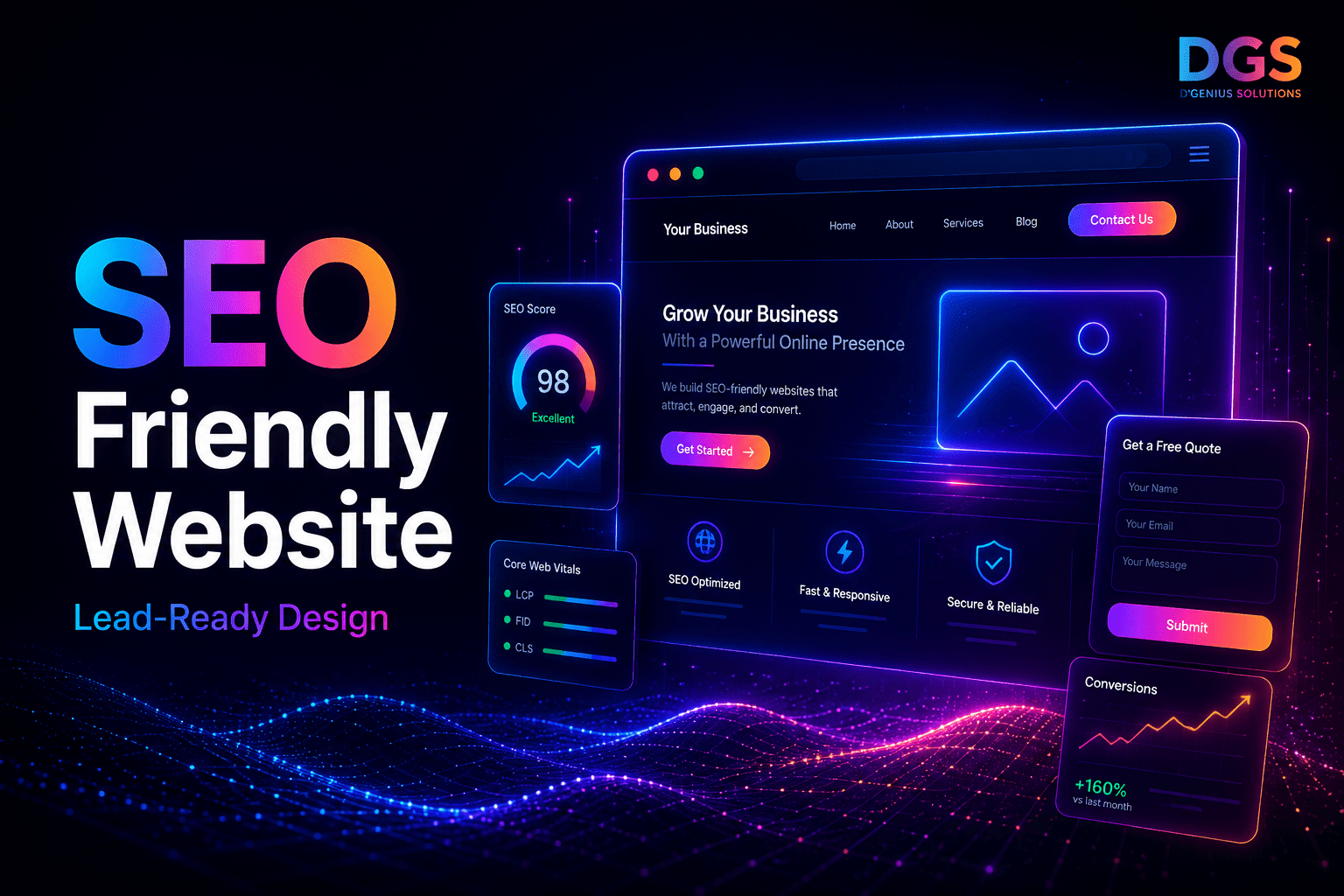
SEO Friendly Website: 7 Powerful Ways to Build a Lead-Ready Site
In this article
- Quick Answer: What Makes a Business Website SEO-Friendly and Lead-Ready?
- What Is an SEO Friendly Website?
- Why Website Development and SEO Should Work Together
- Why a Lead-Ready Website Matters for Business Growth
- SEO Friendly Website vs Normal Business Website
- 7 Powerful Elements of an SEO Friendly Website
- 1. Clear Website Structure
- 2. Search-Friendly Web Design
- 3. Fast Loading Speed
- 4. Mobile-Friendly Experience
- 5. Optimized Content and Headings
- 6. Strong Internal Linking
- 7. Conversion-Focused Lead Generation Flow
- Website SEO Basics Every Business Website Needs
- Technical Features That Support an SEO Friendly Website
- How Web Design Impacts Lead Generation
- Common Mistakes That Make Websites Weak for SEO
- How to Plan an SEO Friendly Website Before Development
- How D'Genius Solutions Builds SEO-Friendly and Lead-Ready Websites
- Final Thoughts
- FAQs
- What is an SEO friendly website?
- Why is website development important for SEO?
- How does web design affect lead generation?
- What should every business website include?
- Is SEO needed before or after website development?
- How do I make my website lead-ready?
SEO friendly website planning is no longer only about adding keywords to pages. A business website now needs clean development, strong web design, fast loading, helpful content, mobile-friendly layouts, and a clear lead generation path.
Many businesses launch a good-looking website but still struggle to get traffic, calls, forms, or enquiries. The reason is simple. A website can look modern but still be weak for search engines and confusing for users.
A strong website should do two jobs together. It should help Google understand the page, and it should help visitors take action without effort.
That is what makes a website SEO-friendly and lead-ready.
Quick Answer: What Makes a Business Website SEO-Friendly and Lead-Ready?
An SEO friendly website is built with clean structure, fast performance, mobile-friendly design, crawlable pages, optimized content, clear navigation, useful internal links, and strong conversion elements. A lead-ready website also includes clear calls-to-action, trust signals, service information, contact options, and user-friendly forms that help visitors become enquiries.
What Is an SEO Friendly Website?
An SEO friendly website is a website that is easy for search engines to crawl, understand, index, and rank. It is also easy for users to browse, read, and use.
This means the website is not only designed for looks. It is planned with website SEO, user experience, technical structure, and lead generation in mind.
A website can be called SEO-friendly when it has clean page structure, fast loading speed, mobile-friendly design, search-friendly URLs, proper headings, optimized content, internal linking, image optimization, schema markup, clear navigation, secure browsing, and strong user experience.
For a business, this matters because the website is often the first place where customers judge trust, service quality, and professionalism.
Why Website Development and SEO Should Work Together
Website development and SEO should not be treated as separate jobs. If SEO is added only after the website is built, many important elements may already be missing.
For example, a website may have beautiful web design but slow speed. It may have service pages but weak content. It may have animations but poor mobile usability. It may look premium but have no clear lead generation path.
Good website development builds SEO from the start.
This includes planning the page structure, navigation, URL format, content sections, technical performance, and conversion flow before the website goes live.
When website development and website SEO work together, your website becomes easier for Google to understand and easier for users to trust. If you are planning a new business website, explore our website development services to build a cleaner SEO and lead-generation foundation.
Why a Lead-Ready Website Matters for Business Growth
Traffic alone does not grow a business. A website also needs to convert visitors into leads.
A lead-ready website guides users toward a clear action. That action may be calling your team, filling out a form, booking a consultation, sending a WhatsApp message, or requesting a quote.
A website becomes lead-ready when users can quickly understand what your business offers, who your service is for, what problem you solve, why they should trust you, what result they can expect, and how they can contact you.
This is where web design, content, and SEO need to work together. If a visitor lands on your website but does not understand the next step, the page can lose a potential lead.
SEO Friendly Website vs Normal Business Website
A normal business website may show your services, brand, and contact details. An SEO friendly website goes deeper. It is built to support search visibility and user action.
| Factor | Normal Website | SEO Friendly Website |
|---|---|---|
| Main Goal | Online presence | Search visibility and lead generation |
| Page Structure | Basic pages | Planned service, location, and content structure |
| Web Design | Looks-focused | UX, readability, and conversion-focused |
| Content | General information | Search intent and user questions |
| Speed | May be ignored | Optimized for better performance |
| Mobile Experience | Sometimes basic | Designed for mobile users first |
| CTA Flow | Limited | Clear calls-to-action across pages |
| SEO Setup | Added later | Built into development |
For businesses, the second option is stronger because it supports both ranking and enquiries.
7 Powerful Elements of an SEO Friendly Website
1. Clear Website Structure
A strong SEO friendly website starts with a clear structure. Search engines and users should be able to understand your website without confusion.
Your website should have properly planned pages such as home page, about page, main service pages, location pages if needed, case studies or portfolio, blog section, contact page, and FAQ section.
Every important service should have its own page. This helps Google understand what your business offers and gives users a focused page for each need.
For example, if your business provides website development, SEO, branding, and social media marketing, each service should have a separate page instead of placing everything on one page.
This improves website SEO and creates better ranking opportunities.
2. Search-Friendly Web Design
Good web design is not only about colors, fonts, and visuals. It is also about clarity.
A lead-ready website should help users understand the page quickly. If the design is too crowded, confusing, or slow, users may leave before reading your offer.
Search-friendly web design includes readable fonts, clear spacing, simple navigation, strong section flow, mobile-friendly layouts, visible call-to-action buttons, easy-to-read service blocks, trust-building elements, and fast-loading visual sections.
Your design should guide the user naturally from problem to solution, then from solution to action.
For example, a service page should not start with vague text. It should clearly say what the service is, who it helps, and what action the visitor can take next.
3. Fast Loading Speed
Website speed is important for both SEO and lead generation. Users do not like waiting for slow pages, especially on mobile.
A slow website can hurt user experience and reduce conversions. Even if your website looks good, visitors may leave if pages take too long to load.
Speed-friendly website development includes compressed images, clean code, lightweight design sections, proper caching, optimized hosting, limited heavy scripts, lazy loading for images, efficient fonts, and reduced unnecessary plugins.
A fast website feels smoother, more professional, and easier to use. It also gives users less reason to leave before taking action.
4. Mobile-Friendly Experience
Most users now browse business websites from mobile devices. This means mobile experience cannot be treated as an extra feature.
An SEO friendly website should work smoothly on phones, tablets, and desktops.
Mobile-friendly design includes responsive layouts, readable text size, easy-to-click buttons, simple menus, fast mobile loading, no overlapping sections, forms that are easy to fill, clear call buttons, and proper spacing between elements.
A mobile visitor should not need to zoom, scroll sideways, or struggle to find your contact button.
For lead generation, mobile design is especially important because many users take quick action from their phones.
5. Optimized Content and Headings
Content is one of the strongest parts of website SEO. Search engines need content to understand your pages, and users need content to understand your business.
An SEO friendly website should have clear headings, useful sections, and content that matches search intent.
For example, a website development page should explain what the service includes, who needs the service, what problems it solves, what makes the website SEO-friendly, how the process works, what results users can expect, why choose your company, and how to get started.
Do not write only generic lines like “we build modern websites.” Explain how your website development service helps with visibility, performance, user experience, and lead generation.
Use headings naturally. A good heading should tell the reader what the section is about before they read the full paragraph.
6. Strong Internal Linking
Internal linking helps users and search engines move through your website.
For example, a blog about an SEO friendly website should link to your website development service page. A website development page can also link to related services such as SEO services for search visibility, branding services, and content creation services.
Internal links help in three ways. They guide users to useful pages, help Google discover important pages, and pass topical relevance between related pages.
A good internal linking strategy makes your website feel connected instead of scattered.
7. Conversion-Focused Lead Generation Flow
A website is not lead-ready if users do not know what to do next.
Lead generation depends on a clear conversion flow. Your website should make it easy for users to contact you at the right moment.
Important conversion elements include clear CTA buttons, contact forms, click-to-call buttons, WhatsApp button, service enquiry forms, trust badges, client logos, case studies, testimonials, process sections, and FAQ sections.
The CTA should not appear only at the bottom of the page. It should appear naturally across important sections.
For example, after explaining your website development process, you can add a CTA such as “Request a Website Consultation” or “Build an SEO-Friendly Website.”
This keeps users moving toward action.
Website SEO Basics Every Business Website Needs
An SEO friendly website should include basic on-page SEO elements on every important page.
These include unique SEO title, meta description, clean URL, one clear H1 heading, proper H2 and H3 headings, optimized images, descriptive alt text, internal links, external trusted links where useful, schema markup, helpful content, fast loading speed, and mobile-friendly layout.
These basics may look small, but together they create a strong SEO foundation.
Google’s official Google SEO Starter Guide explains how website owners can help search engines understand content and help users find useful information.
Technical Features That Support an SEO Friendly Website
Website development should also cover technical SEO. Technical issues can stop even good content from performing well.
Important technical features include crawlable pages, XML sitemap, robots.txt setup, canonical tags, SSL certificate, 404 page handling, redirect setup, schema markup, Core Web Vitals optimization, clean HTML structure, breadcrumbs, image compression, and no broken internal links.
These elements help search engines access and understand your website properly.
For business websites, technical SEO is important because it protects your investment. A good-looking website should not fail because of hidden crawl, speed, or indexing issues.
How Web Design Impacts Lead Generation
Web design has a direct impact on lead generation. If users cannot understand the page quickly, they may leave.
A lead-ready design should answer three questions fast:
Am I in the right place?
Can this business solve my problem?
What should I do next?
Your hero section should be clear. Your service sections should be specific. Your contact options should be easy to find.
A website should not make visitors work hard to understand your offer.
Good web design uses visual hierarchy. This means important elements such as headings, benefits, CTA buttons, and trust signals should stand out.
A clean design builds confidence. A confusing design creates doubt.
Common Mistakes That Make Websites Weak for SEO
Many business websites fail because they are built only for appearance. They may look attractive but miss important SEO and lead generation elements.
Avoid these mistakes:
Using one page for too many services
Publishing thin service content
Ignoring page speed
Using unclear headings
Missing internal links
Not adding image alt text
Using heavy images
Not optimizing for mobile
Hiding contact options
Using weak calls-to-action
Skipping schema markup
Not creating location or service-specific pages
Ignoring blog content
Not connecting SEO with website development
A website should not only impress people visually. It should also help them find, understand, and contact your business.
How to Plan an SEO Friendly Website Before Development
The best time to plan SEO is before development starts.
Before building a website, plan your target services, target locations, main keywords, page structure, navigation, content sections, CTA flow, blog strategy, internal linking, technical SEO setup, tracking, analytics, and lead form placement.
This makes the website stronger from day one.
If SEO is planned after development, you may need to rebuild sections, rewrite content, change URLs, fix speed issues, or restructure pages.
A proper plan saves time and helps the website perform better after launch.
How D'Genius Solutions Builds SEO-Friendly and Lead-Ready Websites
D'Genius Solutions builds business websites with search visibility, user experience, and lead generation in mind.
Our approach connects website development, web design, website SEO, content structure, technical performance, and conversion strategy. We do not build websites only to look good. We build websites that help users understand your business and take action.
Our website development process focuses on clean structure, mobile-friendly layouts, fast loading pages, SEO-ready content sections, service-focused design, clear CTA placement, internal linking, technical SEO basics, lead generation flow, and scalable page structure.
This helps businesses launch websites that are ready for both Google and customers.
If your business needs a website that supports search visibility and enquiries, explore our website development services and build a site with a stronger foundation.
Final Thoughts
An SEO friendly website is more than a digital brochure. It is a business asset that helps people find you, understand you, trust you, and contact you.
Strong website development should bring together web design, website SEO, speed, mobile experience, content structure, and lead generation.
A website that looks good but does not rank or convert is incomplete. A website that is SEO-friendly and lead-ready can support long-term business growth.
If you are planning a new website or improving an existing one, start with structure, speed, content, and conversion flow. These are the elements that make your website useful for both Google and real customers.
FAQs
What is an SEO friendly website?
An SEO friendly website is a website built so search engines can crawl, understand, index, and rank it easily. It also gives users a smooth experience with clear content, fast speed, mobile-friendly design, and simple navigation.
Why is website development important for SEO?
Website development affects SEO because it controls site structure, loading speed, mobile experience, crawlability, code quality, URLs, schema, and page performance. Poor development can limit search visibility even if the design looks good.
How does web design affect lead generation?
Web design affects lead generation by guiding users toward action. Clear headings, strong CTA buttons, trust signals, readable sections, and easy contact options help visitors become leads.
What should every business website include?
Every business website should include clear service pages, mobile-friendly design, fast loading speed, optimized content, internal links, contact forms, trust signals, testimonials, FAQs, and strong calls-to-action.
Is SEO needed before or after website development?
SEO should be planned before website development starts. This helps create the right page structure, URL format, content flow, technical setup, and lead generation path from the beginning.
How do I make my website lead-ready?
To make your website lead-ready, add clear service information, visible CTA buttons, simple forms, contact options, trust signals, case studies, FAQs, and a smooth mobile experience.
Accelerate Your Digital & Search Growth
Speak directly with our Mumbai-based SEO, AI search, and digital marketing strategists for a bespoke growth audit.
Get a Free Strategy AuditRelated Insights
Brand Identity: 7 Powerful Reasons It Builds SEO Trust and Lead Generation - D'Genius Solutions
Brand identity is more than a logo, color palette, or business name. It is the complete way people recognize, remember, and trust your business online. In
SEO Rankings Up but Traffic Down: 9 Reasons Your Clicks Are Falling - D'Genius Solutions
SEO rankings up but traffic down is one of the most confusing situations a business can face. Your tracked keywords may be moving higher on Google, yet
LLM SEO: 9 Smart Ways to Prepare Your Website for AI Tools and Large Language Models - D'Genius Solutions
LLM SEO is becoming important for businesses that want visibility on Google, AI search tools and large language models like ChatGPT, Gemini, Perplexity and