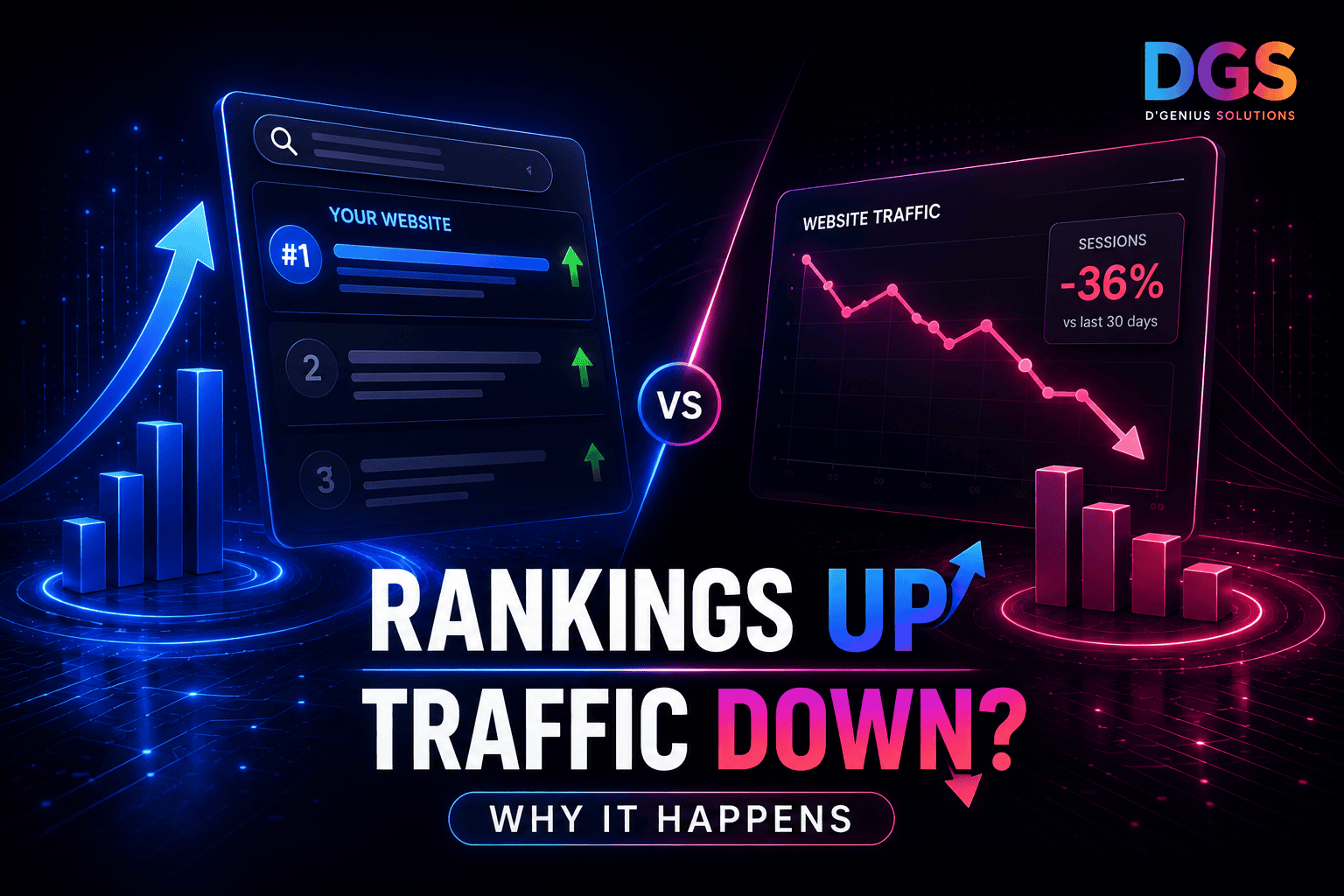
SEO Rankings Up but Traffic Down: 9 Reasons Your Clicks Are Falling
In this article
- Quick Answer
- Why Are SEO Rankings Up but Traffic Down?
- 1. Search Demand Has Declined
- How to Identify Lower Search Demand
- 2. Your Organic Click-Through Rate Has Fallen
- How to Improve Organic CTR
- 3. AI Overviews Are Reducing Informational Clicks
- 4. Your Website Is Ranking for the Wrong Keywords
- Separate Keywords by Search Intent
- 5. Long-Tail Keyword Traffic Has Declined
- How to Check Long-Tail Losses
- 6. The Search Results Page Has Changed
- What to Review
- 7. Mobile Performance Is Weaker
- Compare Performance by Device
- 8. Your Content No Longer Matches Search Intent
- How to Review Search Intent
- 9. Rankings Are Improving but Conversions Are Falling
- How to Diagnose SEO Rankings Up but Traffic Down
- Step 1: Compare Equal Date Ranges
- Step 2: Review Four Core Metrics
- Step 3: Compare Queries
- Step 4: Compare Landing Pages
- Step 5: Segment the Data
- Step 6: Check Technical SEO
- How to Turn Higher Rankings Into More Traffic
- Improve SEO Titles
- Rewrite Weak Meta Descriptions
- Strengthen Commercial Pages
- Improve Internal Linking
- Create Content That Adds Real Value
- Improve Mobile Experience
- Connect SEO With Conversion Optimisation
- How D'Genius Solutions Helps Recover Organic Traffic
- Conclusion
- Frequently Asked Questions
- Why are my SEO rankings up but traffic down?
- Is SEO rankings up but traffic down a sign of failure?
- Can a website rank higher and receive fewer clicks?
- How can I check why organic traffic declined?
- Can AI Overviews reduce website traffic?
- Does a better average position mean SEO is performing well?
- How often should I review organic traffic?
- Should I update content immediately after a traffic drop?
- How can internal links improve organic performance?
SEO rankings up but traffic down is one of the most confusing situations a business can face. Your tracked keywords may be moving higher on Google, yet organic clicks, website sessions and enquiries continue to decline.
At first, these numbers appear to conflict. Better rankings should normally produce more visibility and traffic. However, rankings only show where a page appears for a search query. They do not show how many people are searching, how many users notice your listing, whether they click it or whether those visitors are relevant to your business.
When businesses notice SEO rankings up but traffic down, the real issue often lies in search demand, click-through rate, AI-generated results, long-tail keyword losses or changing user behaviour.
The solution is not to chase more ranking improvements blindly. You need to analyse clicks, impressions, CTR, landing pages, keyword intent and conversions together.
Quick Answer
When you see SEO rankings up but traffic down, your website may be appearing in stronger positions while receiving fewer opportunities to earn clicks. Search demand may have fallen, Google may be answering the query directly, or your website may be ranking for keywords with limited traffic or commercial value.
Why Are SEO Rankings Up but Traffic Down?
The pattern of SEO rankings up but traffic down usually means that average position is improving while another performance metric is weakening.
A page can rise from position eight to position four and still lose traffic when:
- Fewer users search for the keyword.
- Advertisements occupy more space above organic listings.
- Google displays an AI Overview.
- Competitors use more appealing titles.
- The page ranks for low-volume searches.
- Mobile users receive a poor experience.
- Long-tail keyword visibility has declined.
Google Search Console separates clicks, impressions, CTR and average position because each metric explains a different part of organic performance.
Businesses should review the official Google Search Console Performance report instead of depending only on a keyword-tracking tool.
1. Search Demand Has Declined
A keyword can maintain or improve its ranking while receiving fewer searches.
This is one of the most common explanations for SEO rankings up but traffic down.
Search demand can change because of:
- Seasonal buying behaviour
- Industry trends
- Economic conditions
- Local market changes
- News cycles
- Changes in customer terminology
- Reduced interest in a product or service
For example, a service page may remain in the top three results. However, if monthly searches fall sharply, the page will receive fewer impressions and fewer clicks despite holding a stronger position.
How to Identify Lower Search Demand
Compare:
- The latest 28 days with the previous 28 days
- The current quarter with the previous quarter
- The current period with the same period last year
- Search Console impressions with Google Trends data
When rankings remain stable but impressions decline across several related queries, search demand may be the main cause.
2. Your Organic Click-Through Rate Has Fallen
Another reason for SEO rankings up but traffic down is a declining organic click-through rate.
CTR shows the percentage of impressions that result in a click. Your page may be visible more often but attract fewer visitors because users choose another result.
CTR can fall when:
- The SEO title looks generic.
- The description does not match the search query.
- Competitors communicate stronger benefits.
- Your result appears below ads or AI answers.
- The title is outdated.
- Users prefer videos, maps or forums.
- Google rewrites the displayed title.
For example, a page may receive 10,000 impressions at a 3% CTR and generate 300 clicks. If impressions stay the same but CTR falls to 1.5%, traffic drops to 150 clicks.
The ranking position may not have changed significantly, but the traffic has been reduced by half.
How to Improve Organic CTR
Use titles that clearly explain the page and its value.
A weak title:
Organic Traffic Guide
A stronger title:
Why Organic Traffic Is Falling Despite Better Rankings
Your meta description should support the title and explain what users will gain from the page.
Avoid exaggerated claims. A misleading title may improve clicks temporarily but can damage engagement and trust.
3. AI Overviews Are Reducing Informational Clicks
Google can now provide detailed answers directly within search results.
This has made SEO rankings up but traffic down more common for informational searches.
Users may receive a complete summary without opening a website, especially for searches such as:
- What is SEO?
- Why is website traffic falling?
- How does technical SEO work?
- What is search intent?
- How can CTR be improved?
This does not mean businesses should stop creating informational content. It means content must offer more than a basic definition.
Pages should include:
- Original analysis
- First-hand experience
- Practical examples
- Unique data
- Clear expert opinions
- Actionable recommendations
- Visual explanations
- Strong next-step guidance
Businesses should also strengthen answer-focused content and AI-search visibility. A combined SEO, AEO and GEO strategy can help content remain useful across traditional search results and AI-generated experiences.
4. Your Website Is Ranking for the Wrong Keywords
You may experience SEO rankings up but traffic down when Google visibility improves for keywords that do not support your business goals.
Examples include:
- Keywords with very low search volume
- Broad educational terms
- Irrelevant query variations
- Searches from locations you do not serve
- Keywords with no commercial intent
- Branded terms that already ranked well
A ranking report may show that thirty keywords improved. However, those gains may contribute little traffic or business value.
Meanwhile, a small decline in one commercially important term may reduce enquiries significantly.
Separate Keywords by Search Intent
Informational Intent
The user wants an answer or explanation.
Example: “Why is organic traffic declining?”
Commercial Intent
The user is comparing providers or solutions.
Example: “Best SEO company for business websites”
Transactional Intent
The user is ready to take action.
Example: “Hire an SEO agency in Mumbai”
Local Intent
The user wants a nearby or location-specific provider.
Example: “SEO services near me”
A strong SEO strategy should generate visibility across the customer journey, but commercial and local keywords deserve special attention when lead generation is the goal.
5. Long-Tail Keyword Traffic Has Declined
A website can show SEO rankings up but traffic down when its tracked keywords improve but hundreds of smaller queries lose visibility.
Most rank-tracking tools monitor only a selected keyword list. Google Search Console captures a much broader range of searches.
Long-tail keywords may include:
- Detailed customer questions
- Service-related problems
- Industry-specific phrases
- Location variations
- Comparison searches
- Voice-search queries
- Multi-word buying queries
Each long-tail search may generate only a few clicks. Together, however, they can contribute a large share of organic traffic.
For example, ten priority keywords may gain twenty clicks while hundreds of long-tail queries lose two hundred clicks. The ranking report looks positive, but total traffic falls.
How to Check Long-Tail Losses
In Google Search Console:
- Open the Performance report.
- Compare two equal date ranges.
- Review the Queries section.
- Sort by click difference.
- Identify terms that lost impressions or clicks.
- Compare the affected landing pages.
Do not limit your analysis to the keywords included in your monthly ranking report.
6. The Search Results Page Has Changed
The value of a ranking position depends on what appears around it.
Position three may sound strong, but your organic result could appear below:
- Google Ads
- AI Overviews
- Featured snippets
- Local map results
- People Also Ask boxes
- Video carousels
- Image packs
- Shopping results
- Forum discussions
- Knowledge panels
This is another major cause of SEO rankings up but traffic down.
Your rank-tracking tool may report a stable position, while the actual listing becomes less visible because new search features occupy more screen space.
The effect is stronger on mobile devices because users see a smaller portion of the results page.
What to Review
Manually inspect priority keywords on:
- Desktop
- Mobile
- Different locations
- Branded searches
- Non-branded searches
Look beyond the numerical position. Review how much scrolling is required before users see your page.
7. Mobile Performance Is Weaker
Device-level differences can explain SEO rankings up but traffic down when desktop rankings improve but mobile clicks fall.
Mobile users may leave because of:
- Slow loading times
- Layout shifts
- Intrusive pop-ups
- Difficult navigation
- Small buttons
- Unreadable text
- Forms that do not work
- Poorly placed calls to action
Mobile problems may not always reduce ranking immediately. A page can continue appearing prominently while losing engagement and conversions.
Compare Performance by Device
Review:
- Mobile impressions
- Mobile clicks
- Mobile CTR
- Mobile conversions
- Desktop versus mobile landing-page performance
- Form completion rates
- Core Web Vitals
Technical performance should be analysed alongside content quality and user intent.
An experienced SEO company in Mumbai should evaluate how rankings, usability and conversion behaviour work together.
8. Your Content No Longer Matches Search Intent
Search intent can change.
A page may continue ranking but receive fewer clicks because users now prefer a different format.
For example:
- Users may prefer a checklist instead of a long guide.
- Buyers may want a service page instead of a blog.
- Searchers may prefer a comparison.
- Local users may expect map results.
- Product researchers may want specifications.
- Users may prefer a video demonstration.
This can create a situation where SEO rankings up but traffic down even though the page remains relevant to the topic.
How to Review Search Intent
Search your target keyword and examine:
- The type of pages ranking
- The format of the leading results
- The questions Google displays
- Whether results are informational or commercial
- Whether videos, maps or forums dominate
- How quickly top-ranking pages answer the query
Do not copy competitor pages. Use the search results to understand what users currently expect, then create a more useful and original resource.
9. Rankings Are Improving but Conversions Are Falling
Traffic alone does not guarantee business results.
A website may gain rankings and visits but receive fewer enquiries because:
- The keywords attract early-stage researchers.
- Visitors are outside the service area.
- The landing page lacks trust.
- The offer is unclear.
- Calls to action are weak.
- The form is too long.
- Contact details are difficult to find.
- The page does not explain the next step.
The pattern of SEO rankings up but traffic down should not be analysed only through traffic metrics. Conversion quality matters as well.
Track:
- Qualified enquiries
- Form submissions
- Phone calls
- Consultation bookings
- Purchases
- Newsletter sign-ups
- Assisted conversions
The purpose of SEO is not to create an attractive ranking report. It is to connect the business with relevant users who are more likely to take action.
How to Diagnose SEO Rankings Up but Traffic Down
To diagnose SEO rankings up but traffic down, follow a structured process instead of making random content changes.
Step 1: Compare Equal Date Ranges
Compare:
- The latest 28 days with the previous 28 days
- The latest three months with the previous three months
- The current period with the same period last year
Avoid comparing unequal periods because weekends, holidays and seasonal changes can distort the result.
Step 2: Review Four Core Metrics
Analyse:
- Total clicks
- Total impressions
- Average CTR
- Average position
Use these patterns as a guide:
Position improves, but impressions decline:
Search demand may have fallen.
Position improves, impressions remain stable, but clicks decline:
CTR may be weaker, or search-result features may be taking attention.
Average position improves, but important pages lose traffic:
Low-value keyword gains may be hiding valuable losses.
Traffic stays stable, but enquiries decline:
The problem may involve intent or conversion performance.
Step 3: Compare Queries
Focus on queries connected to:
- Services
- Locations
- Commercial intent
- Previous conversions
- Brand demand
- Non-branded discovery
Do not treat every keyword as equally important.
Step 4: Compare Landing Pages
Determine whether the decline affects:
- One service page
- Multiple blog posts
- Location pages
- Product pages
- A category
- The whole website
A page-specific decline requires a focused review. A sitewide decline may point towards demand changes, technical problems or broader search updates.
Step 5: Segment the Data
Filter performance by:
- Device
- Country
- Query
- Landing page
- Search appearance
- Date
- Search type
Segmentation prevents averages from hiding important problems.
Step 6: Check Technical SEO
Confirm that important pages:
- Return a 200 status code
- Are indexable
- Use the correct canonical URL
- Are included in internal links
- Are not blocked by robots directives
- Load properly on mobile
- Appear in the sitemap
- Can be inspected in Search Console
Technical issues may affect clicks and visibility even when some tracked rankings look stable.
How to Turn Higher Rankings Into More Traffic
Improve SEO Titles
Write titles that clearly communicate the topic, problem and value.
Avoid vague wording. Users should immediately understand why the result is relevant.
Rewrite Weak Meta Descriptions
A strong description should:
- Match the search query
- Explain the benefit
- Set accurate expectations
- Encourage qualified users to click
Strengthen Commercial Pages
Prioritise pages connected to:
- Services
- Consultations
- Product comparisons
- Local enquiries
- Demonstrations
- Business decisions
Informational articles can build awareness, but service pages are more closely connected to leads.
Improve Internal Linking
Internal links help users move from educational content to relevant commercial pages.
For example, businesses experiencing declining organic traffic can explore DGS’s SEO services in Mumbai for technical SEO, content optimisation, performance analysis and conversion-focused support.
You can also read our guide on Google Search Console and social media performance to understand how search visibility connects with wider digital performance.
Create Content That Adds Real Value
Avoid publishing another generic summary.
Add:
- Original observations
- Practical examples
- Industry experience
- Case studies
- Screenshots
- Actionable steps
- Expert commentary
- Clear recommendations
Users need a reason to visit your page instead of relying entirely on a search summary.
Improve Mobile Experience
Review:
- Page speed
- Layout stability
- Navigation
- Buttons
- Forms
- Contact options
- Calls to action
A strong search position cannot compensate for a frustrating mobile experience.
Connect SEO With Conversion Optimisation
Once users arrive, help them take the next step.
Improve:
- Service explanations
- Trust signals
- Case studies
- Contact forms
- Calls to action
- Testimonials
- Page hierarchy
- Contact visibility
How D'Genius Solutions Helps Recover Organic Traffic
D'Genius Solutions investigates SEO rankings up but traffic down by connecting keyword movement with real performance data.
Our SEO process examines:
- Search Console trends
- Keyword intent
- Landing-page traffic
- Organic CTR
- Technical SEO issues
- Content gaps
- Internal linking
- Mobile usability
- AI search visibility
- Conversion opportunities
As an experienced SEO agency in Mumbai, DGS helps businesses understand whether a traffic decline is caused by lower demand, weaker click-through rates, changing search behaviour, technical problems or low-quality keyword visibility.
The objective is not simply to rank more keywords. It is to generate qualified search visibility that supports enquiries, leads and sustainable business growth.
Conclusion
When your SEO rankings are up but traffic is down, gaining more positions is not always the immediate solution.
The real issue may involve falling search demand, weaker CTR, AI-generated answers, lost long-tail visibility or ranking improvements for keywords with limited business value.
The problem of SEO rankings up but traffic down should be investigated through clicks, impressions, queries, landing pages, devices and conversions.
Modern SEO must generate relevant visibility, qualified visits and meaningful business outcomes—not just stronger ranking reports.
Explore our SEO services in Mumbai to identify why your organic traffic is declining and build a more effective search-growth strategy.
Frequently Asked Questions
Why are my SEO rankings up but traffic down?
Your rankings may be improving for low-volume or less relevant keywords while search demand, CTR or long-tail visibility declines. Ads, AI answers and other search-result features may also reduce organic clicks.
Is SEO rankings up but traffic down a sign of failure?
Not necessarily. SEO rankings up but traffic down can result from seasonal demand, lower CTR, changing search intent or visibility gains for keywords that generate little traffic.
Can a website rank higher and receive fewer clicks?
Yes. Ranking position is only one factor. Search volume, title quality, advertisements, AI Overviews and competing search features can all reduce clicks.
How can I check why organic traffic declined?
Compare equal date ranges in Google Search Console. Review clicks, impressions, CTR and average position by query, page, device and country.
Can AI Overviews reduce website traffic?
Yes. AI Overviews may answer informational queries directly in search results. Businesses should create original, detailed content that provides value beyond a basic summary.
Does a better average position mean SEO is performing well?
Not always. Average position can improve because of low-value keywords while important commercial pages lose traffic or conversions.
How often should I review organic traffic?
Monthly reviews are useful for identifying meaningful trends. Weekly checks can help detect sudden technical or visibility problems without overreacting to normal daily fluctuations.
Should I update content immediately after a traffic drop?
First diagnose the cause. Review demand, CTR, queries, landing pages, indexing and conversions before making large changes.
How can internal links improve organic performance?
Internal links help search engines understand page relationships and guide users from informational articles to relevant service pages.
Accelerate Your Digital & Search Growth
Speak directly with our Mumbai-based SEO, AI search, and digital marketing strategists for a bespoke growth audit.
Get a Free Strategy AuditRelated Insights
Brand Identity: 7 Powerful Reasons It Builds SEO Trust and Lead Generation - D'Genius Solutions
Brand identity is more than a logo, color palette, or business name. It is the complete way people recognize, remember, and trust your business online. In
Google August 2026 Spam Update What Businesses Need to Know About SEO Rankings - D'Genius Solutions
The Google August 2026 spam update has put website quality back under the spotlight. Learn what businesses need to know about SEO rankings.
5 SEO Strategies for Business Growth That Improve Rankings and Leads
Learn how SEO strategies for business growth improve rankings, search visibility, user trust, and lead generation for businesses.