Voice Search SEO in 2026: How Businesses Can Win Conversational Searches
In this article
- Quick Answer
- What Is Voice Search SEO?
- Why Voice Search SEO Matters in 2026
- How Voice Search Differs from Traditional Search
- 10 Voice Search SEO Strategies for Businesses
- 1. Research Real Customer Questions
- 2. Target Conversational Long-Tail Keywords
- 3. Answer Important Questions Immediately
- How can a business improve voice-search visibility?
- 4. Use Natural and Simple Language
- 5. Strengthen Local SEO
- 6. Improve Mobile Performance
- 7. Organise Content with Question-Based Headings
- 8. Add Relevant Structured Data
- Should Businesses Use Speakable Schema?
- 9. Build Trust and Demonstrate Experience
- 10. Connect Related Content Through Internal Links
- How to Write Voice-Search-Friendly Content
- Common Voice Search SEO Mistakes
- Keyword Stuffing
- Creating Thin Content
- Ignoring Search Intent
- Depending Entirely on Schema
- Using Complicated Language
- Ignoring Local Information
- Writing Only for SEO Plugins
- Voice Search SEO and AI-Powered Search
- How to Measure Voice Search SEO Performance
- How D'Genius Solutions Supports Modern Search Visibility
- Frequently Asked Questions
- Is Voice Search SEO important in 2026?
- How can I find voice-search keywords?
- Does voice search only matter for local businesses?
- Does schema guarantee voice-search rankings?
- How long does voice-search optimisation take?
- Is Voice Search SEO different from traditional SEO?
- Can Voice Search SEO help with AI search visibility?
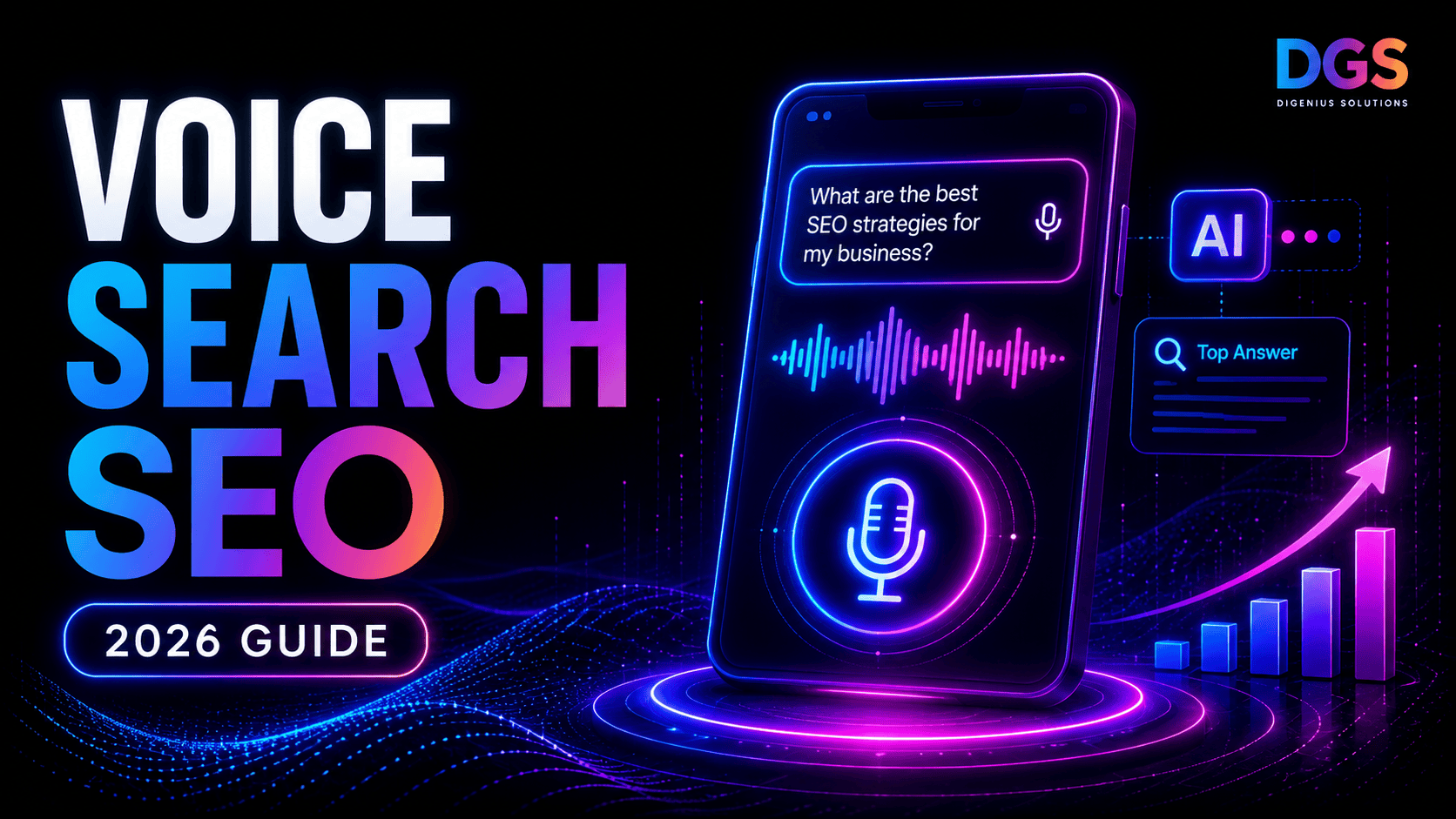
Voice Search SEO helps businesses optimise their websites for searches made through spoken questions and natural, conversational language.
People no longer search only by typing short phrases into Google. They also use smartphones, smart speakers, connected devices and AI-powered search platforms to ask complete questions.
For example, a person may type:
“website development company near me”
However, while using voice search, the same person may ask:
“Which website development company near me can build an SEO-friendly business website?”
This shift means businesses must create content that reflects how people naturally speak, clearly answers their questions and helps them take the next step.
Voice search optimisation is not a separate replacement for traditional SEO. It works alongside technical SEO, local SEO, content optimisation, Answer Engine Optimisation and mobile website performance.
Quick Answer
Voice Search SEO is the process of optimising website content for spoken and conversational search queries. Businesses can improve their visibility by targeting natural-language questions, providing direct answers, improving local SEO, strengthening mobile performance and publishing genuinely useful content.
What Is Voice Search SEO?
Voice Search SEO is a method of improving website content so search engines can understand and present it when users speak their queries instead of typing them.
Spoken searches are usually longer and more detailed than traditional keyword searches. They often include words such as:
- What
- Why
- Where
- When
- Who
- Which
- How
- Can
- Should
For example, a typed search may be:
“best accounting software”
A voice query may be:
“Which accounting software is best for a small business with five employees?”
The voice query gives more information about the user’s needs, business size and expected solution.
Businesses that answer these detailed questions can attract visitors with clearer requirements and stronger intent.
Why Voice Search SEO Matters in 2026
Search behaviour is becoming more conversational across mobile devices, voice assistants and AI-powered platforms.
Users expect search engines to understand complete questions and provide answers that are relevant to their location, situation and immediate requirement.
Voice Search SEO can support visibility for:
- Local business searches
- Service-related questions
- Product comparisons
- Informational queries
- Mobile searches
- “Near me” searches
- Frequently asked questions
- AI-generated search answers
Voice search optimisation also improves the general quality of a website because voice-friendly content is usually clearer, easier to scan and more directly aligned with user intent.
Businesses looking to build a wider organic-search strategy can combine voice optimisation with professional SEO services in Mumbai. A complete SEO strategy can address technical performance, content relevance, local visibility, internal linking and organic lead generation.
How Voice Search Differs from Traditional Search
Traditional search queries are often short and keyword-focused. Voice searches are more likely to sound like a normal conversation.
| Traditional Search | Voice Search |
|---|---|
| dentist near me | Which dentist near me is open today? |
| affordable web design | Where can I find affordable web design for a small business? |
| improve website ranking | How can I improve my website ranking on Google? |
| laptop repair | Who provides laptop repair services near my location? |
| digital marketing services | Which digital marketing services are suitable for a new business? |
Businesses do not need to create a separate page for every possible question.
One useful, well-structured page can answer the main query while covering related questions, examples and supporting information.
10 Voice Search SEO Strategies for Businesses
1. Research Real Customer Questions
The best conversational keywords often come directly from customers.
Businesses should review questions received through:
- Customer phone calls
- Contact forms
- Emails
- Sales meetings
- Social media comments
- Live-chat conversations
- Search Console queries
- Customer-support requests
- Google Business Profile messages
These sources show how people naturally describe their problems and requirements.
For example, customers may not ask:
“What is your pricing structure?”
They may instead ask:
“How much does this service cost every month?”
Content based on genuine customer language is generally more useful than content built only around keyword tools.
2. Target Conversational Long-Tail Keywords
Long-tail keywords are detailed search phrases that represent a specific need or question.
Instead of targeting only a broad keyword such as:
“home loan”
A business can also answer questions such as:
- How can I apply for a home loan?
- What documents are required for a home loan?
- Which home loan is suitable for a first-time buyer?
- How long does home-loan approval take?
- What factors affect home-loan eligibility?
These phrases may receive fewer searches individually, but they often attract users with clearer intent.
Conversational phrases should be used naturally. Repeating the exact focus keyword in every paragraph can reduce readability and make the content feel artificial.
3. Answer Important Questions Immediately
Voice-search users often want a quick and direct answer.
Place a concise response immediately after an important question-based heading. The answer should generally be one or two clear sentences before the detailed explanation begins.
For example:
How can a business improve voice-search visibility?
A business can improve voice-search visibility by answering conversational questions, strengthening local SEO, improving mobile performance and publishing content that directly satisfies the user’s search intent.
This answer-first format makes the page easier for both users and search systems to understand.
It is also a core part of AEO services in Mumbai. Answer Engine Optimisation structures content so it can be understood and presented across featured snippets, People Also Ask results, voice searches and AI-led search experiences.
4. Use Natural and Simple Language
Voice-search content should sound clear and conversational without becoming overly casual.
Use:
- Short sentences
- Familiar words
- Clear explanations
- Active voice
- Relevant examples
- Logical headings
- Short paragraphs
Avoid unnecessary technical language, exaggerated claims and lengthy introductions.
The goal is to provide professional information in a way that can be easily understood when read on a screen or spoken aloud.
5. Strengthen Local SEO
Many voice searches have local or immediate intent.
Users commonly ask questions such as:
- Which pharmacy is open near me?
- Where can I find an electrician nearby?
- Which restaurant near me is open now?
- Who provides emergency repair services in my area?
- Which salon nearby offers bridal services?
Businesses targeting local customers should maintain accurate information across their website, Google Business Profile and relevant business directories.
Important local SEO elements include:
- Correct business name
- Accurate address
- Updated phone number
- Opening hours
- Service areas
- Relevant business categories
- Genuine customer reviews
- Location-specific information
- Clear contact options
- Mobile-friendly directions
Businesses should avoid creating low-quality location pages that only replace one city name with another. Every location page should contain useful information relevant to that area and its customers.
6. Improve Mobile Performance
A large percentage of spoken searches take place on mobile devices.
A slow or confusing website may lose potential customers even when it appears prominently in search results.
Businesses should improve:
- Page-loading speed
- Mobile navigation
- Button size
- Form usability
- Text readability
- Image optimisation
- Page stability
- Server response time
- Pop-up behaviour
- Contact accessibility
Users should be able to find an answer, call the business or complete an enquiry without zooming, waiting or moving through unnecessary pages.
Businesses developing a new site or restructuring an existing one can consider an SEO-ready website development service. A technically strong website provides a better foundation for mobile usability, page speed, crawlability and conversions.
7. Organise Content with Question-Based Headings
Clear headings help users quickly find the information they need.
Useful heading formats include:
- What is Voice Search SEO?
- How does voice search work?
- Why is local SEO important for voice searches?
- How can businesses find conversational keywords?
- Does structured data help voice-search optimisation?
- How can voice-search performance be measured?
Each section should focus on one clear question or subject.
Headings should be written for clarity. Avoid adding them only to repeat keywords or improve an SEO-plugin score.
8. Add Relevant Structured Data
Structured data can help search engines better understand the meaning and purpose of a page.
Depending on the content, businesses may use:
- Organization schema
- LocalBusiness schema
- Article schema
- Service schema
- Product schema
- BreadcrumbList schema
- Event schema
- VideoObject schema
Structured data must accurately match information that users can see on the page.
Google explains that structured data helps it understand page content and may make pages eligible for supported search features. However, correct markup does not guarantee rankings or rich-result visibility.
Businesses should follow Google’s structured data guidelines and validate their implementation before publishing.
Should Businesses Use Speakable Schema?
Speakable schema should not be treated as a universal voice-search ranking solution.
Google currently describes Speakable as a beta feature associated with eligible news content and topical news queries on Google Assistant. Standard business websites should therefore focus first on accurate, supported schema types that match their visible content.
Businesses considering this markup should review Google’s official Speakable structured data documentation.
9. Build Trust and Demonstrate Experience
Search engines and users both benefit from content that demonstrates genuine knowledge and experience.
Businesses can strengthen trust by including:
- First-hand insights
- Original examples
- Author information
- Updated publication dates
- Clear company details
- Genuine customer observations
- Transparent service information
- Supporting sources
- Case studies
- Practical recommendations
A generic article that repeats information already available across many websites may struggle to stand out.
Content should explain why the author or business is qualified to discuss the subject. This is particularly important for topics involving health, finance, safety or major purchasing decisions.
When AI tools are used during content creation, the final content should still be reviewed for originality, factual accuracy, relevance and usefulness.
Google states that generative AI may help with research and content structure, but publishing large numbers of AI-generated pages without adding user value may violate its policies on scaled content abuse.
Businesses can review Google’s guidance on generative AI content before using AI-assisted content at scale.
10. Connect Related Content Through Internal Links
Voice Search SEO works better when a website explains a topic comprehensively.
A business publishing content about voice search may also create resources about:
- Local SEO
- Mobile SEO
- Conversational keyword research
- Featured snippets
- AI search optimisation
- Website speed
- Structured data
- Search intent
- Content writing
- Answer Engine Optimisation
These pages should be connected through natural internal links.
Internal linking helps visitors find related information and allows search engines to understand the relationship between pages.
Anchor text should clearly describe the destination. Avoid repeating the same keyword-rich anchor excessively.
For example, businesses can connect broader voice-search content with content creation services when explaining the role of useful, search-focused articles, service pages and supporting resources.
How to Write Voice-Search-Friendly Content
A practical voice-search content structure includes the following steps:
- Identify an important customer question.
- Use the question as a clear heading.
- Give a direct answer immediately.
- Explain the answer in simple language.
- Include a practical example.
- Address related follow-up questions.
- Support important claims with credible sources.
- Guide the reader towards a useful next step.
For example, a page about office-cleaning services should not only describe the service.
It may also answer:
- How often should an office be cleaned?
- What does professional office cleaning include?
- How much does office cleaning cost?
- Is office cleaning available outside working hours?
- How long does a typical cleaning session take?
This creates one useful resource instead of several thin pages covering minor keyword variations.
Common Voice Search SEO Mistakes
Keyword Stuffing
Repeating the focus keyword excessively makes content sound unnatural.
Use the primary keyword where it is relevant and include related terms, questions and conversational variations throughout the article.
Creating Thin Content
Publishing hundreds of short pages for individual questions may provide little value.
Related questions should be combined into a comprehensive resource when they share the same search intent.
Ignoring Search Intent
A page may contain the right keywords but still perform poorly if it does not answer the user’s actual question.
Businesses should first determine whether the user wants information, a comparison, a nearby provider, pricing details or a specific service.
Depending Entirely on Schema
Structured data supports search-engine understanding but cannot compensate for weak content, poor technical performance or unclear business information.
Using Complicated Language
Long sentences and unnecessary technical terms can make conversational content difficult to understand.
The language should be simple enough to read naturally while maintaining professional accuracy.
Ignoring Local Information
Businesses serving local customers need accurate service areas, opening hours, location details and contact information.
Writing Only for SEO Plugins
SEO plugins offer useful recommendations, but their scores are not direct Google ranking factors.
Businesses should not reduce content quality simply to turn every plugin check green.
Voice Search SEO and AI-Powered Search
Voice search and AI-powered search share several characteristics.
Both depend heavily on:
- Natural-language understanding
- Clear entities
- Contextual relevance
- Direct answers
- Accurate information
- Trustworthy sources
- Well-organised content
- User-focused explanations
Businesses do not need completely separate content for every search platform.
Google’s current guidance states that foundational SEO practices remain relevant for generative AI features because AI Overviews and AI Mode are connected to its core search-ranking and quality systems.
Businesses should therefore focus on useful content, technical accessibility, crawlability, indexability and a clear website structure rather than relying on shortcuts.
Brands seeking visibility across conversational and AI-led platforms may also explore LLM SEO services in Mumbai. LLM SEO focuses on making a brand, its services, expertise and supporting evidence easier for large language models to understand and evaluate.
A broader Generative Engine Optimisation strategy can support the way a business is represented across AI-generated discovery experiences, including recommendation and comparison-based queries.
Google’s official generative AI search guidance should also be reviewed when planning content for AI Overviews and other emerging search experiences.
How to Measure Voice Search SEO Performance
Voice queries are not always displayed as a separate category in analytics or search-reporting platforms.
Businesses therefore need to monitor signals associated with conversational intent.
Track:
- Long conversational queries
- Question-based keywords
- “Near me” searches
- Mobile organic traffic
- Google Business Profile actions
- Featured snippet visibility
- Calls from organic search
- Contact-form submissions
- Landing-page engagement
- Conversion rates
Search Console queries can also be filtered for terms such as:
- How
- What
- Why
- Where
- Which
- Can
- Should
- Near me
Performance should be measured through business outcomes rather than rankings alone.
A detailed question that produces qualified enquiries may be more valuable than a broad keyword generating high impressions but no conversions.
How D'Genius Solutions Supports Modern Search Visibility
D'Genius Solutions helps businesses improve visibility across traditional search results, local searches, conversational queries and AI-powered discovery platforms.
Its search-visibility services may include:
- Conversational keyword research
- Technical SEO improvements
- Answer-focused content structuring
- Local SEO optimisation
- Mobile website improvements
- Structured data implementation
- Internal-link planning
- AI-search visibility analysis
- Content-authority development
- Performance monitoring
Businesses can explore the complete range of DGS digital marketing services to identify the most relevant combination of SEO, AEO, GEO, LLM SEO, content and website-development support.
Frequently Asked Questions
Is Voice Search SEO important in 2026?
Yes. Voice Search SEO remains important because people continue to use smartphones, assistants, connected devices and AI-powered platforms to make conversational searches.
How can I find voice-search keywords?
Review customer questions, Search Console queries, sales calls, support conversations, search suggestions and frequently used question phrases.
Does voice search only matter for local businesses?
No. Local businesses can benefit significantly, but voice optimisation is also relevant for service companies, online stores, informational websites and professional organisations.
Does schema guarantee voice-search rankings?
No. Schema can help search engines understand a page, but it does not guarantee rankings, rich results or selection as a spoken answer.
How long does voice-search optimisation take?
The timeframe depends on competition, website authority, technical health, content quality and indexing. Meaningful improvements may take several weeks or months.
Is Voice Search SEO different from traditional SEO?
Voice Search SEO focuses more heavily on conversational and spoken queries. However, it still depends on traditional SEO factors such as useful content, technical performance, authority, relevance and search intent.
Can Voice Search SEO help with AI search visibility?
Yes. Both voice and AI search depend on clear language, contextual relevance, direct answers and accurate information. A well-structured page can support visibility across both search experiences.
Accelerate Your Digital & Search Growth
Speak directly with our Mumbai-based SEO, AI search, and digital marketing strategists for a bespoke growth audit.
Get a Free Strategy Audit →Related Insights

LLM SEO: 9 Smart Ways to Prepare Your Website for AI Tools and Large Language Models - D'Genius Solutions
LLM SEO is becoming important for businesses that want visibility on Google, AI search tools and large language models like ChatGPT, Gemini, Perplexity and
GEO vs SEO: 7 Powerful Ways Businesses Can Rank in Google and AI Search
GEO vs SEO explains how businesses can improve visibility in Google search, AI Overviews, ChatGPT, Perplexity, and other AI search platforms with SEO and Generative Engine Optimization.
Google AI Search Update: 7 Ways Businesses Can Get Better Leads - D'Genius Solutions
Google AI Search Update helps businesses improve AI search visibility, build trust, answer user queries, and generate better leads.