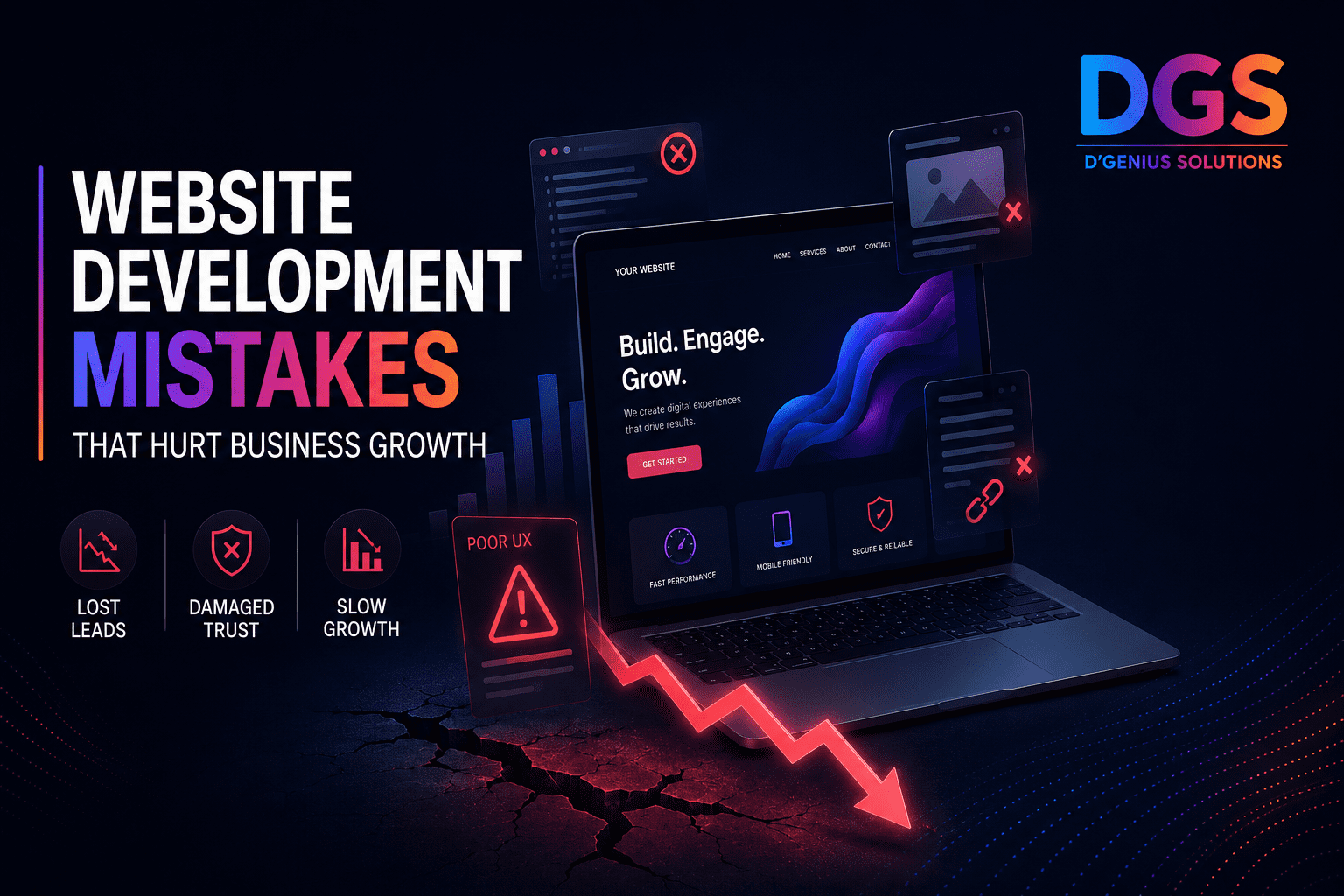
Website Development Mistakes That Hurt Business Growth
In this article
- Building a Website Only for Design
- Ignoring SEO During Website Development
- Not Making the Website AI-Ready
- Weak Service Pages
- Poor Mobile Experience
- Slow Website Speed
- Missing Schema and Structured Data
- No Clear Conversion Path
- Thin and Generic Content
- Ignoring Internal Linking
- Not Building for Local Search
- Lack of Trust Signals
- No Blog or Content Strategy
- Not Optimizing for Answer Search
- Launching Without Proper Testing
- How These Website Mistakes Hurt Business Growth
- How to Build a Growth-Ready and AI-Ready Website
- Is Your Website Ready for Modern Search?
- Final Thoughts
- FAQs
- What are the most common website development mistakes?
- Why is AI readiness important for a business website?
- How does website development affect business growth?
- What is AEO in website development?
Website development mistakes are not just design errors. They are structural, technical, content, and trust-related gaps that stop a website from ranking, converting, and being understood by search engines or AI platforms. A slow, unclear, poorly optimized, or non-AI-ready website can directly affect business growth by reducing traffic, leads, credibility, and customer inquiries.
Today, a business website has to do more than look professional. It must answer user questions, load quickly, explain services clearly, support SEO, build trust, and provide structured business information for Google, AI Overviews, answer engines, and large language models. This is why business website development must be planned with SEO, AEO, AIO, GEO, LLM SEO, and E-E-A-T from the beginning.
Building a Website Only for Design
One of the most common website development mistakes is treating the website like a visual project only. Many businesses approve a website because the colors, banners, and layout look modern. But after launch, they realize the website is not generating leads, enquiries, calls, or search visibility.
A good-looking website is useful only when it supports the business goal. If users cannot quickly understand what the company offers, who it serves, and why they should trust it, the design is not doing its job.
In many website audits, the problem is not always the design quality. The real issue is unclear messaging. The homepage may look polished, but the service explanation is weak. The banner may look premium, but the call-to-action is missing. The layout may be attractive, but the user journey is confusing.
A growth-focused website should guide visitors naturally. It should introduce the business, explain the services, show trust signals, answer common questions, and encourage users to take action.
Ignoring SEO During Website Development
SEO should never be added after the website is completed. It should be part of the development process from the start. When SEO is ignored during development, the website may launch with poor URL structures, weak headings, missing metadata, slow pages, duplicate content, broken links, and crawl issues.
These problems make it harder for search engines to understand the website. They also reduce the chances of ranking for important business keywords.
A strong SEO-friendly website should have a clear page structure, proper heading hierarchy, optimized title tags, meta descriptions, internal linking, clean URLs, image alt text, schema markup, and fast-loading pages. Every important service should have its own dedicated page instead of being hidden inside one general services section.
For example, a company offering website development, SEO, branding, social media marketing, performance marketing, and AI marketing should not depend on one broad services page. Each service needs its own detailed page so users, Google, and AI search platforms can understand the business clearly.
Not Making the Website AI-Ready
Search behavior has changed. People are not only searching through traditional blue links anymore. They are asking questions on Google AI Overviews, ChatGPT, Gemini, Perplexity, voice assistants, and other answer-based platforms. This makes AI readiness an important part of modern website development.
An AI-ready website gives clear and structured information about the brand, services, location, process, expertise, industries served, FAQs, and trust proof. If the website uses vague lines like “we provide the best solutions for every business,” AI systems may not understand what the company actually does.
For better AI search visibility, the website needs machine-readable content. This means clear headings, direct answers, schema markup, entity-rich service descriptions, FAQs, location signals, and well-connected internal pages.
A website that is not AI-ready may slowly lose visibility as search becomes more answer-led and conversational.
Weak Service Pages
Weak service pages are one of the biggest reasons websites fail to convert. Many service pages only include a short paragraph, a few icons, and a contact button. That is not enough for users, search engines, or large language models.
A strong service page should answer the questions a potential customer already has in mind. What is the service? Who needs it? What problems does it solve? What is the process? Why should the customer trust this company? What results can they expect?
For AEO and answer engine optimization, service pages should include direct answers, FAQs, benefits, process steps, comparison points, and use cases. This helps the page appear for question-based searches and AI-generated answers.
For LLM SEO, the content should clearly connect the service with the business, industry, location, and customer pain points. A thin service page gives AI platforms very little context. A detailed service page creates stronger understanding and better discovery potential.
Poor Mobile Experience
Most users now visit websites through mobile devices. If a website is difficult to read, slow to load, or hard to navigate on mobile, the business can lose leads quickly.
A poor mobile experience affects trust. Users may not wait, zoom, scroll endlessly, or struggle to click small buttons. They simply leave and choose another business.
A mobile-friendly website should have readable fonts, proper spacing, fast-loading images, simple menus, clickable phone numbers, WhatsApp or enquiry buttons, and clean page sections. The CTA should be easy to find without forcing the user to scroll too much.
For local businesses, mobile experience is even more important because many users search with urgent intent. If someone is looking for a service provider near them, the website must make it easy to call, enquire, or book a consultation.
Slow Website Speed
Website speed is not only a technical factor. It is a business factor. A slow website can reduce user engagement, increase bounce rate, and lower conversions.
Common speed issues include heavy images, unnecessary plugins, poor hosting, unused JavaScript, bulky themes, large videos, and uncompressed files. These problems often happen when websites are developed without performance planning.
A fast website makes the user journey smoother. It helps visitors move from the homepage to service pages, blogs, enquiry forms, and contact sections without frustration.
For SEO and technical SEO for websites, page speed, Core Web Vitals, mobile performance, and clean coding matter. A website that performs well technically has a stronger foundation for rankings, crawling, and conversions.
Missing Schema and Structured Data
Schema markup helps search engines and AI systems understand website content more clearly. It adds structured meaning to important information such as business name, services, FAQs, location, breadcrumbs, articles, and contact details.
Without structured data, search engines may still crawl the website, but they may not fully understand the relationship between the brand, services, pages, and content.
For GEO and LLM SEO, schema markup works like an additional clarity layer. It helps machines understand what the page is about and how it connects with the overall website.
Important schema types for business websites include Organization schema, LocalBusiness schema, Service schema, FAQ schema, Breadcrumb schema, and Article schema for blogs. These help improve AI readability and support better search interpretation.
No Clear Conversion Path
A website may receive traffic but still fail to generate leads if the conversion path is weak. This usually happens when CTAs are unclear, enquiry forms are too long, contact details are hidden, or the website does not guide users toward the next step.
Every important page should have a clear action. The CTA can be “Book a Consultation,” “Request a Quote,” “Get a Website Audit,” “Call Now,” or “Send an Enquiry.”
Good website conversion optimization is about reducing confusion. After explaining the service, benefits, process, and trust proof, the website should tell the visitor what to do next.
A visitor should never have to search for the contact button. The website should make the next step obvious and simple.
Thin and Generic Content
Thin content is one of the most damaging website development mistakes. Many business websites use generic content that could apply to any company in any industry. This creates a weak impression for users and search engines.
Lines like “we help businesses grow with innovative solutions” do not explain anything specific. Users want to know what the company does, how it helps, what problems it solves, and why it is trustworthy.
For E-E-A-T, website content should show experience, expertise, authority, and trust. This can be done through real service explanations, team expertise, case studies, client results, testimonials, process details, portfolio work, and practical insights.
A professional website development agency should not create pages only to fill space. Every page should have a clear purpose and should help users make a decision.
Ignoring Internal Linking
Internal linking helps search engines, AI platforms, and users understand the structure of a website. When pages are not connected properly, important service pages may remain isolated.
For example, a blog about website design should naturally link to website development services, SEO services, branding services, and lead-generation strategy pages where relevant. This helps users explore related services and helps search engines understand topical authority.
Internal linking also supports AIO and LLM SEO because it creates clear relationships between topics. If a website has strong internal links between blogs, services, FAQs, and location pages, AI systems can better understand the business ecosystem.
A website with poor internal linking feels disconnected. A website with smart internal linking feels organized, useful, and authoritative.
Not Building for Local Search
For businesses that serve specific cities or regions, local search should be part of website development. A website should clearly mention where the business operates, what locations it serves, and how it helps local customers.
For example, a Mumbai-based company should include natural local signals across its website. This can include city-specific service pages, local business schema, Google Business Profile integration, area-served details, contact information, and location-based FAQs.
Local SEO should not look like keyword stuffing. The goal is not to repeat the city name again and again. The goal is to show real local relevance.
For businesses targeting local leads, this can improve visibility for searches like “website development services in Mumbai,” “digital marketing agency near me,” or “SEO-friendly website development company.”
Lack of Trust Signals
Users do not enquire just because a website looks attractive. They enquire when they feel the business is credible. This is where trust signals become important.
A strong business website should include testimonials, Google reviews, client logos, case studies, team details, certifications, awards, founder information, portfolio work, and clear contact details.
Trust signals also support E-E-A-T. They show that the business has real experience, real clients, and real proof of work.
If a website has no reviews, no case studies, no client proof, and no team visibility, users may hesitate. In competitive industries, lack of trust can directly affect conversions.
No Blog or Content Strategy
A website without a proper blog or resource section may struggle to build topical authority. Blogs help answer customer questions, target long-tail keywords, support internal linking, and improve visibility in both search and AI-led platforms.
However, posting random blogs does not help much. A blog strategy should support the main service pages.
For example, a business offering website development services can publish blogs on website speed, lead generation, service page structure, AI-ready website planning, landing page mistakes, mobile optimization, technical SEO for websites, and conversion-focused design.
This helps the website become a stronger source of information around its services. Over time, it also improves the chances of being recognized by search engines and AI platforms as a helpful authority.
Not Optimizing for Answer Search
Users now search in a more conversational way. They ask full questions like “Why is my website not getting leads?” or “What makes a website AI-ready?” This is why AEO is important.
Answer engine optimization means creating content that directly answers user questions. A website should include short answer blocks, FAQs, comparison sections, step-by-step explanations, and simple definitions.
For example, instead of only saying “We build professional websites,” a page can answer: “What is an AI-ready website?” or “How does website development affect business growth?”
This improves visibility for featured snippets, voice search, AI Overviews, and conversational search platforms.
Launching Without Proper Testing
Many websites are launched without a complete testing process. This can lead to broken links, form errors, missing thank-you pages, slow mobile layouts, incorrect redirects, missing metadata, tracking issues, and indexing problems.
Before launch, every website should go through a proper checklist. This should include testing mobile responsiveness, website speed, enquiry forms, CTA buttons, tracking codes, Google Analytics, Search Console, sitemap, robots.txt, canonical tags, schema markup, redirects, and page indexing.
A rushed launch may create problems that affect SEO and lead generation for months. Proper testing helps avoid these issues before the website goes live.
How These Website Mistakes Hurt Business Growth
These mistakes may look small individually, but together they can create a major growth problem. Poor speed affects user experience. Weak content affects trust. Missing SEO affects rankings. No schema affects AI understanding. Weak CTAs affect conversions. Poor mobile design affects enquiries.
In simple terms, the website may exist online, but it does not work as a business asset.
A growth-ready website should attract the right visitors, answer their questions, build confidence, and make it easy for them to enquire. It should also be readable for search engines, answer engines, AI crawlers, and large language models.
How to Build a Growth-Ready and AI-Ready Website
A growth-ready website should be planned with strategy, content, technology, and conversion in mind. It should not be built only as a design project.
The website should have clear service pages, strong internal linking, fast website speed, mobile-friendly layouts, structured data, SEO-ready content, FAQs, trust signals, and clear CTAs.
For AI readiness, the website should also include direct answers, entity-rich information, service-specific details, location relevance, author or company credibility, and structured business information.
When all these elements work together, the website becomes more useful for users and easier for search engines and AI systems to understand.
Is Your Website Ready for Modern Search?
If a website is not bringing enough leads, the issue may not be only traffic. The real problem could be weak structure, unclear content, poor technical performance, missing trust signals, or low AI readiness.
A proper website audit can reveal where the website is losing users, rankings, and conversions. It can also show what needs to be improved across SEO, AEO, AIO, GEO, LLM SEO, technical SEO for websites, and user experience.
For any business that wants long-term digital growth, the website should be treated as a performance platform, not just an online brochure.
Final Thoughts
Website development mistakes can quietly hurt business growth. A website may look good visually but still fail to generate traffic, leads, trust, and conversions if it is not built with the right strategy.
Modern websites need to be fast, clear, mobile-friendly, SEO-ready, AI-readable, and conversion-focused. They should answer user questions, show expertise, build trust, and help search engines and AI platforms understand the business.
For businesses that want to grow online, website development must go beyond design. It must include SEO, AEO, AIO, GEO, LLM SEO, and E-E-A-T from the beginning. That is how a website becomes more than a digital presence. It becomes a real growth engine.
FAQs
What are the most common website development mistakes?
The most common website development mistakes include poor mobile experience, slow website speed, weak service pages, unclear CTAs, missing SEO structure, thin content, no schema markup, poor internal linking, and lack of trust signals.
Why is AI readiness important for a business website?
AI readiness helps search engines, AI Overviews, answer engines, and large language models understand the website better. An AI-ready website uses clear content, structured data, FAQs, service details, entity-rich information, and trust signals.
How does website development affect business growth?
Website development affects business growth by improving search visibility, user experience, trust, lead generation, and conversions. A poorly developed website can reduce enquiries and make users choose competitors.
What is AEO in website development?
AEO stands for Answer Engine Optimization. It means structuring website content to directly answer user questions so the website can perform better in featured snippets, voice search, AI Overviews, and answer-based search results.
Accelerate Your Digital & Search Growth
Speak directly with our Mumbai-based SEO, AI search, and digital marketing strategists for a bespoke growth audit.
Get a Free Strategy AuditRelated Insights
How to Turn Website Traffic Into Qualified Leads
Website Development helps businesses turn website traffic into qualified leads through better structure, trust, content, and user journey.
7 Website Development Features That Help Businesses Generate Quality Leads - D'Genius Solutions
Website Development plays a major role in how a business attracts, engages, and converts potential customers online. A website may look professional, but its
5 SEO Strategies for Business Growth That Improve Rankings and Leads
Learn how SEO strategies for business growth improve rankings, search visibility, user trust, and lead generation for businesses.