Why Website Design Directly Affects Lead Generation
In this article
- Quick Answer: How Does Website Design Affect Lead Generation ?
- First Impression Builds or Breaks Trust
- Clear Navigation Helps Visitors Reach the Right Service Faster
- Page Speed Can Decide Whether a Lead Stays or Leaves
- Mobile-Friendly Design Is No Longer Optional
- Website Copy Should Answer Before It Sells
- Why AEO , AIO , GEO and LLM SEO Matter in Website Design
- Conversion-Focused Design Turns Visitors Into Leads
- Service Pages Should Be Built Like Lead Generation Assets
- AI Readiness Is the Future of Website Lead Generation
- Why Businesses Need a Website That Sells, Not Just Looks Good
- Conclusion
- FAQs
- How does website design help in lead generation ?
- What type of website design generates more leads?
- Why is website design important for SEO ?
- What is an AI-ready website ?
- How do AEO , AIO , GEO , and LLM SEO support website visibility?
Website design and lead generation are directly connected because users decide within seconds whether they trust a business or not. A website may get traffic, but if the design is slow, confusing, outdated, or difficult to use, visitors leave without filling out a form, calling the company, or requesting a quote.
A good website does much more than look attractive. It helps people understand what the business does, why they should trust it, and what step they should take next. For service-based businesses, this matters even more because the website often becomes the first serious touchpoint before a customer speaks to the team.
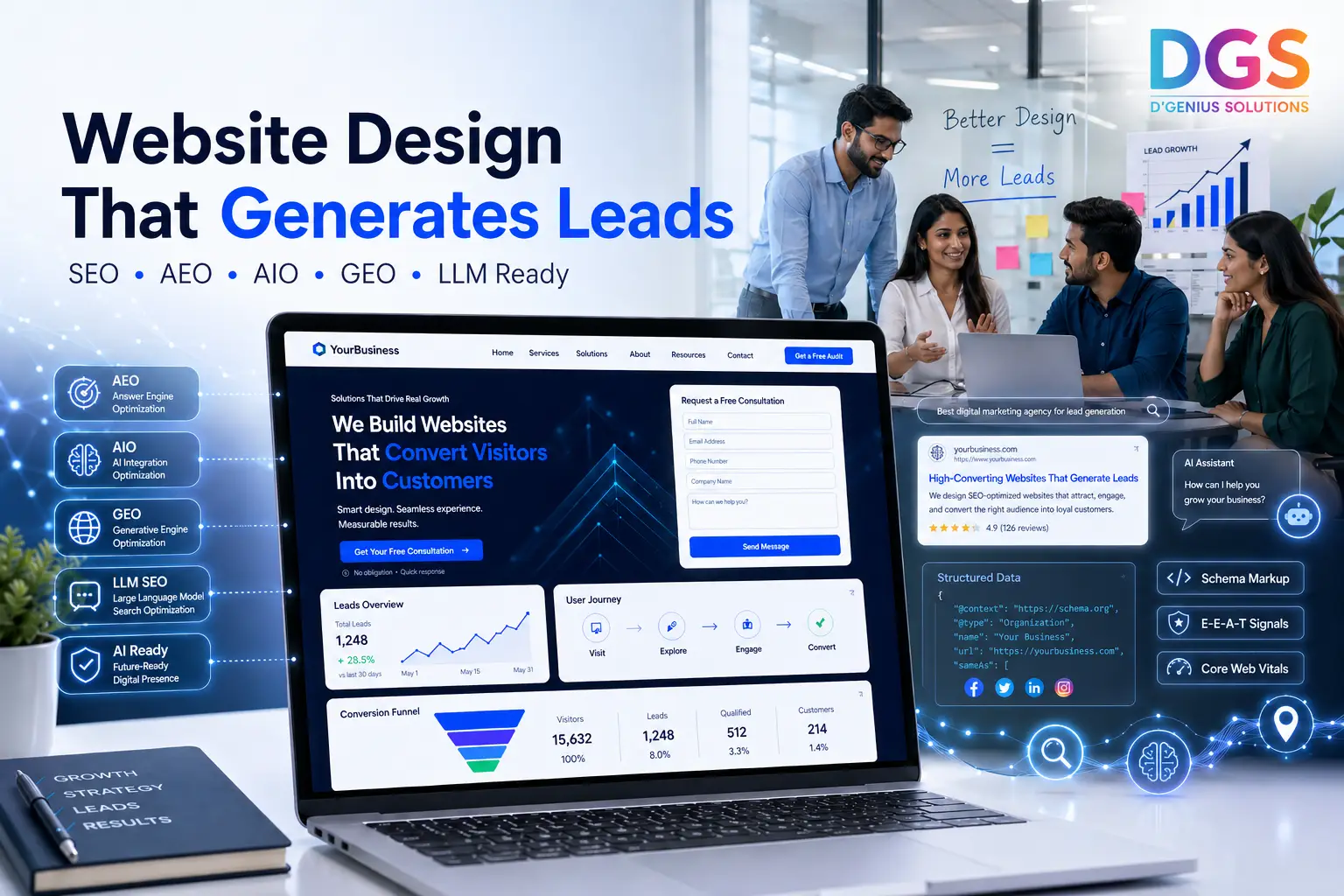
Today, website design also needs to support SEO, AEO, AIO, GEO, LLM SEO, and overall AI readiness. Search is no longer limited to normal Google results. People now discover businesses through AI Overviews, answer engines, voice search, ChatGPT-style platforms, and other AI-driven search experiences. That means a website must be designed for both humans and search systems.
Quick Answer: How Does Website Design Affect Lead Generation?
Website design affects lead generation by improving trust, page speed, mobile experience, content clarity, navigation, and conversion flow. A strong lead generation website design makes it easy for users to find the right service, understand the business, and take action through calls, forms, WhatsApp, or consultation requests.
In simple words, better design reduces confusion. And when confusion goes down, enquiries go up.
First Impression Builds or Breaks Trust
Before a user reads the full content of a website, they notice the design. The layout, font size, color balance, image quality, spacing, and overall structure silently tell them whether the business feels professional or not.
If the website looks outdated, users may assume the business is also outdated. If the page feels cluttered, they may feel the service will be complicated too. This is why design is not just a visual choice. It is a trust signal.
A professional website should clearly show who the business helps, what services it offers, where it operates, and why users should choose it. Elements like testimonials, client logos, case studies, service highlights, founder or team information, and visible contact options make the user feel more confident.
For a digital marketing agency in Mumbai like D'Genius Solutions, this becomes even more important. The website itself reflects the agency’s understanding of branding, user experience, SEO, content, and conversion strategy.
Clear Navigation Helps Visitors Reach the Right Service Faster
One of the biggest reasons websites fail to generate leads is poor navigation. A user should never feel lost on a business website. If someone visits looking for SEO, website development, branding, social media marketing, AEO, GEO, or AI marketing services, they should be able to reach the right page quickly.
Good navigation helps users move naturally from one section to another. It also helps Google and AI systems understand how services are connected. For example, if a website has separate pages for SEO, website development services, LLM SEO, branding, and content creation, the menu and internal links should connect them logically.
This improves topical authority. It also gives large language models a clearer understanding of the brand’s service ecosystem.
For better results, every important service page should be reachable within a few clicks from the homepage.
Page Speed Can Decide Whether a Lead Stays or Leaves
A slow website can kill leads before the user even sees the content. People do not wait patiently anymore. If a website takes too long to load, especially on mobile, visitors often close it and move to another company.
Page speed also affects SEO. Google wants to show users pages that offer a better experience. A slow-loading page may struggle to perform well even if the content is good.
A strong SEO-friendly website design should include compressed images, clean code, optimized scripts, lightweight layouts, proper hosting, and good Core Web Vitals. These technical design decisions directly affect how users behave on the site.
From an AI search perspective, clean and fast-loading pages are also easier for search engines and AI crawlers to process.
Mobile-Friendly Design Is No Longer Optional
Most users check business websites on mobile before making an enquiry. They may search while travelling, during office hours, or while comparing agencies. If the mobile version is hard to read or difficult to use, the website loses potential leads.
A mobile-friendly design should have readable text, properly spaced buttons, short forms, sticky contact options, fast-loading images, and clear service sections. The user should not need to zoom, scroll endlessly, or struggle to find the contact button.
This is especially important for local searches like “best website agency near me,” “SEO agency in Mumbai,” or website development agency in Mumbai. In these searches, users often want quick answers and quick action. If the website experience is smooth, the chance of conversion increases.
Website Copy Should Answer Before It Sells
A beautiful website with weak content will not generate quality leads. Users need clarity before they trust a brand. They want to know what the service includes, how it helps, who it is for, and what makes the company different.
This is where website copy supports AEO and AIO. Answer Engine Optimization works best when the page answers common user questions in a direct and simple way. AI Overview Optimization works best when the first few lines of the page clearly explain the topic.
For example, instead of starting a service page with a vague line like “We create powerful digital experiences,” a better opening would be:
“A lead-focused website helps businesses attract visitors, explain services clearly, and convert interested users into enquiries.”
This type of answer-first writing is easier for users, Google, and AI systems to understand.
Why AEO, AIO, GEO and LLM SEO Matter in Website Design
Modern website design should not only focus on how the page looks. It should also focus on how easily the page can be understood by search engines and AI platforms.
AEO helps the website answer specific user questions. AIO helps the content become suitable for AI Overview-style results. GEO helps the brand become more visible in generative search experiences. LLM SEO helps large language models understand the business, services, location, expertise, and relevance.
This is why headings, FAQs, schema markup, internal links, author information, service clarity, and structured content are now part of good website design. A website that is visually attractive but poorly structured may still struggle in AI-driven search.
A strong AI-ready website should clearly explain the business, services, audience, location, process, proof, and conversion path.
Conversion-Focused Design Turns Visitors Into Leads
A website should not make users think too much about what to do next. Every page should guide the visitor toward an action. That action can be filling out a form, booking a consultation, calling the business, sending a WhatsApp message, or requesting an audit.
This is where conversion-focused website design becomes important. CTA buttons should be placed naturally across the page, not hidden only at the bottom. Forms should be short. Contact details should be visible. Service benefits should be easy to scan.
For example, after explaining website development services, a CTA like “Request a Website Audit” or “Talk to Our Website Team” can work better than a generic “Submit” button.
The goal is simple: reduce friction and make the next step obvious.
Service Pages Should Be Built Like Lead Generation Assets
Many businesses treat service pages like basic information pages. That is a mistake. A service page should work like a sales and SEO asset.
A strong service page should include a clear service definition, pain points, benefits, process, industries served, FAQs, proof points, internal links, and a strong CTA. This structure supports users as well as Google and AI platforms.
For D'Genius Solutions, this matters across services such as SEO, AEO, GEO, LLM SEO, website development, branding, content creation, and social media marketing. Each service page should clearly tell users what the service does, who it helps, and why DGS is the right team to handle it.
When service pages are designed properly, they do not just rank. They convert.
AI Readiness Is the Future of Website Lead Generation
AI readiness means a website is prepared for how users search today and how they will search tomorrow. People may find a business through Google Search, AI Overviews, ChatGPT, Perplexity, Gemini, voice search, or other answer-based platforms.
To appear in these spaces, the website must be easy to crawl, easy to understand, and easy to trust. That means the content should be structured, the technical setup should be clean, and the brand information should be consistent.
An AI-ready website should include schema markup, FAQs, author or company expertise, service-specific pages, location signals, helpful content, internal linking, and clear brand positioning.
This is no longer an advanced SEO option. It is becoming a basic requirement for online visibility.
Why Businesses Need a Website That Sells, Not Just Looks Good
A visually good website can attract attention, but a strategically designed website attracts leads. There is a big difference between the two.
A website that only looks good may impress users for a few seconds. A website built with SEO, UX, AEO, AIO, GEO, LLM readability, and conversion strategy can support long-term business growth.
For businesses in competitive cities like Mumbai, this difference matters. Users compare multiple companies before making a decision. If the website does not explain the value clearly, another competitor will win the lead.
That is why a business website should be treated as a lead generation engine, not a one-time design project.
Conclusion
Website design directly affects lead generation because it shapes how users feel, how they move through the site, how quickly they understand the service, and how confidently they take action.
A strong website should be fast, mobile-friendly, structured, SEO-focused, answer-ready, AI-readable, and conversion-driven. When design works together with SEO-friendly website design, AEO, AIO, GEO, LLM SEO, and AI readiness, the website becomes much more than an online presence. It becomes a growth channel.
For businesses that want better enquiries, better trust, and better visibility across search and AI platforms, website design is not just about appearance anymore. It is about performance.
Want a website that brings qualified leads instead of just traffic? D'Genius Solutions builds SEO-friendly, AI-ready, and conversion-focused websites for businesses that want stronger visibility across Google Search, AI Overviews, answer engines, and LLM-based platforms.
Connect with the DGS team to review where your current website may be losing leads.
FAQs
How does website design help in lead generation?
Website design helps in lead generation by improving trust, speed, navigation, mobile experience, content clarity, and conversion actions. A well-designed website makes it easier for users to understand the business and submit an enquiry.
What type of website design generates more leads?
A lead generation website design includes clear service pages, strong CTAs, fast loading speed, mobile-friendly layouts, FAQs, testimonials, case studies, and simple contact options.
Why is website design important for SEO?
Website design is important for SEO because it affects page speed, mobile usability, internal linking, crawlability, content structure, and user experience. A strong design helps both users and search engines understand the website better.
What is an AI-ready website?
An AI-ready website is structured in a way that search engines, AI Overviews, answer engines, and large language models can easily understand the business, services, expertise, and location relevance.
How do AEO, AIO, GEO, and LLM SEO support website visibility?
AEO helps answer user questions, AIO supports AI Overview visibility, GEO improves generative search presence, and LLM SEO helps AI platforms understand and reference the business more accurately.
Accelerate Your Digital & Search Growth
Speak directly with our Mumbai-based SEO, AI search, and digital marketing strategists for a bespoke growth audit.
Get a Free Strategy AuditRelated Insights
Brand Identity: 7 Powerful Reasons It Builds SEO Trust and Lead Generation - D'Genius Solutions
Brand identity is more than a logo, color palette, or business name. It is the complete way people recognize, remember, and trust your business online. In
SEO Friendly Website: 7 Powerful Ways to Build a Lead-Ready Site - D'Genius Solutions
SEO friendly website planning is no longer only about adding keywords to pages. A business website now needs clean development, strong web design, fast
Website Traffic but No Leads? 9 Proven Fixes That Work
Website traffic but no leads? Discover 9 proven reasons visitors do not convert and learn how to improve traffic quality, landing pages, CTAs, trust and tracking.