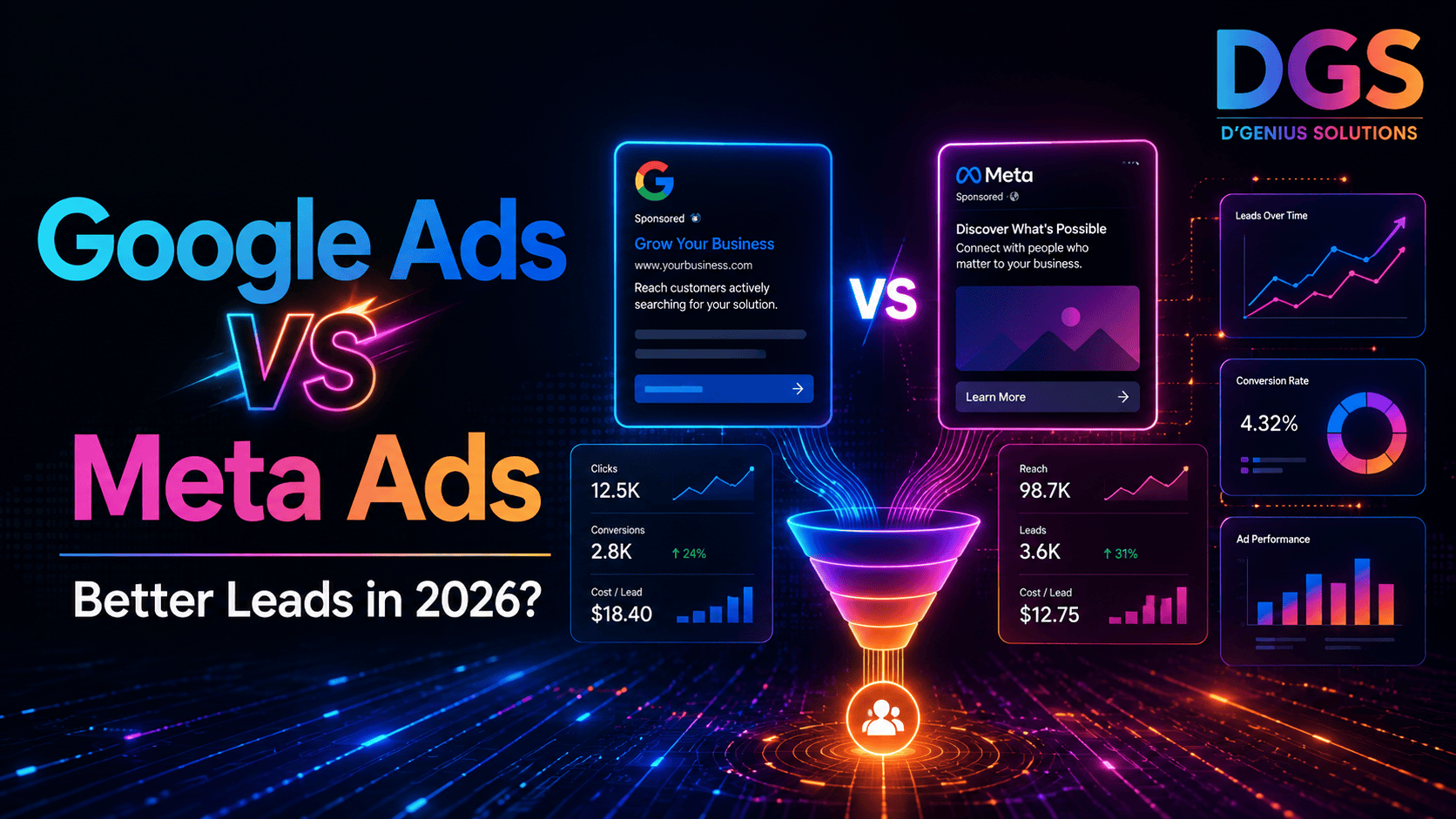
Google Ads vs Meta Ads: Which Generates Better Leads in 2026?
In this article
- Quick Answer
- Why Google Ads vs Meta Ads Matters More in 2026
- Google Ads vs Meta Ads at a Glance
- How Google Ads Lead Generation Works in 2026
- Where Google Ads Usually Has the Advantage
- How Meta Ads Lead Generation Works in 2026
- Where Meta Ads Usually Has the Advantage
- Search Intent vs Demand Generation Is the Real Difference
- Which Platform Generates Cheaper Leads?
- Which Generates Better Quality Leads?
- The Biggest Google Ads Lead Generation Mistake
- The Biggest Meta Ads Lead Generation Mistake
- Google Ads Is Becoming More Visual While Meta Is Becoming More Automated
- Google Ads vs Meta Ads for Different Businesses
- B2B Services
- Local Businesses
- Ecommerce and Consumer Brands
- High Ticket Services
- Why Using Both Platforms Can Generate Better Leads
- A Better Paid Advertising Funnel for 2026
- How D'Genius Solutions Approaches Google Ads and Meta Ads
- Which Should You Choose in 2026?
- Final Verdict
- Frequently Asked Questions
- Is Google Ads better than Meta Ads for lead generation?
- Is Meta Ads cheaper than Google Ads?
- Are Google Ads good for B2B leads?
- Are Meta Ads good for service businesses?
- Should I run Google Ads and Meta Ads together?
- What is more important than cost per lead?
Quick Answer
Google Ads vs Meta Ads does not have one universal winner for lead generation in 2026. Google Ads generally performs strongly when people are already searching for a product, service or solution, while Meta Ads can be more effective for generating demand through Facebook and Instagram before users actively search. For many businesses, the strongest result comes from combining high intent Google campaigns with Meta prospecting and remarketing rather than choosing only one platform.
Google’s current advertising ecosystem combines Search with increasingly AI driven campaign formats such as Performance Max and Demand Gen. Performance Max can optimise across Search, YouTube, Display, Discover, Gmail and Maps, while Demand Gen reaches users across visual Google surfaces including YouTube and Discover.
Why Google Ads vs Meta Ads Matters More in 2026
Google Ads vs Meta Ads has become a more complicated comparison than simply search advertising versus social media advertising.
Both platforms now depend heavily on machine learning, conversion signals, audience data, automated bidding and creative quality. The real question for a business is no longer simply which platform can generate the cheapest enquiry.
The more important question is:
Which platform can generate leads that are most likely to become paying customers at a sustainable acquisition cost?
That distinction matters because a campaign generating 100 leads at ₹500 per lead is not necessarily more successful than a campaign generating 40 leads at ₹1,000 per lead.
If the first campaign produces only two customers while the second produces twelve, the more expensive leads may actually generate far better business results.
A modern performance marketing strategy therefore needs to measure qualified leads, sales opportunities, lead to customer conversion rates, customer acquisition cost and revenue rather than judging campaigns only by cost per lead.
Google Ads vs Meta Ads at a Glance
| Factor | Google Ads | Meta Ads |
|---|---|---|
| Primary user behaviour | Captures existing search intent | Creates and influences demand |
| Strongest environments | Search, YouTube, Maps and wider Google inventory | Facebook and Instagram |
| Best suited to | High intent services, urgent needs, B2B and local searches | Visual brands, consumer offers, discovery and remarketing |
| Lead journey | Often shorter for high intent searches | Often requires nurturing |
| Creative dependence | Moderate to high depending on campaign type | Very high |
| Keyword targeting | Major advantage through Search campaigns | Not keyword driven in the same way |
| Native lead forms | Available depending on campaign setup | Strong Instant Form ecosystem |
| Remarketing | Strong | Strong |
| AI optimisation | Smart Bidding, Performance Max, Demand Gen and other automation | Meta automated audience, placement and creative systems |
| Best success metric | Qualified lead cost and customer acquisition cost | Qualified lead cost and customer acquisition cost |
The important takeaway is that the platforms influence different parts of the buying journey. Comparing them only through CPC or CPL can hide their actual contribution to revenue.
In 2026, feeding deeper funnel outcomes back into advertising systems is increasingly important. Google’s Enhanced Conversions for Leads can use first party customer data and offline conversion information to improve conversion measurement and help advertisers understand which leads ultimately create business value.
How Google Ads Lead Generation Works in 2026
Google Ads lead generation is especially powerful when a prospect already knows what they need.
Imagine someone searching for:
“commercial interior designer near me”
“enterprise cybersecurity company”
“international student admission consultant”
“performance marketing agency”
These users are actively expressing a need. Google gives advertisers an opportunity to appear during that demand.
This makes Google Ads for leads particularly relevant to businesses where potential customers search before making contact.
Google Search campaigns remain valuable for capturing keyword driven intent, while Performance Max can extend optimisation across Google’s advertising inventory. Google specifically recommends supplying Performance Max with accurate conversion data, meaningful conversion actions and strong creative assets so its AI can optimise towards valuable leads rather than simply form submissions.
Where Google Ads Usually Has the Advantage
Google can be particularly effective for businesses offering solutions people actively search for.
Professional services often fit this model because someone looking for a lawyer, accountant, marketing agency, software provider or consultant may already be researching providers.
Local services can also benefit because searches frequently indicate immediate intent.
B2B businesses can use the same principle when prospects search for software, outsourcing partners, manufacturers, consultants or specialised business solutions.
The strength of Google Ads lead generation comes from meeting the buyer after demand already exists.
How Meta Ads Lead Generation Works in 2026
Meta Ads lead generation approaches the customer differently.
Instead of waiting until someone searches for a solution, Facebook and Instagram can introduce a brand, offer or problem to people while they are consuming content.
A user may not wake up intending to search for a new skincare clinic, jewellery collection, education programme or interior design service. A strong Instagram Reel or Facebook advertisement can introduce that need.
That makes Meta Ads for leads particularly useful when visual storytelling, emotional appeal, product demonstration or an attractive offer can influence a customer before active search begins.
Meta also supports Instant Forms designed specifically for lead advertising. Businesses can provide information about their offer before users submit their details, including higher intent form experiences depending on campaign configuration.
Where Meta Ads Usually Has the Advantage
Meta can work especially well for categories where the product needs to be seen before people become interested.
Fashion, jewellery, beauty, education, hospitality, fitness, real estate, lifestyle products and many consumer services can benefit from visual discovery.
The platform is also valuable for remarketing because users who interacted with a brand but did not convert can continue seeing relevant messaging across Facebook and Instagram.
Successful Meta Ads lead generation therefore depends heavily on creative quality, offer positioning, audience signals and the follow up experience after a lead is captured.
Search Intent vs Demand Generation Is the Real Difference
A useful way to understand Google Ads vs Meta Ads is to stop thinking about platforms and start thinking about customer psychology.
Google often answers existing demand.
Meta often helps create demand.
Consider a company selling premium modular kitchens.
Someone searching Google for “premium modular kitchen company” has already entered the consideration stage. A relevant search advertisement can capture that intent.
Another homeowner may not currently be searching for a kitchen company. However, an impressive Instagram video showing a kitchen transformation could create interest and move that person into the buying journey.
Both leads can eventually become customers.
They simply entered the funnel at different points.
This is why a strong performance marketing strategy maps advertising platforms to stages of customer intent instead of forcing every channel to perform the same job.
Which Platform Generates Cheaper Leads?
This is where many advertising comparisons become misleading.
Meta Ads for leads can sometimes generate a lower initial CPL because users can respond directly through social advertising experiences without necessarily conducting an active search.
Google Search traffic can be more competitive because advertisers may be bidding for valuable commercial keywords.
But cheaper does not automatically mean better.
Businesses should compare:
| Metric | Why It Matters |
|---|---|
| Cost per lead | Shows the cost of generating an enquiry |
| Qualified lead rate | Shows how many leads fit the business |
| Appointment rate | Shows whether leads move forward |
| Sales conversion rate | Measures actual customer acquisition |
| Customer acquisition cost | Shows the real cost of winning a customer |
| Revenue from ads | Connects campaigns with business outcomes |
| Lifetime value | Helps determine how much a customer is worth long term |
The objective should therefore be qualified lead efficiency, not simply the lowest possible CPL.
Which Generates Better Quality Leads?
For high intent services, Google Ads for leads frequently has an important structural advantage because users can explicitly communicate what they want through their search.
Someone searching “hire PPC agency” is showing stronger immediate intent than someone who happens to see an agency advertisement while browsing Instagram.
That does not mean Meta leads are poor quality.
Meta can generate excellent prospects when targeting, creative, offer design, qualification questions and CRM follow up are properly aligned.
Meta specifically recommends connecting lead campaigns with CRM systems so leads can move into the sales process quickly and businesses can manage follow up more effectively.
The difference is largely one of intent maturity.
Google often reaches customers closer to action.
Meta can reach customers earlier and influence them before their intent becomes explicit.
The Biggest Google Ads Lead Generation Mistake
The biggest mistake in Google Ads lead generation is optimising campaigns for the easiest conversion rather than the most valuable business outcome.
For example, suppose Google sees that one type of user frequently submits a form. The platform may naturally look for more users with similar behaviour.
But what happens if those forms rarely become sales?
The campaign can appear successful while the sales team receives weak enquiries.
In 2026, feeding deeper funnel outcomes back into advertising systems is increasingly important. Google’s enhanced conversions for leads can use first party lead information together with imported offline outcomes to improve attribution and bidding signals. Google also updated enhanced conversion infrastructure during 2026, including broader use of Data Manager for lead data connections.
The campaign should therefore understand the difference between:
A form submission
A marketing qualified lead
A sales qualified lead
A booked consultation
A completed sale
The closer optimisation gets to actual business value, the more useful automation can become.
The Biggest Meta Ads Lead Generation Mistake
The biggest mistake with Meta Ads lead generation is assuming that attractive creative alone will produce qualified customers.
Creative earns attention.
It does not automatically create qualification.
A campaign advertising “Book a Free Consultation” to a broad audience may produce many submissions, but the business could receive students, job seekers, vendors, low budget prospects or users with little buying intention.
Strong Meta Ads for leads should therefore qualify prospects before the sales team spends time on them.
That can be achieved through stronger offer language, clear pricing context where appropriate, qualification questions, better landing pages, higher intent forms and immediate CRM based follow up.
Meta’s Instant Form tools allow businesses to provide additional information and structure before submission, while CRM integrations can make new leads available for rapid follow up.
Google Ads Is Becoming More Visual While Meta Is Becoming More Automated
The old idea that Google is only text search and Meta is only visual social advertising is becoming less accurate.
Google Demand Gen campaigns can serve image and video advertising across YouTube, including Shorts, Discover, Gmail, Maps and the Google Display Network. Google began allowing eligible advertisers to voluntarily migrate existing Display campaigns toward Demand Gen in June 2026.
Performance Max also combines multiple Google channels inside an AI driven campaign environment.
At the same time, Meta continues to use automated delivery systems that can expand beyond initial audience definitions when its systems predict better performance opportunities.
The competitive gap between the two ecosystems is therefore changing.
Google increasingly participates in discovery.
Meta increasingly automates audience discovery.
But customer intent remains one of the biggest strategic differences.
Google Ads vs Meta Ads for Different Businesses
B2B Services
For many B2B companies, Google Ads vs Meta Ads should usually begin with buyer intent.
If decision makers actively search for your solution, Google Search can provide a direct route to demand.
Meta can then support the funnel through thought leadership videos, case studies, founder content and remarketing.
The combination can be stronger than depending entirely on either platform.
Local Businesses
Clinics, consultants, home services, legal firms and other location based businesses can benefit heavily from search demand because customers often search when they need the service.
Meta can strengthen awareness and remarketing around that search activity.
Ecommerce and Consumer Brands
Visual product categories can benefit substantially from Facebook and Instagram discovery.
Google can then capture shoppers searching for products, categories and brands while its wider campaign inventory can support additional discovery and remarketing.
High Ticket Services
High ticket decisions often require several interactions.
A prospect might discover the company on Instagram, search the brand later on Google, visit the website, leave without converting and finally respond to remarketing.
Trying to assign the entire sale to one isolated click can create the wrong conclusion about platform performance.
Why Using Both Platforms Can Generate Better Leads
For many companies, the winning Google Ads vs Meta Ads strategy in 2026 is not choosing a winner.
It is assigning each platform the job it performs best.
Meta can introduce your business to potential customers.
Google can capture active demand.
Meta can retarget website visitors.
Google can recapture high intent searches.
Both platforms can receive stronger conversion signals from customer and CRM data when tracking is configured appropriately. Google recommends accurate conversion tracking and deeper funnel conversion actions for lead generation, while Meta encourages CRM integration for faster lead management and stronger downstream conversion processes.
This creates a more complete performance marketing strategy.
A Better Paid Advertising Funnel for 2026
An effective funnel starts with awareness and moves gradually towards revenue.
At the discovery stage, strong Facebook, Instagram, YouTube and visual advertising can introduce the brand and problem.
At the consideration stage, educational content, case studies, remarketing and proof help potential customers evaluate the company.
At the intent stage, Google Search campaigns can capture people actively searching for solutions.
At the conversion stage, the landing page, form, offer and sales process determine whether advertising traffic becomes revenue.
Finally, CRM and conversion data should flow back into advertising systems so campaigns learn from actual business outcomes rather than surface level conversions.
This is where Google Ads for leads and social advertising can complement one another instead of competing for all the credit.
How D'Genius Solutions Approaches Google Ads and Meta Ads
D'Genius Solutions builds performance marketing around qualified leads, sales and ROI rather than traffic alone.
The current DGS performance marketing approach includes Google Search Ads, Performance Max, Meta campaigns, lead generation, remarketing, landing page optimisation, GA4 measurement, conversion events and campaign reporting.
Instead of asking only “How cheap is the lead?”, the more useful questions are:
Is the person genuinely interested?
Does the lead match the target customer?
Can the sales team contact the prospect quickly?
How many advertising leads become opportunities?
How many opportunities become customers?
What does each acquired customer actually cost?
Those answers determine whether the campaign deserves a larger budget.
Which Should You Choose in 2026?
Choose Google first when your customers already search actively for what you sell and your service has strong commercial search intent.
Choose Meta first when demand needs to be created through visuals, storytelling, offers or repeated exposure.
Use both when customers require several interactions before buying, when you want to combine demand creation with demand capture, or when remarketing plays an important role in conversion.
The strongest Google Ads vs Meta Ads decision therefore depends on customer intent, business model, sales cycle, creative strength, budget and measurement quality.
There is no platform that automatically generates better leads for every business.
There is only a platform strategy that matches the way your customers actually buy.
Final Verdict
Google Ads vs Meta Ads in 2026 is less about declaring one advertising platform superior and more about understanding where each one fits in the customer journey.
Google has a major advantage when users are already expressing commercial intent through search. Meta has a major advantage when businesses need to create interest, visually communicate value and repeatedly reach prospects across Facebook and Instagram.
For many businesses, the most scalable model is to use Meta to generate and nurture demand while Google captures high intent prospects when they begin actively searching.
The final winner should not be determined by impressions, clicks or even raw CPL.
It should be determined by qualified leads, customer acquisition cost and revenue.
Businesses that want an integrated paid growth system can work with D'Genius Solutions to build a performance marketing strategy covering Google Ads, Meta Ads, landing page optimisation, remarketing, lead tracking and conversion focused campaign management. DGS currently positions its performance marketing service around Google Search, Performance Max, Meta Ads, lead generation campaigns and measurable ROI.
Frequently Asked Questions
Is Google Ads better than Meta Ads for lead generation?
Google Ads can be stronger when customers are actively searching for your product or service because search behaviour can indicate immediate intent. Meta can be stronger when a business needs to create awareness and demand before someone begins searching. The better platform depends on the customer journey and business model.
Is Meta Ads cheaper than Google Ads?
Meta can sometimes produce a lower initial cost per lead, particularly for broad consumer audiences and native lead generation. However, businesses should compare qualified lead cost and customer acquisition cost rather than judging performance only by CPL.
Are Google Ads good for B2B leads?
Yes. Google Ads lead generation can work particularly well for B2B services when decision makers actively search for suppliers, software, consultants, agencies or specialised solutions. Accurate conversion measurement and deeper funnel lead signals can help Google optimise towards more valuable outcomes.
Are Meta Ads good for service businesses?
Yes. Meta can work for service businesses when the campaign combines strong creative, clear positioning, appropriate targeting and lead qualification. Instant Forms and CRM integrations can also support lead capture and faster follow up.
Should I run Google Ads and Meta Ads together?
For many businesses, yes. Meta can generate awareness and nurture prospects while Google captures customers with stronger search intent. Remarketing across both ecosystems can help businesses remain visible throughout a longer decision journey.
What is more important than cost per lead?
Qualified lead rate, lead to sale conversion rate, customer acquisition cost and revenue are more useful measures of business performance. A cheaper lead is not valuable if it rarely becomes a customer.
Accelerate Your Digital & Search Growth
Speak directly with our Mumbai-based SEO, AI search, and digital marketing strategists for a bespoke growth audit.
Get a Free Strategy AuditRelated Insights
Google Ads AI Max 2026 What Advertisers Need to Know Before the September Changes - D'Genius Solutions
Google Ads AI Max 2026 is changing how advertisers manage Search campaigns, targeting, advertising assets and landing pages.
Google AI Search Update: 7 Ways Businesses Can Get Better Leads - D'Genius Solutions
Google AI Search Update helps businesses improve AI search visibility, build trust, answer user queries, and generate better leads.
Google AI Overviews Image Generation: 7 SEO Actions Brands Should Take - D'Genius Solutions
Google AI Overviews image generation is changing how people discover, create and interact with visual information through Google Search.