Google Agentic Browsing: 7 Website Changes for 2026
In this article
- Quick Answer
- What Is Google Agentic Browsing?
- Is Google Agentic Browsing a Ranking Factor?
- Google Agentic Browsing vs Google AI Mode
- 7 Ways to Prepare for Google Agentic Browsing
- 1. Strengthen Technical SEO
- 2. Build a Complete Accessibility Structure
- 3. Maintain Strong Layout Stability
- 4. Make Forms Easy for Machines to Understand
- 5. Create Clear Service Page Content
- 6. Publish an Accurate llms.txt File
- 7. Create Original and People-First Content
- How Agentic Browsing Changes Website Development
- What Businesses Should Do Now
- Why Google Agentic Browsing Matters for SEO
- How D'Genius Solutions Prepares Brands for AI Search
- Final Takeaway
- What is Google Agentic Browsing?
- Is Agentic Browsing a Google ranking factor?
- Does a website need llms.txt to appear in Google AI Mode?
- How can a business make its website agent-ready?
- Can DGS audit a website for Agentic Browsing?
Google Agentic Browsing is introducing a new way to evaluate whether websites are ready for AI agents.
Traditional search engines primarily crawl, understand and rank website content. AI agents can go further. They may need to identify buttons, interpret forms, navigate pages and complete digital actions on behalf of users.
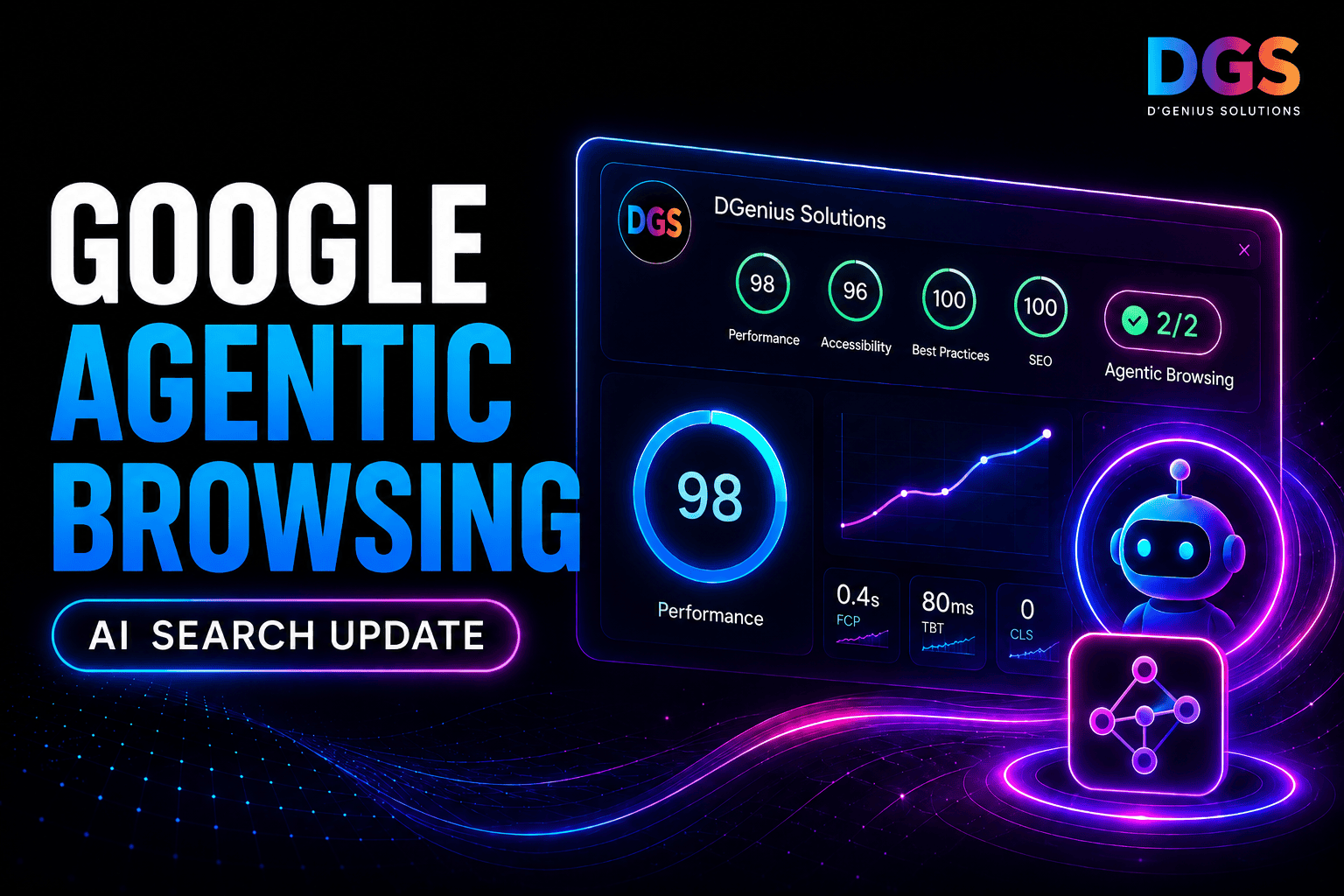
Google Chrome has therefore introduced an Agentic Browsing category in Lighthouse. It checks whether a website is structured clearly enough for reliable machine interaction. Unlike the normal Performance, Accessibility and SEO categories, Agentic Browsing currently uses pass-and-fail checks instead of a score from 0 to 100.
This development does not mean that traditional SEO is disappearing. It means businesses must start preparing websites for both human visitors and AI-powered browsing systems.
Quick Answer
Google Agentic Browsing evaluates whether AI agents can understand, navigate and interact with a website reliably. It examines areas such as accessibility, layout stability, machine-readable website information, form structure and emerging WebMCP implementation. It is not currently a confirmed Google Search ranking factor, but it signals how websites may need to evolve for an agent-driven internet.
What Is Google Agentic Browsing?
Google Agentic Browsing is a new Lighthouse audit category designed to evaluate a website’s readiness for interaction by AI agents.
An AI agent may do more than retrieve information. Depending on the service and the user’s permission, it may attempt to:
- Find the correct service
- Compare available options
- Complete an enquiry form
- Register for an event
- Book an appointment
- Subscribe to a newsletter
- Navigate a multi-step customer journey
The Agentic Browsing category runs deterministic checks to identify whether the page provides a reliable technical environment for these actions. Its current fractional result, such as 2/2, represents how many available readiness checks the website has passed.
This category is still developing, so businesses should treat it as an early technical-readiness signal rather than a direct guarantee of higher organic rankings.
Is Google Agentic Browsing a Ranking Factor?
There is currently no official confirmation that the Lighthouse Agentic Browsing result is a direct Google Search ranking factor.
Google’s documentation explains that the standards for the agentic web are still emerging. The current audit is intended to collect data and provide actionable technical signals rather than calculate a conventional ranking score.
However, several qualities measured or supported by agent readiness already contribute to a stronger digital experience:
- Accessible page structures
- Stable layouts
- Clear navigation
- Crawlable content
- Descriptive forms
- Strong technical SEO
- Fast, usable websites
These improvements can benefit users, search engines and AI systems simultaneously.
Businesses should therefore avoid trying to “game” the Agentic Browsing result. The better approach is to create a technically reliable website that genuinely helps visitors complete their intended tasks.
Google Agentic Browsing vs Google AI Mode
Google Agentic Browsing and Google AI Mode are connected to the wider shift towards AI, but they are not the same feature.
Google AI Mode is an AI-led Search experience that helps users ask complex questions, explore topics and continue with conversational follow-up queries. Google states that existing SEO best practices remain relevant for appearing in AI Mode and AI Overviews.
Google Agentic Browsing, meanwhile, is focused on whether an AI agent can reliably interact with a website.
In simple terms:
- AI Mode helps users discover and understand information.
- Agentic Browsing measures whether an AI system can use a webpage effectively.
- SEO helps the website become discoverable.
- AEO helps content deliver direct answers.
- GEO and LLM SEO improve contextual understanding and AI visibility.
- Agentic optimization prepares the website for machine-led actions.
A complete search strategy should connect all these elements instead of treating them as separate marketing trends.
7 Ways to Prepare for Google Agentic Browsing
1. Strengthen Technical SEO
Google Agentic Browsing begins with a technically accessible website.
Important pages should be crawlable, indexable and connected through clear internal links. Broken links, duplicate pages, blocked resources, incorrect canonicals and unclear navigation can make it harder for both search engines and AI agents to interpret a website.
Google confirms that foundational SEO remains relevant for generative AI search, including crawlability, index eligibility, page experience, internal linking and technically clear page structures.
Businesses that need help diagnosing these issues can explore D'Genius Solutions’ SEO services in Mumbai.
2. Build a Complete Accessibility Structure
AI agents often depend on the same semantic and accessibility information used by assistive technologies.
A website should use:
- Logical heading levels
- Descriptive button labels
- Proper form labels
- Meaningful link text
- Image alt attributes
- Accessible menus
- Clear input instructions
Google’s Lighthouse documentation specifically identifies the accessibility tree as an important component for agent interaction.
A button labelled “Submit SEO Audit Request” is more informative than a generic button labelled “Click Here.”
3. Maintain Strong Layout Stability
Unexpected movement can cause an AI agent to click or interact with the wrong element.
Large layout shifts may happen when:
- Images load without fixed dimensions
- Pop-ups appear suddenly
- Fonts change after rendering
- Advertisements push content downward
- Dynamic sections load above forms or buttons
Lighthouse explains that agents may use screenshots or coordinate-based interactions. A visually unstable layout can therefore cause failed actions.
Improving Cumulative Layout Shift benefits both Core Web Vitals and agent reliability.
4. Make Forms Easy for Machines to Understand
Forms are likely to become one of the most important areas of agent-ready website development.
Every form field should have:
- A proper
nameattribute - A visible label
- The correct input type
- Clear validation messages
- A descriptive submit button
- A predictable completion process
For example, an enquiry form should clearly distinguish between the user’s name, business email, phone number, service requirement and message.
Google is also experimenting with WebMCP, which can allow developers to describe website tools and form actions using machine-readable attributes.
WebMCP is still emerging and should not be added carelessly. It must be implemented and tested by developers who understand the form’s purpose and security requirements.
5. Create Clear Service Page Content
An AI agent should not have to guess what your company does.
Each service page should clearly explain:
- What the service is
- Who needs it
- What business problem it solves
- What is included
- Which locations are served
- How the process works
- Why the provider is credible
- What users should do next
For example, a page should not merely say, “We help businesses grow online.”
A clearer version would be:
D'Genius Solutions provides SEO services in Mumbai for companies that want to improve Google rankings, organic traffic, local visibility, AI search presence and qualified enquiries.
This structure helps search engines, prospective customers and AI systems understand the service without ambiguity.
DGS also provides dedicated AEO services in Mumbai, GEO services and LLM SEO services for brands adapting to answer-led and generative search.
6. Publish an Accurate llms.txt File
The Lighthouse Agentic Browsing category includes an audit for llms.txt, a proposed machine-readable file that can summarize a website’s purpose and important links.
A useful llms.txt file may contain:
- Business name
- Short company description
- Main services
- Priority service-page links
- Important documentation
- Contact information
- Key content resources
However, there is an important distinction.
Google Search states that websites do not need a new AI-specific text file or special markup to become eligible for AI Overviews or AI Mode.
Therefore, llms.txt should be treated as an emerging machine-readability resource, not a shortcut to Google rankings.
7. Create Original and People-First Content
Agent readiness cannot replace content quality.
Google’s ranking systems are designed to prioritize helpful, reliable and people-first information rather than content created mainly to manipulate rankings.
Strong content should include:
- Original observations
- Practical examples
- First-hand experience
- Clear expert explanations
- Accurate information
- Updated references
- Useful next steps
- Evidence supporting important claims
Google’s newer guidance for generative AI Search also warns against producing large numbers of low-value pages for every possible query variation. Unique and useful content is more valuable than repetitive keyword pages.
How Agentic Browsing Changes Website Development
Website development can no longer focus only on visual appearance.
An attractive website may still fail AI-led interactions when its buttons are unclear, forms lack labels, layouts move unexpectedly or essential content is hidden inside complex scripts.
Modern website development should account for:
- Search engine crawlability
- Mobile usability
- Core Web Vitals
- Accessibility
- Semantic HTML
- Structured data
- Conversion journeys
- AI agent interaction
- Data security and user consent
D'Genius Solutions develops SEO-ready websites in Mumbai with technical performance, user experience, search visibility and conversion paths built into the website structure.
What Businesses Should Do Now
Businesses do not need to redesign their entire website simply because Lighthouse has introduced an Agentic Browsing category.
Begin with a structured audit:
- Run Lighthouse across important pages.
- Review performance, accessibility, SEO and agentic checks.
- Test enquiry and conversion forms manually.
- Correct unclear labels and buttons.
- Reduce layout shifts.
- improve crawlability and internal linking.
- Update thin or unclear service-page content.
- Add accurate schema that matches the visible page.
- Review whether
llms.txtor WebMCP is appropriate. - Monitor Search Console, leads and completed actions.
The objective is not merely to achieve a green report. The objective is to build a website that humans and authorized AI systems can use reliably.
Why Google Agentic Browsing Matters for SEO
Google Agentic Browsing represents a broader shift from websites being treated only as documents to websites being understood as interactive systems.
In traditional search, the journey often looks like this:
Search → Result → Website → User Action
In an agent-led journey, it may eventually become:
User Request → AI Research → Website Selection → Authorized Agent Action
SEO will remain important because AI agents still need to discover reliable websites. Google has explicitly stated that generative AI features are rooted in its existing Search ranking and quality systems.
The businesses most prepared for this shift will combine visibility, trust, technical clarity and safe interaction design.
How D'Genius Solutions Prepares Brands for AI Search
D'Genius Solutions helps businesses strengthen visibility across Google Search, Google AI Overviews, AI Mode and conversational discovery platforms.
Our integrated approach includes:
- Technical SEO audits
- Website performance optimization
- AEO and answer-first content
- GEO and generative search optimization
- LLM SEO
- Service-page optimization
- Schema implementation
- Internal-link architecture
- Website development
- Agentic-readiness reviews
Instead of optimizing only for one score, DGS focuses on creating a connected search and website system that supports rankings, AI visibility and qualified enquiries.
Final Takeaway
Google Agentic Browsing is not a replacement for SEO and is not currently a confirmed direct ranking factor.
It is an early indication of how websites may be evaluated and used in an internet where AI systems do more than summarize content. Businesses should continue following SEO fundamentals while improving accessibility, technical clarity, stable layouts, form structure and machine-readable context.
The future-ready website will not only be easy to find. It will also be easy to understand, navigate and use.Frequently Asked Questions
What is Google Agentic Browsing?
Google Agentic Browsing is a Lighthouse audit category that evaluates whether a website is technically prepared for interaction by AI agents. It examines machine interaction signals such as accessibility, layout stability and emerging agent-related technologies.
Is Agentic Browsing a Google ranking factor?
Google has not confirmed Agentic Browsing as a direct Search ranking factor. Its Lighthouse category currently provides fractional pass-and-fail results because agentic web standards are still developing.
Does a website need llms.txt to appear in Google AI Mode?
No. Google states that no special AI text file is required for eligibility in AI Mode or AI Overviews. A page should instead be indexable, eligible for a Search snippet and compliant with Google Search requirements.
How can a business make its website agent-ready?
A business should improve semantic HTML, accessibility, layout stability, form labels, technical SEO, clear service descriptions and predictable conversion journeys. Emerging features such as WebMCP should be evaluated carefully before implementation.
Can DGS audit a website for Agentic Browsing?
Yes. D'Genius Solutions can review technical SEO, Lighthouse performance, accessibility, service-page clarity, internal linking, structured data and emerging agent-readiness requirements.
Accelerate Your Digital & Search Growth
Speak directly with our Mumbai-based SEO, AI search, and digital marketing strategists for a bespoke growth audit.
Get a Free Strategy AuditRelated Insights
Google Ads AI Max 2026 What Advertisers Need to Know Before the September Changes - D'Genius Solutions
Google Ads AI Max 2026 is changing how advertisers manage Search campaigns, targeting, advertising assets and landing pages.
Google AI Overviews Image Generation: 7 SEO Actions Brands Should Take - D'Genius Solutions
Google AI Overviews image generation is changing how people discover, create and interact with visual information through Google Search.
Google Search Console Social Media Update: 7 Key Changes for Brands in 2026 - D'Genius Solutions
Google Search Console social media tracking is becoming an important topic for businesses, marketers, creators and SEO teams. Google Search is no longer