7 Critical Reasons Why Your Business Is Not Ranking on Google
In this article
- Why Google Ranking Matters for Businesses
- Poor Website SEO Is One Reason Your Business Is Not Ranking on Google
- Your Keywords Are Too Broad or Not Targeted Properly
- Your Content Does Not Match Search Intent
- Technical SEO Issues Can Stop Your Website from Ranking on Google
- Your Website Content Is Too Weak or Generic
- Your Website Does Not Have Strong Internal Linking
- Your Business Has Weak Local SEO Signals
- Your Website Does Not Have Enough Authority
- Your Competitors Are Doing Better SEO
- What We Usually Find During SEO Audits
- Top 15 Reasons Your Business Is Not Ranking on Google
- 1. Your Website Is Not Indexed
- 2. Your Website Is Too Slow
- 3. Your Website Is Not Mobile-Friendly
- 4. Your Content Is Too Thin
- 5. Your Keywords Are Not Clear
- 6. Your Meta Titles Are Weak
- 7. Your Headings Are Not Structured Properly
- 8. Your Internal Linking Is Poor
- 9. Your Website Has Duplicate Content
- 10. Your Backlink Profile Is Weak
- 11. Your Google Business Profile Is Not Optimized
- 12. Your Website Has Technical Errors
- 13. Your Content Does Not Answer User Questions
- 14. Your Website Has Poor User Experience
- 15. Your SEO Is Not Consistent
- How to Fix Your Google Ranking Problems with SEO
- Why Website SEO Needs a Complete Strategy
- What Businesses Should Do Next
- How D'Genius Solutions Helps Businesses Improve Google Ranking
- Final Thoughts
- Conclusion
- FAQs
- Why is my business not ranking on Google?
- How can I improve my Google ranking?
- How long does SEO take to show results?
- What is website SEO?
- Why is my website not showing on Google?
- How do I know if my website is indexed on Google?
- Can a new website rank on Google?
- Why is my competitor ranking higher than my business?
- Does content quality affect Google ranking?
- Are backlinks important for SEO?
- Is local SEO important for businesses?
- Do I need SEO services to improve Google ranking?
- Can SEO help generate business leads?
- How can D'Genius Solutions help improve Google ranking?
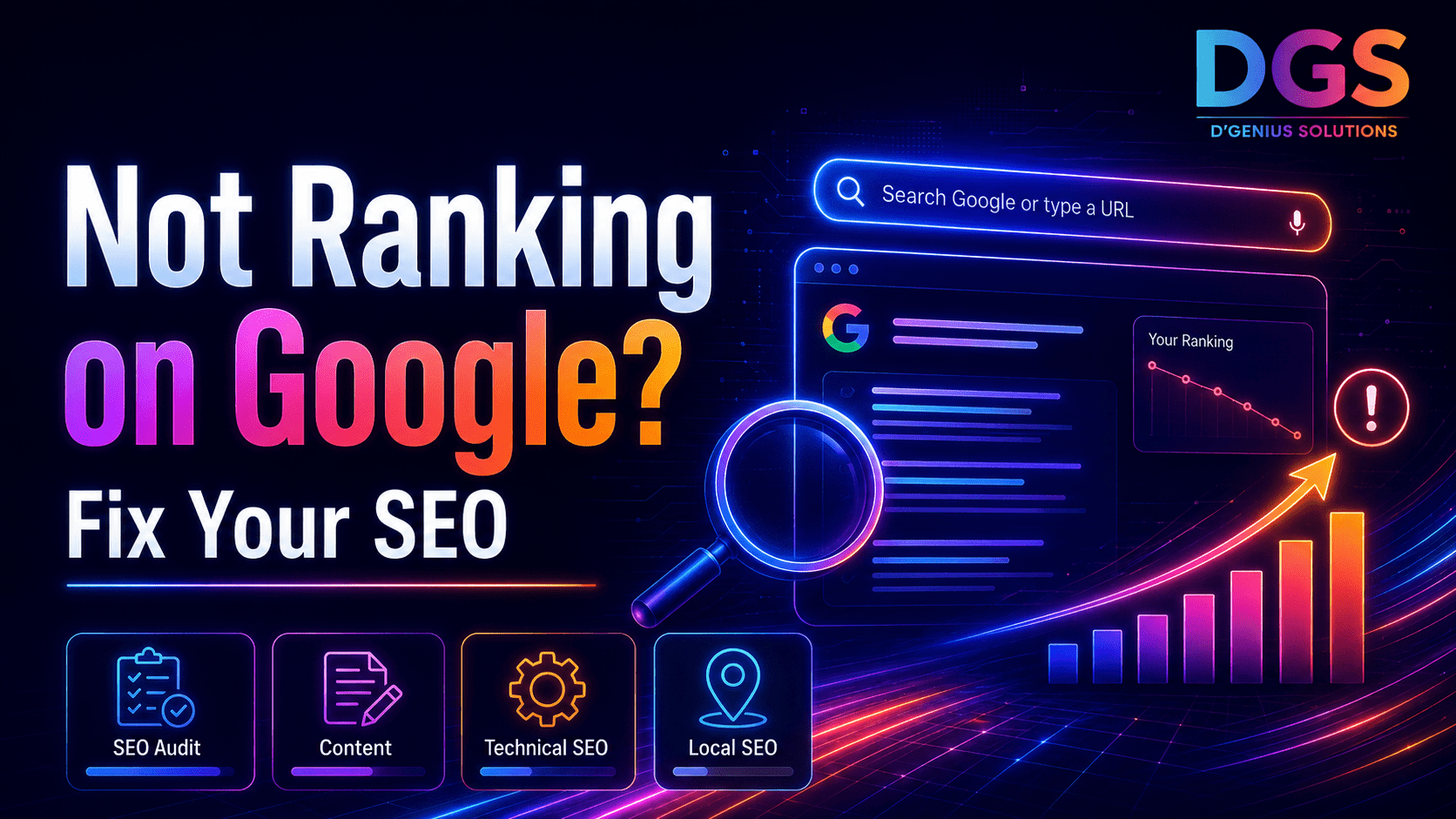
Why your business is not ranking on Google is one of the most common questions business owners ask when their website is live but not getting traffic, enquiries, or search visibility If your business is not ranking on Google, you are not alone. Many businesses have a website, social media presence, and regular content, but still struggle to appear when customers search for their products or services online.
This usually happens because Google cannot clearly understand your website, your content does not match search intent, your technical SEO is weak, or your competitors have stronger authority.
For businesses, Google ranking is not just about visibility. It directly affects website traffic, brand trust, enquiries, and sales. If your website is not appearing in search results, your potential customers may be choosing competitors before they even discover your brand.
At D'Genius Solutions, we help businesses improve their search ranking through website SEO, content optimization, technical SEO, local SEO, and growth-focused digital strategies.
If your business is not ranking on Google, this guide will help you understand the common reasons behind poor visibility and how to fix them with the right SEO strategy.
Why Google Ranking Matters for Businesses
Google is often the first place people go when they want to find a product, service, agency, consultant, or local business. If your business does not appear on Google, you may lose high-intent customers who are already searching for what you offer.
According to Google Search Central, SEO helps search engines understand your content and helps users find your website through relevant search results. This makes website SEO an important part of improving Google ranking, search visibility, and long-term organic growth.
Why your business is not ranking on Google is not always connected to one single issue. In most cases, it happens because multiple SEO problems are affecting your website together.
A strong Google ranking helps your business:
- increase organic website traffic
- build trust with potential customers
- generate qualified enquiries
- improve local visibility
- reduce dependency on paid ads
- strengthen long-term brand authority
Search ranking is important because users usually trust websites that appear higher on Google. If your competitors are ranking and your website is not, they are getting the visibility, clicks, and leads that your business could be receiving.
This is why SEO services are important for businesses that want consistent online growth.
Poor Website SEO Is One Reason Your Business Is Not Ranking on Google
One of the biggest reasons your business is not ranking on Google is poor website SEO.
Website SEO helps Google understand what your website is about, which services you offer, which locations you serve, and why your pages should appear for relevant searches.
If your website has missing meta titles, weak descriptions, poor heading structure, duplicate content, slow-loading pages, broken links, or unoptimized images, Google may not rank your pages properly.
Your website SEO should include:
- optimized meta titles
- keyword-focused meta descriptions
- clear H1 and H2 headings
- SEO-friendly URLs
- internal linking
- image alt text
- schema markup
- mobile-friendly design
- fast page speed
- proper indexing setup
When these elements are missing, your website may exist online but still fail to perform in search results.
A proper website SEO strategy makes your pages easier to crawl, easier to understand, and more relevant for the search terms your customers are using.
Your Keywords Are Too Broad or Not Targeted Properly
Many businesses try to rank for broad keywords like “SEO,” “digital marketing,” “website design,” or “best agency.” These keywords are highly competitive and difficult to rank for without a strong SEO foundation.
Instead, your keyword strategy should focus on search intent.
For example, the keyword “SEO” is too broad. But a long-tail keyword like “why your business is not ranking on Google” clearly shows that the user is looking for a solution.
A good SEO strategy includes:
- primary keywords
- secondary keywords
- long-tail keywords
- location-based keywords
- service-based keywords
- question-based keywords
- buyer-intent keywords
If your website does not target the right keyword combinations, Google may not understand which searches your pages should rank for.
The goal is not to use more keywords everywhere. The goal is to use the right keywords in the right places, including the title, headings, content, meta description, image alt text, internal links, and FAQs.
Your Content Does Not Match Search Intent
Google ranking is no longer only about adding keywords. Your content must match what the user is actually searching for.
If someone searches “why your business is not ranking on Google,” they are not only looking for a basic definition of SEO. They want to understand the reasons behind poor ranking and how to fix the problem.
Your content should answer real customer questions clearly.
For example, your blog or service page should explain:
- why the website is not visible
- what SEO mistakes are affecting ranking
- how technical SEO impacts performance
- how content quality affects visibility
- why backlinks and authority matter
- how local SEO improves search ranking
- what steps a business should take next
If your content is too thin, generic, or only written for keywords, it may not perform well on Google.
Search intent-focused content helps users find answers faster and helps Google understand that your page is relevant to the query.
Technical SEO Issues Can Stop Your Website from Ranking on Google
If you are still wondering why your business is not ranking on Google after publishing content, technical SEO issues may be stopping Google from crawling, indexing, or understanding your pages properly.
Technical SEO plays a major role in Google ranking. Even if your content is good, technical problems can stop your website from ranking properly.
Common technical SEO issues include:
- slow website speed
- poor mobile experience
- crawl errors
- indexing issues
- broken links
- duplicate pages
- incorrect canonical tags
- missing sitemap
- poor Core Web Vitals
- unoptimized website structure
Google needs to crawl, understand, and index your website correctly. If your website has technical issues, your important pages may not appear in search results.
A complete SEO audit can identify these problems and help you fix them before they affect your rankings further.
Technical SEO is important because it builds the foundation for all other SEO activities. Without a technically healthy website, even strong content and backlinks may not deliver the best results.
Your Website Content Is Too Weak or Generic
Many business websites have service pages with very little content. They mention the service name, a few benefits, and a contact form, but they do not explain the service in enough detail.
Google prefers helpful content that gives users clear answers.
Your website content should explain:
- what the service is
- who the service is for
- what problems it solves
- why your business is different
- what process you follow
- what results users can expect
- why customers should trust you
Generic content makes it difficult for Google and users to understand your value. Strong content improves website SEO, search ranking, and lead generation.
This is where strategic content creation becomes important for businesses that want better organic visibility.
Your content should not only describe your services. It should educate users, answer their doubts, and guide them toward the right action.
Your Website Does Not Have Strong Internal Linking
Internal linking helps Google understand your website structure. It also helps users move from one important page to another.
If your blogs, service pages, case studies, and landing pages are not linked properly, your important pages may not receive enough SEO value.
For example, a blog about why your business is not ranking on Google should internally link to your SEO service page because users reading the blog may need professional help.
Good internal linking helps:
- improve page authority
- support service page ranking
- reduce bounce rate
- guide users to conversion pages
- improve crawlability
- strengthen topical relevance
Internal links should be natural, useful, and connected to the topic.
For a business website, blogs should support service pages. Service pages should connect with related services, case studies, and relevant resources. This helps both users and search engines understand your website better.
Your Business Has Weak Local SEO Signals
If your business serves a specific location, local SEO is extremely important.
Many businesses struggle with Google ranking because their local SEO is not optimized. This affects visibility in Google Maps, local search results, and location-based keywords.
A complete SEO audit helps identify why your business is not ranking on Google and shows which technical, content, keyword, backlink, or local SEO problems need to be fixed first.
Your local SEO should include:
- optimized Google Business Profile
- accurate business name, address, and phone number
- service categories
- business photos
- customer reviews
- location-based website content
- local backlinks
- local citations
- city-specific keywords
If your Google Business Profile is incomplete or your website does not have strong location signals, your competitors may appear above you in local search results.
For service-based businesses, local SEO can help attract customers who are searching with high intent, such as “SEO agency near me,” “SEO services in Mumbai,” or “digital marketing agency in my area.”
Your Website Does Not Have Enough Authority
Google looks at trust and authority when ranking websites. If your competitors have stronger backlinks, better content, more brand mentions, and stronger online credibility, they may rank higher than you.
Authority can be built through:
- quality backlinks
- guest posting
- business listings
- PR mentions
- case studies
- customer reviews
- helpful blogs
- consistent brand presence
- social proof
Backlinks are still important for SEO, but quality matters more than quantity. A few relevant, trustworthy backlinks can be more valuable than many low-quality links.
Authority building should be consistent. It helps Google understand that your business is credible, active, and relevant in your industry.
Your Competitors Are Doing Better SEO
Sometimes your business is not ranking on Google because your competitors are simply doing SEO better.
They may have:
- better service pages
- stronger blogs
- faster websites
- more backlinks
- better local SEO
- stronger keyword targeting
- more optimized content
- better user experience
- higher topical authority
SEO is competitive. To rank higher, your website needs to be better structured, more useful, and more trustworthy than the websites already ranking on Google.
This is why competitor analysis is an important part of every SEO strategy. It helps you understand what is working in your industry and what your website needs to improve.
What We Usually Find During SEO Audits
Most businesses do not rank on Google because of one issue alone. During SEO audits, we usually find a combination of technical errors, weak content depth, poor internal linking, missing local SEO signals, slow website performance, and low authority signals.
Before creating new content, it is important to check whether the existing service pages are crawlable, indexed, internally linked, and aligned with the right search intent.
At D'Genius Solutions, we focus on identifying the real reason behind poor Google ranking before suggesting changes. This includes checking website structure, page speed, keyword targeting, content quality, metadata, backlinks, local SEO signals, and conversion flow.
Fixing these issues step by step helps Google understand the website better and improves its chances of ranking for relevant searches.
Top 15 Reasons Your Business Is Not Ranking on Google
1. Your Website Is Not Indexed
If Google has not indexed your website or important pages, they will not appear in search results. Indexing issues can happen because of robots.txt errors, noindex tags, sitemap problems, or crawl errors.
2. Your Website Is Too Slow
A slow website creates a poor user experience. If your pages take too long to load, users may leave quickly, and Google may reduce your visibility.
3. Your Website Is Not Mobile-Friendly
Most users search on mobile devices. If your website does not work properly on mobile, it can affect your search ranking and conversions.
4. Your Content Is Too Thin
Pages with very little useful content often struggle to rank. Google prefers detailed, helpful, and relevant content.
5. Your Keywords Are Not Clear
If your pages do not target clear keywords, Google may not understand what the page should rank for.
6. Your Meta Titles Are Weak
Meta titles help Google and users understand your page. Weak or duplicate titles can reduce your ranking potential.
7. Your Headings Are Not Structured Properly
A proper heading structure improves readability and SEO. Every page should have a clear H1, followed by useful H2 and H3 sections.
8. Your Internal Linking Is Poor
Without internal links, Google may not understand which pages are important on your website.
9. Your Website Has Duplicate Content
Duplicate content can confuse Google and affect ranking performance.
10. Your Backlink Profile Is Weak
If your website has very few quality backlinks, it may struggle to compete with stronger domains.
11. Your Google Business Profile Is Not Optimized
For local businesses, an incomplete Google Business Profile can reduce visibility in local search and Google Maps.
12. Your Website Has Technical Errors
Broken links, crawl issues, poor canonical setup, and missing schema can affect website SEO.
13. Your Content Does Not Answer User Questions
Google prefers pages that solve user problems. If your content is only promotional, it may not rank well.
14. Your Website Has Poor User Experience
Difficult navigation, cluttered design, poor layout, and weak CTAs can affect engagement and conversions.
15. Your SEO Is Not Consistent
SEO requires regular updates, monitoring, content publishing, and optimization. One-time SEO is usually not enough for long-term ranking.
How to Fix Your Google Ranking Problems with SEO
If your business is not ranking on Google, the first step is to perform a complete SEO audit. This helps identify what is stopping your website from performing.
Your SEO improvement plan should include:
- Check whether important pages are indexed
- Fix technical SEO errors
- Improve website speed
- Optimize meta titles and descriptions
- Rewrite weak content
- Add keyword-focused headings
- Improve internal linking
- Optimize images
- Add FAQs and schema markup
- Improve Google Business Profile
- Build quality backlinks
- Update outdated pages
- Create helpful blogs
- Track keyword ranking
- Monitor organic traffic and leads
The goal is not only to rank higher. The goal is to attract the right visitors and convert them into customers.
A proper SEO strategy connects technical improvements, content quality, internal linking, local SEO, and authority building into one clear plan.
Why Website SEO Needs a Complete Strategy
Website SEO is not one single activity. It includes technical improvements, content planning, keyword targeting, authority building, local optimization, and performance tracking.
A complete SEO strategy helps your website become easier for Google to crawl, easier for users to understand, and stronger than competing websites.
A good SEO strategy should focus on:
- search intent
- website structure
- technical health
- content quality
- local visibility
- topical authority
- backlinks
- conversion optimization
- regular reporting
When all these elements work together, your website has a stronger chance of improving its Google ranking.
This is why businesses should not depend only on one-time optimization. SEO needs regular monitoring, content updates, technical checks, and ranking analysis.
What Businesses Should Do Next
If your business is not ranking on Google, do not guess the problem. Start with data.
The next steps are:
- Audit your website SEO
- Review your current keyword rankings
- Check your competitors
- Fix technical issues
- Improve content quality
- Optimize service pages
- Add helpful blogs
- Build internal links
- Strengthen local SEO
- Track performance monthly
SEO takes time, but the right strategy can create long-term growth. Businesses that invest in consistent SEO are more likely to improve visibility, traffic, and qualified enquiries.
If your business has already invested in a website but is still not getting traffic, leads, or search visibility, it may be time to review the SEO foundation.
How D'Genius Solutions Helps Businesses Improve Google Ranking
At D'Genius Solutions, we help businesses improve their Google ranking with complete SEO strategies.
Our SEO services include:
- website SEO audit
- technical SEO
- on-page SEO
- keyword research
- content optimization
- local SEO
- Google Business Profile optimization
- internal linking strategy
- backlink planning
- blog strategy
- performance tracking
- monthly SEO reporting
If your business is not ranking on Google, DGS can help you identify the issues, fix your website SEO, and build a stronger search ranking strategy.
Explore our professional SEO services to improve your website visibility and attract more qualified leads from Google.
We also help businesses with content creation services to build SEO-friendly blogs, service pages, website content, and digital assets that support search visibility.
Final Thoughts
If your business is not ranking on Google, it does not mean your website cannot grow. It means your SEO foundation needs improvement.
Google ranking depends on many factors, including website SEO, content quality, technical performance, backlinks, user experience, and local SEO signals.
The businesses that rank well are usually the ones that invest in clear content, strong website structure, consistent optimization, and long-term SEO planning.
If you want your business to appear in search results, attract better traffic, and generate more leads, SEO should be treated as a growth strategy, not just a marketing task.
Conclusion
Not sure why your business is not ranking on Google?
Understanding why your business is not ranking on Google is the first step toward improving website SEO, search ranking, and long-term organic visibility.
D'Genius Solutions can help you find what is stopping your website from getting traffic, enquiries, and better search visibility.
With the right SEO audit, technical fixes, content optimization, local SEO, and authority-building strategy, your business can improve its visibility and compete more effectively on Google.
Contact DGS today and start improving your Google ranking with a clear, performance-focused SEO strategy.
FAQs
Why is my business not ranking on Google?
Your business may not be ranking on Google because of poor website SEO, weak content, technical issues, low authority, poor keyword targeting, or incomplete local SEO optimization.
How can I improve my Google ranking?
You can improve your Google ranking by fixing technical SEO issues, optimizing website content, using the right keywords, improving page speed, building backlinks, and strengthening your local SEO.
How long does SEO take to show results?
SEO usually takes time because Google needs to crawl, index, and evaluate your website. Some improvements may show within a few weeks, while stronger ranking growth often takes consistent work over several months.
What is website SEO?
Website SEO is the process of optimizing your website so search engines can understand, index, and rank your pages for relevant keywords.
Why is my website not showing on Google?
Your website may not show on Google if it is not indexed, blocked by technical settings, missing important SEO elements, or does not have enough relevant content.
How do I know if my website is indexed on Google?
You can check if your website is indexed by searching site:yourdomain.com on Google. If your pages do not appear, there may be indexing, crawling, or technical SEO issues that need to be fixed.
Can a new website rank on Google?
Yes, a new website can rank on Google, but it needs proper website SEO, useful content, technical optimization, internal linking, and consistent authority building.
Why is my competitor ranking higher than my business?
Your competitor may be ranking higher because their website has stronger content, better backlinks, faster performance, stronger local SEO, better keyword targeting, or a more complete SEO strategy.
Does content quality affect Google ranking?
Yes. Google prefers helpful, clear, and relevant content that answers user questions and matches search intent.
Are backlinks important for SEO?
Yes. Quality backlinks help build website authority and can improve search ranking when they come from trusted and relevant websites.
Is local SEO important for businesses?
Yes. Local SEO helps businesses appear in Google Maps, local search results, and location-based searches.
Do I need SEO services to improve Google ranking?
If your website has technical issues, weak content, poor search visibility, or low traffic, professional SEO services can help identify and fix the problems more effectively.
Can SEO help generate business leads?
Yes. SEO can attract users who are already searching for your services, which can improve website traffic and qualified enquiries.
How can D'Genius Solutions help improve Google ranking?
D'Genius Solutions helps businesses with SEO audits, technical SEO, website SEO, content optimization, keyword strategy, local SEO, internal linking, backlink planning, and search ranking improvement.
Accelerate Your Digital & Search Growth
Speak directly with our Mumbai-based SEO, AI search, and digital marketing strategists for a bespoke growth audit.
Get a Free Strategy AuditRelated Insights
Google Spam Update: 7 Smart Ways to Protect Your Website Ranking
A Google spam update can affect your website ranking, traffic, and leads. Learn why rankings drop and how DGS helps businesses recover with clean SEO, content, and backlink fixes.
Google August 2026 Spam Update What Businesses Need to Know About SEO Rankings - D'Genius Solutions
The Google August 2026 spam update has put website quality back under the spotlight. Learn what businesses need to know about SEO rankings.
Google AI Search Update: 7 Ways Businesses Can Get Better Leads - D'Genius Solutions
Google AI Search Update helps businesses improve AI search visibility, build trust, answer user queries, and generate better leads.