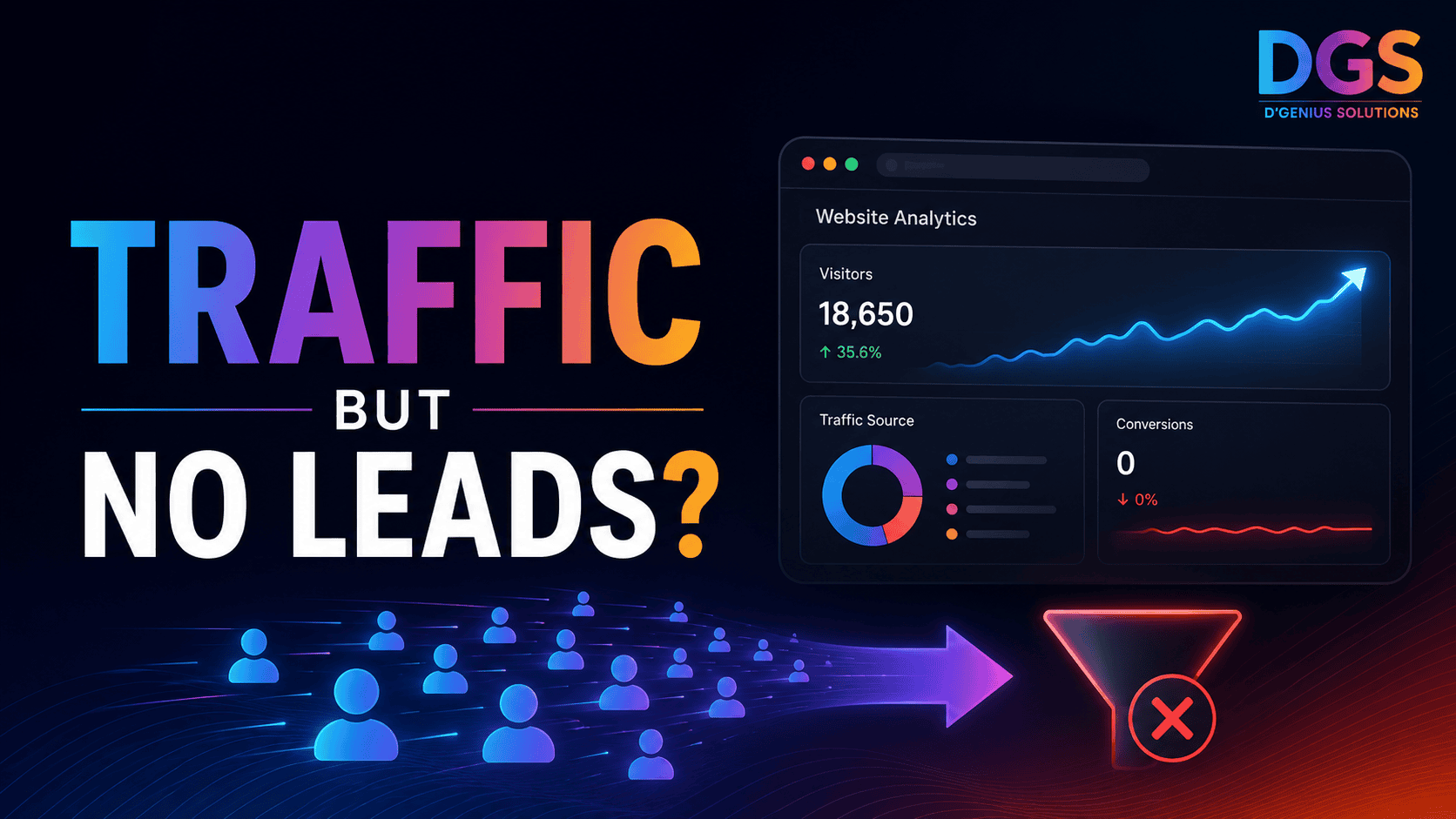
Website Traffic but No Leads? 9 Proven Fixes That Work
In this article
- Quick Answer
- Why Does Website Traffic but No Leads Happen?
- 1. You Are Attracting the Wrong Search Intent
- 2. Your Landing Page Does Not Match What Visitors Expected
- 3. Your Website Has Weak Calls to Action
- 4. Visitors Do Not Trust the Website Enough
- 5. Your Form Is Creating Too Much Friction
- 6. The Website Experience Is Hurting Conversions
- 7. Your Paid Traffic Is Generating Clicks Instead of Buyers
- 8. Your Conversion Tracking Is Incomplete
- 9. Your Content Educates Visitors but Never Moves Them Forward
- How to Diagnose Website Traffic but No Leads
- Traffic Is Only Useful When It Reaches the Right People
- Frequently Asked Questions
- Why is my website getting traffic but no leads?
- How can I convert website traffic into leads?
- Is high website traffic always good for SEO?
- What is a good website lead conversion rate?
- Should I increase traffic if my website is not generating leads?
Website traffic but no leads is one of the most frustrating problems for a business. Google Analytics may show hundreds or even thousands of visitors, your Search Console impressions may be increasing, and your campaigns may be generating clicks, but your inbox remains quiet.
The problem is usually not traffic alone. It is the gap between who is visiting your website, what they expect to find and what happens after they arrive.
A website can attract plenty of visitors and still struggle to generate enquiries when search intent, page experience, messaging, trust signals and conversion paths are not working together.
Quick Answer
If you have website traffic but no leads, first check whether you are attracting the right audience. Then review your landing pages, CTAs, mobile experience, forms, trust signals and conversion tracking. High traffic does not automatically mean high sales potential. Businesses need relevant visitors and a clear reason for those visitors to take action.
Why Does Website Traffic but No Leads Happen?
Most businesses immediately assume they need more traffic. That can actually make the problem worse.
Imagine your website gets 10,000 monthly visits, but most visitors are researching a general topic rather than looking for a company to hire. Increasing that traffic to 20,000 visitors may improve your analytics dashboard without significantly increasing inquiries.
This is why businesses facing website traffic but no leads should look beyond total sessions and start measuring traffic quality, commercial intent and conversion behaviour.
Here are nine areas to investigate.
1. You Are Attracting the Wrong Search Intent
Ranking for a keyword does not automatically make that keyword valuable.
Someone searching for:
“What is SEO?”
is at a very different stage from someone searching for:
“SEO agency in Mumbai”
The first user may simply want information. The second is far more likely to be comparing service providers.
If most of your organic traffic comes from broad informational keywords, high traffic with low enquiries is not surprising.
Review Google Search Console and divide your keywords into:
- Informational searches
- Problem-aware searches
- Comparison searches
- Commercial searches
- Transactional searches
- Local service searches
Your content strategy should attract users throughout the funnel while your key commercial pages target people closer to making a decision.
Businesses struggling with organic traffic quality can strengthen this through SEO services in Mumbai built around search intent, technical optimisation, service-page relevance and qualified organic visibility.
2. Your Landing Page Does Not Match What Visitors Expected
Imagine searching for “performance marketing agency” and landing on a generic digital marketing page that barely discusses performance marketing.
You would probably leave.
That same disconnect happens across thousands of websites.
Your page needs to confirm immediately that visitors have reached the right destination. The headline, supporting copy, visuals and CTA should closely match the search term or advertisement that brought the visitor there.
If you have website traffic but no leads, compare your highest-traffic landing pages with the actual queries generating those visits.
Ask:
- Does the page clearly answer the visitor’s need?
- Is the service obvious within the first screen?
- Does the headline match the search intent?
- Can visitors quickly understand the benefit?
- Is there an obvious next step?
Traffic without message relevance usually produces exits rather than enquiries.
3. Your Website Has Weak Calls to Action
A visitor should never have to search for a way to contact you.
Buttons such as Learn More or Read More can be useful, but they are often too vague on high-intent service pages.
Depending on the business, stronger CTAs can include:
- Request a Website Audit
- Book a Consultation
- Get a Quote
- Talk to an Expert
- Request a Callback
- Discuss Your Project
Your primary CTA should appear naturally at important decision points instead of being hidden only at the bottom of the page.
At the same time, avoid covering every section with buttons. The objective is to make the next action easy, not aggressive.
4. Visitors Do Not Trust the Website Enough
A lead form requires something valuable from the visitor: their personal information and their time.
Before submitting it, people naturally ask questions such as:
“Can I trust this company?”
“Have they done this before?”
“Will they actually solve my problem?”
“Why should I choose them instead of another provider?”
A website with attractive graphics but little evidence may get attention without earning confidence.
Add genuine trust signals wherever relevant:
- Client logos
- Case studies
- Testimonials
- Project examples
- Reviews
- Certifications
- Team expertise
- Business location
- Real performance results
- Clear contact information
- Industry experience
Do not simply say that your company delivers “excellent results.” Show visitors enough evidence to reach that conclusion themselves.
5. Your Form Is Creating Too Much Friction
A visitor finally decides to enquire and discovers a form asking for their name, company, designation, email, telephone number, budget, location, service, project description and several other details.
That is unnecessary friction.
For an initial enquiry, collect only the information the sales team genuinely needs.
For many businesses, this could be:
- Name
- Email or phone
- Company
- Required service
- Short message
You can collect deeper information after the conversation begins.
If you have website traffic but no leads, test your form yourself on both desktop and mobile. Check whether it loads properly, submissions actually work, confirmation messages appear, and inquiry notifications reach the correct team.
A broken form can make a successful marketing campaign look unsuccessful.
6. The Website Experience Is Hurting Conversions
Visitors judge a website quickly.
Slow pages, confusing navigation, oversized pop-ups, broken mobile layouts, difficult-to-read text, or buttons that are hard to tap can reduce the likelihood of an enquiry.
Google also recommends building websites primarily around users and making sites secure, accessible, fast, and usable across devices in its official Search documentation.
Review:
- Mobile responsiveness
- Page speed
- Core Web Vitals
- Navigation
- Font readability
- CTA visibility
- Form usability
- Layout stability
- Image size
- Broken elements
- Conversion journey
If the underlying website experience is limiting inquiries, conversion-focused website development services can help connect UI/UX, development, SEO readiness, and lead-generation journeys rather than treating the website as a digital brochure.
7. Your Paid Traffic Is Generating Clicks Instead of Buyers
More clicks do not necessarily mean a better campaign.
A Google Ads or Meta Ads campaign can produce impressive traffic while targeting audiences that are unlikely to convert.
Review your advertising by looking beyond CPC and CTR.
Analyse:
- Search terms
- Keyword intent
- Geographic targeting
- Audience targeting
- Negative keywords
- Device performance
- Landing-page alignment
- Cost per qualified lead
- Lead quality
- Conversion rate
Suppose one campaign generates 500 clicks and five genuine opportunities while another generates only 150 clicks but 20 opportunities. The second campaign is clearly more valuable even though its traffic is lower.
For businesses investing in paid acquisition, performance marketing services should connect campaign targeting, landing page optimization, remarketing, and conversion tracking instead of focusing on traffic volume alone.
8. Your Conversion Tracking Is Incomplete
Sometimes the website is generating leads, but the tracking system is not recording them correctly.
This becomes particularly common when customers can contact a business through several routes:
- Website forms
- Telephone calls
- Booking systems
- Live chat
- Download requests
Set up meaningful conversion events in GA4 and your advertising platforms.
UTM parameters should also help identify where inquiries originated.
Instead of only asking:
“How much website traffic did we get?”
Start asking:
“Which source generated qualified inquiries?”
That shift changes marketing decisions dramatically.
9. Your Content Educates Visitors but Never Moves Them Forward
Helpful content is important, but every article should have a purpose within the wider customer journey.
A blog may attract thousands of people searching for answers. Once they have that answer, where do they go?
Relevant internal links can move readers from educational content toward deeper resources and commercial pages.
For example, a visitor learning about Google visibility could naturally explore AEO services in Mumbai if they want to understand visibility across AI Overviews and answer-driven search.
Google’s own SEO Starter Guide also emphasizes creating content that helps users understand a page and make decisions about visiting and using a website.
Internal links should therefore be contextual. Do not insert ten unrelated service links simply for SEO. Connect each article to the most relevant next step.
How to Diagnose Website Traffic but No Leads
Instead of changing everything at once, analyze the journey in order.
Start with acquisition. Identify where the traffic comes from and which queries, campaigns and audiences generate visitors.
Next, analyse behaviour. Find the pages visitors enter, where they leave and whether they interact with CTAs, forms or important page sections.
Then evaluate conversion. Check whether forms work, contact options are visible and conversion events are recorded correctly.
Finally, evaluate lead quality. Ten enquiries from people who cannot buy your service may be less valuable than three enquiries from decision-makers.
This approach helps separate an SEO problem from a UX problem, advertising problem or tracking problem.
Traffic Is Only Useful When It Reaches the Right People
Businesses often celebrate traffic growth because it is easy to see on a dashboard. But traffic itself does not pay for marketing.
Qualified opportunities do.
If you are experiencing website traffic but no leads, avoid immediately publishing more articles or increasing your advertising budget. First understand what is already happening between the first click and the final enquiry.
The strongest digital growth strategy connects search intent, helpful content, user experience, trust, technical performance and conversion tracking.
That is when website traffic stops being just another analytics number and starts becoming a measurable business opportunity.
Frequently Asked Questions
Why is my website getting traffic but no leads?
Your website may be attracting visitors with low buying intent, sending them to mismatched landing pages or giving them an unclear conversion path. Weak trust signals, difficult forms, poor mobile experience and incorrect conversion tracking can also contribute to website traffic but no leads.
How can I convert website traffic into leads?
Start by attracting commercially relevant visitors. Then improve your landing-page messaging, CTA placement, trust signals, forms, mobile experience, and conversion tracking. Test changes based on user behaviour rather than redesigning pages without data.
Is high website traffic always good for SEO?
High traffic can be valuable, but relevance matters more for business growth. A smaller number of visitors who are actively looking for your services may produce significantly more revenue than a large audience interested only in general information.
What is a good website lead conversion rate?
There is no universal conversion rate that applies to every business. Performance varies by industry, traffic source, offer, device, service value and visitor intent. Compare conversion rates by landing page and acquisition source rather than relying only on broad benchmarks.
Should I increase traffic if my website is not generating leads?
Usually, fix the existing conversion gaps first. If current visitors are not converting because of poor targeting, weak pages or broken tracking, increasing traffic may simply increase wasted opportunities. Resolve the biggest conversion issues before aggressively scaling acquisition.
Accelerate Your Digital & Search Growth
Speak directly with our Mumbai-based SEO, AI search, and digital marketing strategists for a bespoke growth audit.
Get a Free Strategy AuditRelated Insights
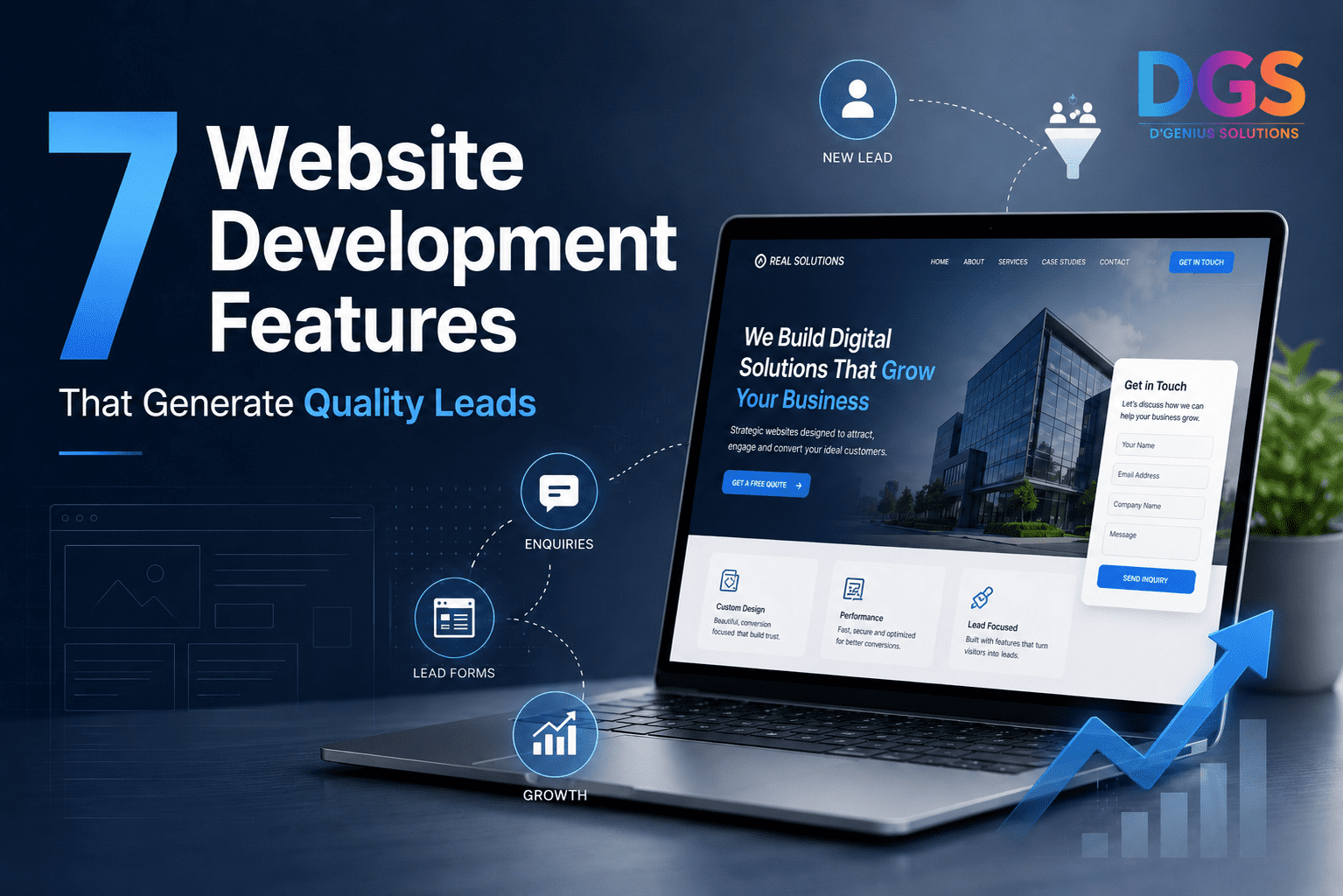
7 Website Development Features That Help Businesses Generate Quality Leads - D'Genius Solutions
Website Development plays a major role in how a business attracts, engages, and converts potential customers online. A website may look professional, but its
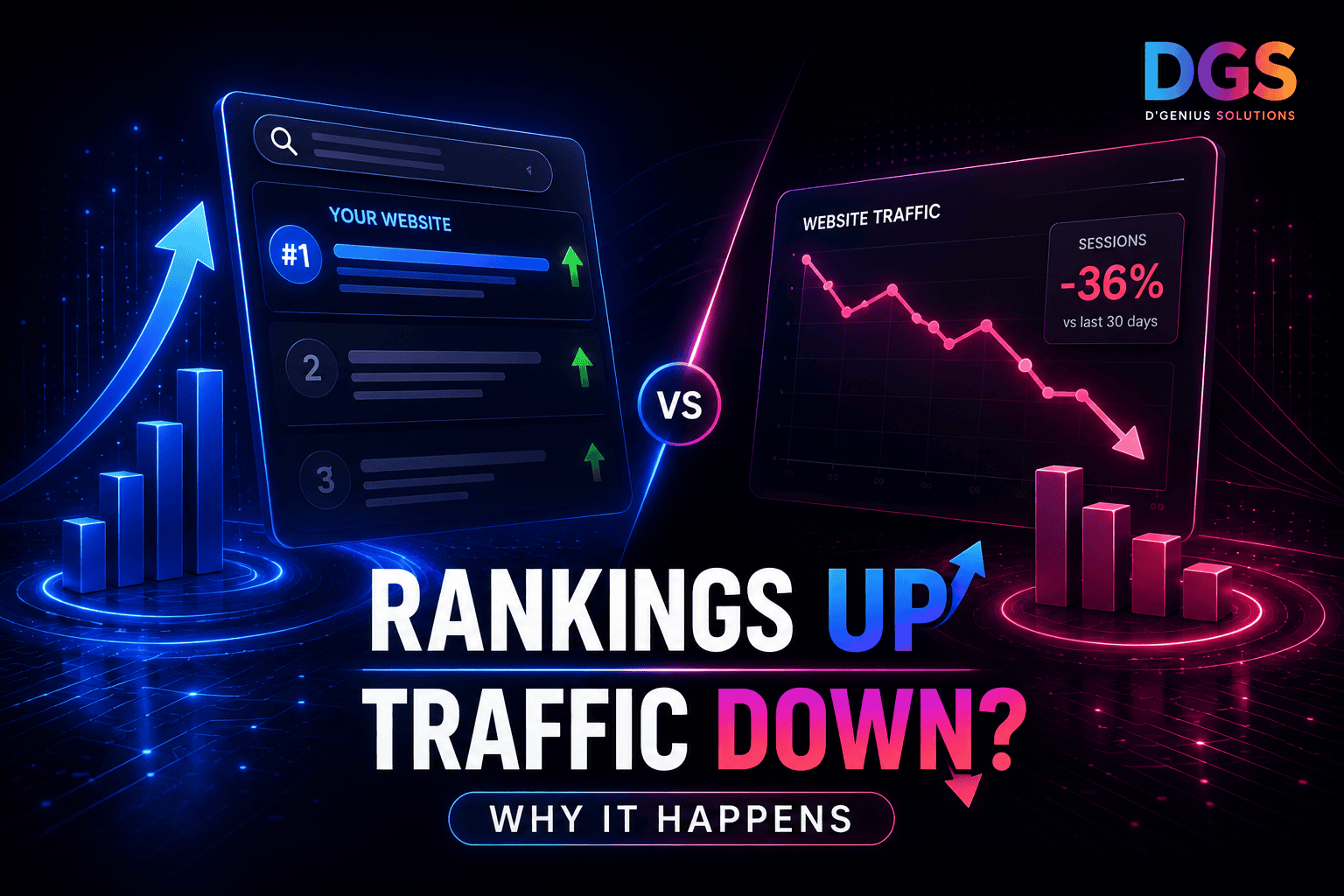
SEO Rankings Up but Traffic Down: 9 Reasons Your Clicks Are Falling - D'Genius Solutions
SEO rankings up but traffic down is one of the most confusing situations a business can face. Your tracked keywords may be moving higher on Google, yet