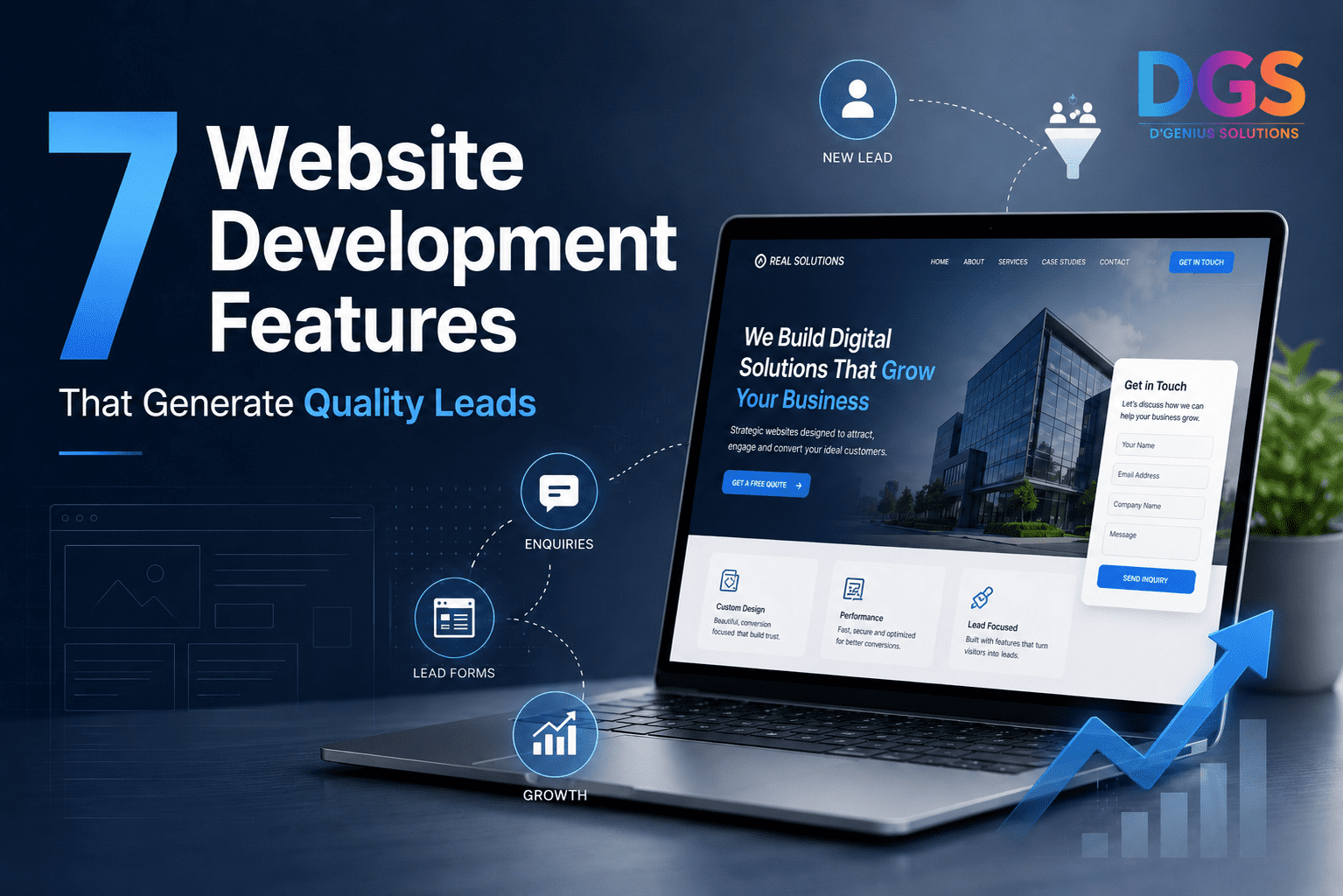
7 Website Development Features That Help Businesses Generate Quality Leads
In this article
- Why Website Development Matters for Quality Leads
- 1. Clear Service Page Structure
- 2. Answer-Friendly Content Structure
- 3. Mobile-First User Experience
- 4. Fast Loading and Technical Stability
- 5. Trust Signals and Credibility Elements
- 6. AI-Readable and Machine-Readable Content
- 7. Local GEO Signals and Internal Linking
- The Role of Website Development in AI Search Visibility
- Conclusion
- FAQs
- How does Website Development help generate quality leads?
- Why is AI readiness important in Website Development?
- What website features support AEO?
- How does GEO support business websites?
- Why do trust signals matter for lead generation?
Website Development plays a major role in how a business attracts, engages, and converts potential customers online. A website may look professional, but its real value comes from how clearly it communicates, how easily users move through it, and how well search engines and AI platforms understand it.
For modern businesses, a website is not only a digital profile. It acts as a lead-generation system, brand credibility tool, search asset, and AI-readable business source. With search evolving through Google AI Overviews, answer engines, voice search, ChatGPT, Gemini, Perplexity, and large language models, Website Development now needs to support both human visitors and machine understanding.
A lead-generating website brings the right visitors closer to enquiry. It explains services clearly, builds trust, answers intent-based questions, and helps users decide whether the business is relevant to their needs.
Why Website Development Matters for Quality Leads
Quality leads usually come from users who understand the business before they enquire. They know what the company offers, why the service matters, and whether the brand feels credible. This clarity is influenced by the way a website is structured, written, designed, and optimized.
Website Development affects every stage of this journey. It shapes first impressions, search visibility, mobile experience, trust, AI readability, and conversion behavior. When these elements are weak, a website may attract traffic but fail to generate meaningful enquiries.
A strong website does not only bring more visitors. It helps attract better-fit visitors who are more likely to take action.
1. Clear Service Page Structure
Service pages are one of the most important features of lead-focused Website Development. They help users understand what a business offers and whether that service matches their requirement.
A weak service page often leaves visitors uncertain. It may mention the service briefly but fail to explain the business value behind it. A strong service page gives more context by connecting the service with user needs, pain points, benefits, process, credibility, and outcomes.
For search engines, clear service pages create stronger topical relevance. For AI systems, they provide structured information that can be understood and summarized more easily. This supports SEO, AEO, AI Overview readiness, GEO, and LLM SEO because the page gives both humans and machines enough context about the business.
In lead generation, clarity reduces hesitation. When visitors understand the service faster, they are more likely to continue exploring the website.Website performance can also be reviewed using Google PageSpeed Insights, which helps businesses check loading speed, mobile usability, and technical performance issues that may affect user experience and lead generation.
2. Answer-Friendly Content Structure
Users often visit a website with questions already in mind. They may want to know what a service includes, who it is meant for, how it supports business growth, or why one provider is different from another.
Answer-friendly content helps a website respond to these search behaviors. It supports Answer Engine Optimization because it makes important information easier to identify, extract, and present in search experiences.
This feature is also important for voice search and AI Overviews. Conversational search queries are usually question-based. When website content includes clear explanations, definitions, FAQs, and direct answers, search systems can better understand the purpose of the page.
For lead generation, answer-friendly content creates confidence. Visitors who find useful answers on a website are more likely to see the business as knowledgeable and trustworthy.
3. Mobile-First User Experience
Mobile experience is a major part of Website Development because many users discover, compare, and contact businesses through smartphones. A website that feels difficult on mobile can lose leads even if the service itself is strong.
Mobile-first development affects readability, navigation, page speed, button visibility, contact access, and overall comfort. A mobile visitor expects quick information and a simple path to action. If the experience feels slow or confusing, the user may leave before reaching the enquiry stage.
For local and high-intent searches, mobile performance becomes even more important. Users searching from mobile devices often have immediate intent. A smooth mobile experience can influence whether that user continues engaging with the business or moves to a competitor.
Mobile-first Website Development also supports search visibility because usability and performance affect how users interact with the page.
4. Fast Loading and Technical Stability
Website speed directly affects user behavior. A slow website creates friction before the visitor even reads the content. This can reduce engagement, increase exits, and affect the number of qualified enquiries.
Technical stability is also important for search engines and AI crawlers. A website with clean code, crawlable content, optimized assets, and stable performance is easier to process. Technical issues can make it harder for search engines to access important content or understand page relationships.
For businesses, speed is not only a technical metric. It shapes trust. A fast website feels more professional, reliable, and easier to use. This matters when visitors are comparing multiple service providers before making an enquiry.
In Website Development, performance supports both visibility and conversion quality.
5. Trust Signals and Credibility Elements
Trust is one of the biggest factors behind quality lead generation. Visitors rarely enquire from a business they do not trust. A website needs credibility elements that help users feel more confident about the company.
Trust signals can include client logos, testimonials, reviews, case studies, portfolio work, certifications, founder details, team information, awards, contact details, and visible business information. These elements show that the company has real experience and proof of work.
For E-E-A-T, trust signals help strengthen the perception of experience, expertise, authority, and reliability. For AI systems and large language models, clear business credibility also provides useful context about the brand.
A website with strong trust signals can turn uncertain visitors into warmer leads because it reduces doubt during the decision-making process.
6. AI-Readable and Machine-Readable Content
AI-readable content is becoming an important part of Website Development. Search is no longer limited to traditional blue links. Users now receive answers from Google AI Overviews, ChatGPT, Gemini, Perplexity, voice assistants, and other AI-led platforms.
Machine-readable content helps these systems understand what a business offers, where it operates, who it serves, and why it is relevant. This includes clear headings, visible text, structured sections, FAQs, schema markup, internal links, service details, and entity-rich information.
For LLM SEO, context matters. Large language models understand a website better when the content connects services, brand details, locations, industries, FAQs, and expertise in a clear way.
AI-readable Website Development improves the chances of a business being understood correctly in AI-led discovery. This can support visibility before a user even clicks on a website.
7. Local GEO Signals and Internal Linking
GEO-focused signals help search engines and AI platforms understand where a business operates and which locations it serves. For businesses targeting local or regional customers, this is an important lead-generation feature.
Local relevance can appear through service area details, location-specific content, contact information, Google Business Profile consistency, local FAQs, and LocalBusiness schema. These signals help connect the website with location-based searches.
Internal linking also supports discovery. It connects blogs, service pages, location pages, FAQs, and important business content. This creates a clearer website structure for users, search engines, and AI systems.
For lead generation, internal linking helps users move from awareness content to commercial pages. A visitor reading a blog can discover a relevant service page, case study, or enquiry page through well-planned internal connections.
Together, GEO signals and internal linking help make the website more organized, discoverable, and relevant.
The Role of Website Development in AI Search Visibility
AI search visibility depends on clarity, structure, credibility, and context. A website that uses vague content or hides important information inside images, sliders, or scripts may be harder for AI platforms to understand.
Website Development supports AI readiness by making important business information accessible and structured. This helps AI systems identify the brand, services, locations, expertise, FAQs, and relevance of the website.
For businesses, this matters because AI-led search is influencing how users discover and evaluate service providers. A website that is easier for AI systems to understand has a stronger foundation for future search visibility.
Conclusion
Website Development has a direct impact on lead quality. A website that is clear, fast, trustworthy, mobile-friendly, structured, locally relevant, and AI-readable is more likely to attract visitors who understand the business and are ready to enquire.
The strongest websites do more than present information. They support SEO, AEO, GEO, AI Overview readiness, LLM SEO, user trust, and conversion behavior together.
For businesses that want long-term digital growth, Website Development is not just a design activity. It is a strategic foundation for visibility, credibility, AI discovery, and quality lead generation.
FAQs
How does Website Development help generate quality leads?
Website Development helps generate quality leads by improving clarity, trust, search visibility, mobile experience, AI readability, and the user journey from discovery to enquiry.
Why is AI readiness important in Website Development?
AI readiness is important because search engines, AI Overviews, ChatGPT, Gemini, Perplexity, and voice assistants need clear, structured, and machine-readable content to understand a business website.
What website features support AEO?
AEO-friendly website features include answer-style content, FAQs, clear headings, definitions, structured sections, and conversational content that matches user questions.
How does GEO support business websites?
GEO supports business websites by helping search engines and AI platforms understand the locations, service areas, and local relevance of a business.
Why do trust signals matter for lead generation?
Trust signals matter because users are more likely to enquire when they see proof of experience, client work, reviews, testimonials, case studies, and clear business information.
Accelerate Your Digital & Search Growth
Speak directly with our Mumbai-based SEO, AI search, and digital marketing strategists for a bespoke growth audit.
Get a Free Strategy AuditRelated Insights
How to Turn Website Traffic Into Qualified Leads
Website Development helps businesses turn website traffic into qualified leads through better structure, trust, content, and user journey.
Website Development Mistakes That Hurt Business Growth
Website development mistakes are not just design errors. They are structural, technical, content, and trust-related gaps that stop a website from ranking,
Website Traffic but No Leads? 9 Proven Fixes That Work
Website traffic but no leads? Discover 9 proven reasons visitors do not convert and learn how to improve traffic quality, landing pages, CTAs, trust and tracking.